Main links
Main
HRDCC framework details
- HRDCC landing page
- The HRDCC Publication Program
-
Paper pages
- Paper I. - Holographic Rotation-Driven Cyclic Cosmology (HRDCC): A Unified Dynamical Framework for Cyclic Cosmology
- Paper II. - Planck Remnants and the Origin of Cold Dark Matter within the HRDCC Framework
- Paper III. - Inherited Cosmic Neutrino Background within the HRDCC Framework
- Paper IV. - Black Hole Interior Dynamics and Horizon Mechanics within the HRDCC Framework
- Paper V. - Primordial Perturbations, Chladni Resonances and Non-Gaussianity within the HRDCC Framework
- Paper VI. - Observational Tests of the HRDCC Framework: Effective Cosmological Signatures from CMB to Next-Generation Surveys
- Paper VII. - Rotational Dynamics and Phase Reversal within the HRDCC Framework
- Paper VIII. - Microscopic Foundations of the HRDCC Framework
- « Paper IX. - Effective Particle Physics across Successive Cosmological Cycles within the HRDCC Framework »
Research & Profiles
Paper IX. - Effective Particle Physics across Successive Cosmological Cycles within the HRDCC Framework


Abstract
The Standard Model successfully describes elementary particle interactions over a wide range of experimentally accessible energies, yet several fundamental questions remain unresolved, including the origin of strong CP symmetry, the electroweak hierarchy, the flavor structure of the fermion sector, and the physical conditions governing primordial nucleosynthesis.
Within the Holographic Rotation-Driven Cyclic Cosmology (HRDCC) framework, we investigate an alternative phenomenological interpretation in which selected effective particle-physics parameters may evolve across successive cosmological cycles as part of the long-term effective cosmological evolution.
The principal contribution is a unified phenomenological interpretation in which the electroweak sector, the Strong CP problem and effective QCD \(\theta\) parameter, primordial nuclear physics, and the emergence of stable cosmic chemistry are treated as complementary manifestations of a common \(\xi\)-dependent effective particle-physics sector.
The present work does not modify the Standard Model or propose a microscopic mechanism for the evolution of its fundamental parameters.
1 Introduction
The Standard Model of particle physics provides an exceptionally successful description of fundamental interactions across a broad range of experimentally accessible energies [1]. Nevertheless, several long-standing theoretical questions remain unresolved, including the origin of the strong CP symmetry, the electroweak hierarchy, the flavor structure of the fermion sector, the remarkable stability of the proton, and the physical conditions governing primordial nucleosynthesis [2, 3]. Although these problems are usually investigated independently, they all concern the origin, evolution, and apparent fine structure of the effective particle-physics sector describing the observed Universe.
Within the standard cosmological paradigm, the fundamental parameters entering particle physics are generally assumed to remain constant throughout cosmic history. Consequently, the above questions are typically formulated as independent problems requiring distinct microscopic mechanisms. While this approach has achieved considerable phenomenological success, it offers no common evolutionary framework in which these apparently unrelated properties could emerge collectively through the long-term evolution of the Universe.
The Holographic Rotation-Driven Cyclic Cosmology (HRDCC) framework adopts a different phenomenological perspective. Rather than introducing new elementary particles or modifying the Standard Model directly, the framework investigates whether selected effective particle-physics parameters may themselves undergo gradual effective evolution across successive cosmological cycles.
Within this interpretation, the particle-physics sector is viewed as part of the macroscopic effective cosmological evolution, where the observable properties of the present Universe reflect the cumulative evolution of effective physical degrees of freedom inherited through the regularized Holographic Transition Core (HTC) [4, 5].
The present work develops this phenomenological interpretation for several representative problems in particle physics and early-universe nuclear physics. Particular attention is given to the effective evolution of the QCD \(\theta\) parameter, the Strong CP problem, the effective electroweak sector, primordial nuclear conditions, and the Principle of Mediocrity as a possible phenomenological interpretation of the emergence of stable cosmic chemistry across successive cosmological cycles. Possible implications for primordial nucleosynthesis and the cosmological lithium problem are discussed within this effective framework, while detailed microscopic mechanisms remain outside the scope of the present work.
The principal contribution of the present work is therefore not a new microscopic particle-physics mechanism, but a unified phenomenological interpretation in which the electroweak sector, Strong CP problem, primordial nuclear physics, and related chemical properties are treated as complementary manifestations of a common \(\xi\)-dependent effective particle-physics sector.
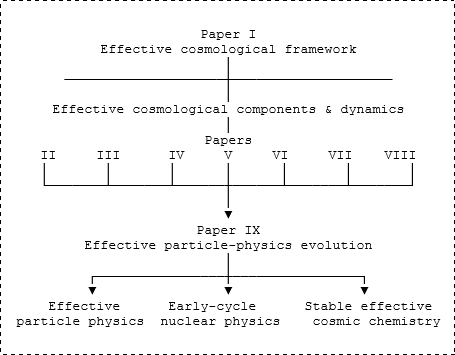
This paper forms part of the broader HRDCC publication program, in which different physical aspects of the framework are developed through a sequence of self-contained studies. Earlier papers established the effective cosmological framework, its principal effective cosmological components, their observational implications, and selected microscopic interpretations [4–8]. Building upon these results, the present work focuses specifically on the effective particle-physics sector and its possible long-term cosmological evolution.
Figure 1 summarizes the publication context of the present work.
2 Effective Particle-Physics Sector within the HRDCC Framework
The effective cosmological framework introduced in earlier HRDCC studies was formulated primarily at the level of cosmological dynamics and effective cosmological components [4]. Within that phenomenological description, the macroscopic evolution of the Universe is characterized by the coupled evolution of effective gravitational, thermodynamic, and inherited physical sectors. The present work extends this effective description to the particle-physics sector.
Within the present framework, the effective particle-physics sector denotes the collection of effective physical parameters that characterize particle interactions at the phenomenological level relevant for cosmological evolution. Rather than treating these parameters as completely isolated from the global cosmological history, the HRDCC framework explores the possibility that their effective values may reflect the cumulative macroscopic evolution of successive cosmological cycles.
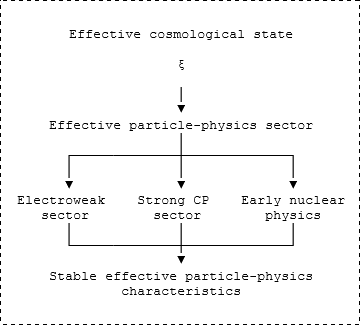
Here, \(\xi\) denotes the effective evolutionary state parameter characterizing the coupled macroscopic state of a mature HRDCC cosmological cycle; it is neither a temporal coordinate nor a cycle counter [8]. Different physical sectors may evolve differently with \(\xi\), and no monotonic physical optimization is implied.
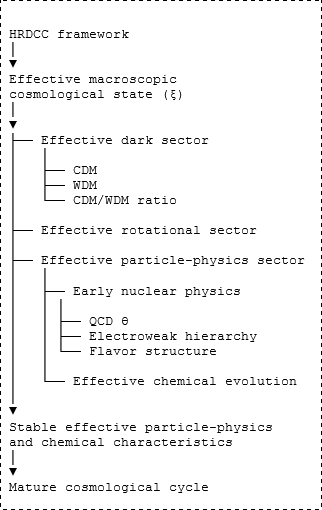
Figure 2 summarizes this organization.
This interpretation does not modify the Standard Model of particle physics at the level of its fundamental field content or gauge symmetries. No additional elementary particles, gauge interactions, or microscopic Lagrangian terms are introduced in the present work. Instead, the effective particle-physics sector is interpreted as an emergent phenomenological description whose observable properties may depend on the effective evolutionary state of a mature HRDCC cosmological cycle.
Within this phenomenological picture, different particle-physics questions need not be regarded as completely independent. Instead, several apparently distinct problems may represent different manifestations of the same long-term effective cosmological evolution. The present work therefore considers the effective electroweak sector, the Strong CP problem, primordial nuclear physics, and related phenomenological consequences within a unified effective framework.
Having established the role of the effective particle-physics sector, we next examine several representative physical sectors within this common framework.
3 Effective Electroweak Sector
The electroweak interaction constitutes one of the fundamental components of the Standard Model and has been verified experimentally with remarkable precision [1]. Nevertheless, several open theoretical questions remain, including the origin of the electroweak hierarchy and the observed flavor structure of the fermion sector. These problems are generally treated independently of cosmological evolution.
Within the HRDCC framework, the electroweak sector is interpreted at the effective phenomenological level. The present work does not modify the Standard Model electroweak theory or introduce additional gauge symmetries or scalar fields. Instead, it explores whether the effective macroscopic cosmological evolution described by the HRDCC framework may provide a broader phenomenological context in which certain effective electroweak properties gradually emerge across successive cosmological cycles.
Within this interpretation, the effective electroweak sector forms one component of the broader effective particle-physics evolution introduced in the previous section. Its effective properties are therefore considered together with the evolution of other particle-physics sectors rather than as completely isolated physical systems.
3.1 Electroweak hierarchy
The large separation between the electroweak scale and the Planck scale remains one of the central conceptual questions of contemporary particle physics. Within the Standard Model, this hierarchy is accommodated phenomenologically, while its deeper physical origin remains uncertain. Numerous theoretical approaches have therefore been proposed, including supersymmetry, compositeness, extra-dimensional scenarios, and anthropic interpretations [2].
Within the HRDCC framework, the hierarchy problem is considered from a different phenomenological perspective. Rather than interpreting the observed electroweak scale as the consequence of a unique microscopic mechanism established during a single cosmological history, the present framework explores the possibility that the effective electroweak sector may itself participate in the long-term effective particle-physics evolution associated with successive cosmological cycles.
In this interpretation, the observed hierarchy is not regarded as an isolated property requiring an independent explanation. Instead, it represents one effective manifestation of the macroscopic evolutionary state summarized by the effective evolutionary parameter \(\xi\). Consequently, the electroweak hierarchy is interpreted within the same effective phenomenological framework that is later applied to the Strong CP problem, primordial nuclear physics, and the emergence of stable cosmic chemistry.
The present work does not attempt to derive the microscopic origin of the electroweak scale. Rather, it establishes an effective phenomenological framework in which the observed hierarchy may be interpreted consistently as part of the broader effective particle-physics evolution developed throughout this paper.
3.2 Effective flavor structure
The origin of the observed flavor structure of the Standard Model remains one of the major open questions in contemporary particle physics. The existence of three fermion generations, together with the hierarchical pattern of quark and lepton masses and their mixing parameters, is accurately described experimentally but is not explained by the Standard Model itself. Numerous theoretical approaches have therefore been proposed, including flavor symmetries, grand unified theories, extra-dimensional models, and various ultraviolet completions [3].
Within the HRDCC framework, the flavor sector is considered from the same phenomenological perspective adopted throughout the present work. Rather than introducing new microscopic flavor dynamics, the framework explores whether the observed effective flavor structure may be interpreted as one manifestation of the long-term effective particle-physics evolution associated with successive cosmological cycles.
From this viewpoint, the observed flavor hierarchy is not regarded as an isolated property requiring an independent cosmological origin. Instead, it is interpreted as part of the broader effective macroscopic state summarized by the effective evolutionary parameter \(\xi\). The effective flavor sector therefore complements the effective electroweak hierarchy discussed above, while remaining fully consistent with the phenomenological scope adopted throughout the HRDCC framework.
No microscopic mechanism responsible for fermion masses, flavor mixing, or generation multiplicity is proposed in the present work. These questions remain beyond the scope of the current phenomenological description and are reserved for future investigations if a corresponding microscopic formulation of the framework becomes available.
4 Effective Evolution of Fundamental Parameters
The previous sections introduced the effective particle-physics sector as a phenomenological extension of the effective cosmological framework developed within the HRDCC publication program. We now consider the possibility that selected effective particle-physics parameters may themselves participate in the long-term effective cosmological evolution associated with successive cosmological cycles.
Within the standard cosmological paradigm, the parameters entering the Standard Model are generally regarded as fundamental constants that remain unchanged throughout cosmic history. The HRDCC framework adopts a different phenomenological viewpoint. Rather than assuming that every effective particle-physics parameter necessarily reflects a fixed microscopic quantity, the present framework explores whether some effective parameters may gradually approach their presently observed values through the cumulative macroscopic evolution summarized by the effective evolutionary state parameter \(\xi\).
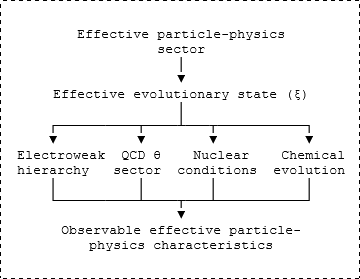
Within this interpretation, the effective particle-physics sector evolves together with the effective cosmological state of a mature HRDCC cycle. Different physical sectors are not required to evolve identically with \(\xi\); instead, the effective evolutionary parameter summarizes the coupled macroscopic state resulting from their collective long-term evolution. Consequently, the framework does not require individual particle-physics problems to possess completely independent physical origins.
Figure 3 summarizes the phenomenological organization.
The following sections illustrate this phenomenological interpretation using the Strong CP problem, the effective evolution of the QCD \(\theta\) parameter, and the Principle of Mediocrity as representative examples.
4.1 Strong CP problem
The Strong CP problem remains one of the longstanding conceptual questions of contemporary particle physics. Although the Quantum Chromodynamics (QCD) Lagrangian naturally permits a CP-violating \(\theta\) term, experimental measurements constrain the effective value of the corresponding parameter to be extremely small [9, 10]. The absence of observable strong CP violation therefore requires an explanation that extends beyond the Standard Model itself.
Several theoretical approaches have been proposed to account for the observed smallness of the QCD \(\theta\) parameter. Among the most widely investigated are the Peccei–Quinn mechanism and its associated axion field [11–13], spontaneous CP symmetry breaking, Nelson–Barr type constructions [14, 15], and other ultraviolet completions. While these approaches differ substantially in their microscopic realization, they all attempt to explain why the effective value of the \(\theta\) parameter is observed to be extremely close to zero.
Within the HRDCC framework, the Strong CP problem is interpreted from a different phenomenological perspective. Rather than seeking an isolated microscopic mechanism operating during a single cosmological history, the present framework considers whether the observed small value of the effective QCD \(\theta\) parameter may instead represent one manifestation of the long-term effective particle-physics evolution associated with successive cosmological cycles.
This interpretation does not replace existing microscopic approaches to the Strong CP problem. Instead, it provides an alternative phenomenological framework in which the effective value of the QCD \(\theta\) parameter is considered together with the broader macroscopic evolution of the effective particle-physics sector.
4.2 Effective evolution of the QCD \(\theta\) parameter
Within the phenomenological interpretation developed in the previous subsection, the exceptionally small observed value of the effective QCD \(\theta\) parameter is not regarded as an isolated property established exclusively during the earliest stages of a single cosmological history. Instead, the HRDCC framework explores the possibility that the effective value of the parameter may reflect the cumulative macroscopic evolution of successive cosmological cycles.
From this viewpoint, the effective QCD \(\theta\) parameter is interpreted as one representative component of the broader effective particle-physics sector introduced in the present work. As the effective cosmological state evolves across successive cosmological cycles, different physical sectors may gradually approach the effective macroscopic configuration characterizing mature HRDCC cosmological cycles. The effective QCD sector is considered one possible manifestation of this collective evolution.
Within the present phenomenological description, this interpretation does not imply that the microscopic QCD Lagrangian itself evolves. Instead, the framework considers whether the effective macroscopic manifestation of the particle-physics sector may gradually approach the values observed in the present cosmological cycle. Consequently, the effective evolution discussed here should be understood as a property of the effective cosmological description rather than as a modification of the underlying Standard Model.
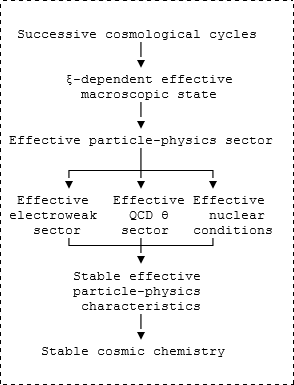
This phenomenological interpretation naturally connects the Strong CP problem to the broader effective particle-physics evolution developed throughout the present work. Rather than representing an isolated fine-tuning problem, the observed effective value of the QCD \(\theta\) parameter may be interpreted as one characteristic of the effective macroscopic evolutionary state summarized by the parameter \(\xi\).
Figure 4 summarizes the broader interpretation developed above.
4.3 Principle of Mediocrity and cosmic chemical evolution
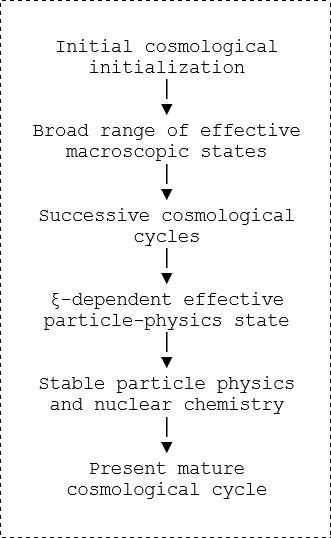
The preceding discussion suggests that the observed particle-physics properties of the present Universe need not be interpreted as isolated parameters established by a single initial condition. Within the HRDCC framework, they may instead be regarded as components of a broader effective particle-physics sector whose macroscopic state evolves across successive cosmological cycles.
This interpretation provides a natural context for the Principle of Mediocrity. The present cosmological cycle is not assumed to occupy a uniquely selected or privileged position within the full HRDCC evolution. Its observed particle-physics and chemical properties are instead interpreted as one realization within a broader sequence of cosmological states characterized by different effective macroscopic conditions.
The effective evolutionary state parameter \(\xi\) summarizes this coupled macroscopic state. It may therefore reflect variations not only in selected particle-physics parameters, but also in the inherited dark-sector composition, the relative contributions of effective cold and warm dark matter, the duration and thermodynamic history of individual cosmological cycles, and the initial conditions governing early nuclear reactions. These sectors need not evolve monotonically or at identical rates, and no single mechanism is assumed to control their collective behavior.
Within this picture, stable nuclear and chemical structures emerge when the coupled effective particle-physics and cosmological sectors occupy a sufficiently compatible region of the macroscopic state space. The small effective QCD \(\theta\) parameter may contribute to this compatibility, but it is not treated as its unique cause. Electroweak properties, flavor structure, inherited particle populations, early expansion history, and nuclear reaction conditions may all participate in determining the chemical character of a given cosmological cycle.
The resulting interpretation differs from an anthropic selection argument. The framework does not assume that the observed parameters are selected because they permit observers. Rather, it suggests that cosmological cycles displaying sufficiently stable particle-physics and nuclear conditions may arise as ordinary realizations within the long-term effective evolution of the HRDCC system. The present Universe is therefore interpreted as chemically and physically viable without being cosmologically exceptional.
This Principle of Mediocrity does not imply that all cosmological cycles are equivalent. Earlier, transitional, or otherwise distinct cycles may possess substantially different particle-physics sectors, dark-sector compositions, expansion histories, and nuclear reaction environments. The principle states only that the present cycle need not be assigned a privileged ontological status in order to account for its observed physical complexity.
The consequences of this interpretation for early-cycle nuclear physics, primordial nucleosynthesis, and the cosmological lithium problem are examined in the following section.
Figure 5 illustrates the Principle of Mediocrity interpretation used here.
5 Early-Cycle Nuclear Physics
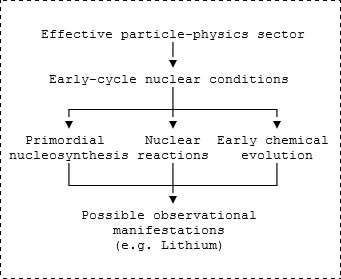
The phenomenological framework developed in the preceding sections naturally extends to the physical conditions governing primordial nuclear processes. If the effective particle-physics sector participates in the long-term macroscopic evolution of successive cosmological cycles, the nuclear environment characterizing the earliest stages of a mature cosmological cycle need not be expected to remain identical throughout the entire HRDCC evolution.
Within the present framework, early-cycle nuclear physics is therefore interpreted as an effective consequence of the coupled macroscopic cosmological state summarized by the effective evolutionary parameter \(\xi\). This state may influence several physical sectors simultaneously, including the effective particle-physics sector, inherited matter composition, the relative contributions of effective cold and warm dark matter, and the thermodynamic history of the cosmological transition.
Figure 6 summarizes the role of early-cycle nuclear physics in the present framework.
Consequently, primordial nucleosynthesis is considered within a broader phenomenological context than in the standard single-history cosmological picture. The present work does not propose a replacement for the standard theory of Big Bang Nucleosynthesis. Instead, it investigates whether modifications of the effective macroscopic cosmological state may provide an additional phenomenological framework within which early nuclear conditions can be interpreted.
5.1 Modified Primordial Nucleosynthesis
The phenomenological interpretation developed above suggests that primordial nucleosynthesis should be considered within the context of the effective macroscopic cosmological state characterizing an individual mature HRDCC cycle. In this framework, the physical conditions governing the onset of nuclear reactions are not determined solely by a unique cosmological history but may depend on the coupled effective state resulting from successive cosmological cycles.
Within the present work, this interpretation does not replace the standard theory of Big Bang Nucleosynthesis. Rather, relative to the standard precision-BBN baseline [16, 17], it explores whether gradual variations of the effective particle-physics sector, together with differences in inherited matter composition and the thermodynamic properties of individual cosmological cycles, may provide an extended phenomenological context for early nuclear processes.
Consequently, the initial conditions relevant for primordial nucleosynthesis may differ moderately between cosmological cycles while remaining fully compatible with the effective phenomenological scope adopted throughout the HRDCC framework. Such variations need not arise from a single physical mechanism but may instead reflect the collective macroscopic state summarized by the effective evolutionary parameter \(\xi\).
5.2 Lithium problem
The long-standing discrepancy between the primordial abundance of lithium predicted by standard Big Bang Nucleosynthesis and the values inferred from observations remains one of the unresolved questions of modern cosmology. Although numerous explanations have been proposed, including revised nuclear reaction rates, stellar depletion mechanisms, modified particle sectors, and non-standard cosmological scenarios, no universally accepted solution has yet emerged [17, 18].
Within the HRDCC framework, the lithium problem is not treated as an isolated anomaly requiring a dedicated microscopic mechanism. Instead, it is considered one possible observational manifestation of the broader effective particle-physics evolution discussed throughout the present work.
If the effective macroscopic cosmological state may vary between successive cosmological cycles, then the early nuclear environment responsible for primordial nucleosynthesis may also differ moderately from one mature cycle to another. Such differences need not originate from any single physical process. Rather, they may reflect the coupled effective evolution of the particle-physics sector, inherited matter composition, thermodynamic history, and cosmological transition conditions summarized by the effective evolutionary parameter \(\xi\).
Within this phenomenological framework, modified early-cycle nuclear conditions may influence the production of light nuclei, including lithium, while remaining compatible with the effective scope adopted throughout the HRDCC framework. The present work does not claim to resolve the cosmological lithium problem. Instead, it proposes a broader effective cosmological context within which this long-standing discrepancy may be investigated alongside other manifestations of the evolving effective particle-physics sector.
5.3 Early chemical evolution
The phenomenological interpretation developed in the previous subsections naturally extends beyond primordial nucleosynthesis to the subsequent emergence of chemically stable matter. Within the HRDCC framework, early chemical evolution is not regarded as an isolated consequence of primordial nuclear reactions alone. Instead, it reflects the collective influence of the effective particle-physics sector and the macroscopic cosmological state characterizing a mature cosmological cycle.
In this interpretation, the emergence of stable nuclei, atomic structure, and chemically complex matter depends on the coupled effective behavior of multiple physical sectors rather than on any single cosmological parameter. Effective particle-physics properties, inherited matter composition, dark-sector evolution, thermodynamic history, and early nuclear conditions together define the chemical environment from which subsequent astrophysical evolution proceeds.
The present framework therefore considers chemical evolution as one effective macroscopic manifestation of the broader cosmological evolution summarized by the effective evolutionary parameter \(\xi\). Different mature cosmological cycles may consequently exhibit different effective chemical environments without requiring fundamentally different microscopic laws of physics.
This interpretation provides the physical context underlying the Principle of Mediocrity discussed in the previous section. Chemically favorable cosmological cycles need not represent exceptional realizations selected by anthropic arguments. Instead, they may emerge naturally as ordinary effective macroscopic states within the long-term cosmological evolution described by the HRDCC framework.
The same phenomenological reasoning can also be extended, more cautiously, to the question of proton stability.
6 Proton Stability and Topological Considerations
The remarkable stability of the proton represents another long-standing question in particle physics. While the Standard Model preserves baryon number at the perturbative level, many extensions of the theory predict proton decay on timescales that remain experimentally inaccessible. The continued absence of proton decay therefore provides an important constraint on theories extending the Standard Model [19, 20].
Within the HRDCC framework, proton stability is not treated as an isolated microscopic problem. Instead, it is considered within the broader phenomenological context of the effective particle-physics evolution developed throughout the present work. If the effective particle-physics sector reflects the macroscopic cosmological state of a mature HRDCC cycle, then proton stability may likewise represent one effective manifestation of this collective phenomenological evolution rather than requiring an entirely independent cosmological interpretation.
The present work does not propose a microscopic mechanism responsible for proton stability. Nevertheless, several topological approaches developed within quantum-gravity research suggest that stable particle states may ultimately admit microscopic descriptions based on topological information rather than solely on local quantum fields. Such approaches illustrate the type of microscopic structures that could eventually become compatible with the effective phenomenological interpretation proposed here; braided quantum-geometrical constructions provide one representative example [21].
Within this perspective, topological models should be regarded as possible microscopic realizations rather than as assumptions of the HRDCC framework itself. The present work therefore remains entirely at the phenomenological level while acknowledging that future microscopic developments may provide a more fundamental description of the effective particle-physics evolution discussed throughout this paper.
7 Discussion
7.1 Scientific interpretation
The principal objective of the present work is not to provide independent solutions to several long-standing problems in particle physics. Instead, it proposes a common phenomenological interpretation in which the effective particle-physics sector evolves together with the \(\xi\)-dependent macroscopic cosmological state characterizing mature HRDCC cycles.
Within this framework, the electroweak hierarchy, flavor structure, the Strong CP problem, primordial nuclear physics, and the emergence of stable cosmic chemistry are interpreted as different effective manifestations of a common long-term cosmological evolution rather than as completely unrelated physical questions.
7.2 Relationship to existing cosmological models
Most phenomenological cosmological models successfully describe how a Universe evolves once its effective parameters have been specified. The present work addresses a complementary question by exploring whether the effective particle-physics sector itself may emerge as part of the long-term macroscopic cosmological evolution.
In this sense, the HRDCC framework does not compete with standard cosmological models at the phenomenological level. Rather, it investigates a different level of physical interpretation concerning the effective origin of the particle-physics sector characterizing mature cosmological cycles.
7.3 Principle of Mediocrity in the HRDCC Framework
Within the phenomenological interpretation proposed in the present work, the Principle of Mediocrity should not be regarded merely as a philosophical statement concerning the status of the present Universe. Rather, it provides a physical interpretation of how chemically and dynamically stable cosmological cycles may naturally emerge within the long-term evolution of the HRDCC framework.
The present framework does not assume that the observed particle-physics sector represents a uniquely selected configuration established by fine tuning or anthropic selection. Instead, mature cosmological cycles are interpreted as occupying effective macroscopic states that naturally arise through the coupled evolution of multiple inherited physical sectors.
Consequently, the Principle of Mediocrity may be interpreted as a phenomenological consequence of the effective cosmological evolution itself rather than an independent postulate. Within this picture, the present Universe is not considered exceptional because it supports complex structures. Rather, its observed particle-physics properties, nuclear environment, and chemical stability are interpreted as characteristic of one mature effective cosmological state among many possible realizations.
7.4 Future Perspective and Publication Context
The phenomenological interpretation developed in the present work intentionally remains independent of any specific microscopic realization. Throughout the HRDCC publication program, effective phenomenological descriptions have consistently preceded detailed microscopic interpretations. The same philosophy is maintained here.
Future developments may investigate whether microscopic quantum-gravitational descriptions, topological particle models, holographic information encoding, or other approaches can provide a more fundamental origin for the effective particle-physics evolution proposed in this work. Such investigations, however, represent subsequent stages of the HRDCC publication program rather than prerequisites for the present phenomenological framework.
Accordingly, the present work should be viewed as establishing an effective interpretative layer linking particle physics to the broader macroscopic cosmological evolution developed throughout the HRDCC framework. Any future microscopic realization should therefore be regarded as an extension of, rather than a replacement for, the phenomenological description presented here.
Figure 7 summarizes the complete Paper IX phenomenological architecture.
8 Limitations
The present work is intentionally restricted to the phenomenological level of the HRDCC framework. No microscopic derivation of the proposed effective particle-physics evolution is attempted.
The Standard Model of particle physics is not modified, and no additional elementary particles, gauge symmetries, or fundamental interactions are introduced. Likewise, no explicit evolution law for the effective particle-physics parameters is derived.
The discussion of primordial nucleosynthesis remains qualitative. No modified nuclear reaction network, Boltzmann treatment, or numerical Big Bang Nucleosynthesis calculations are presented.
Similarly, the phenomenological interpretation of proton stability is not intended as a microscopic topological theory. Existing topological approaches are discussed only as examples of possible future microscopic realizations compatible with the effective framework developed here.
Accordingly, the principal contribution of the present work is the establishment of a unified phenomenological framework in which several long-standing particle-physics and early-universe questions can be interpreted consistently within the \(\xi\)-dependent macroscopic cosmological evolution of the HRDCC framework.
9 Conclusion
The present work proposes that the effective particle-physics sector may evolve together with the \(\xi\)-dependent macroscopic cosmological state characterizing mature HRDCC cycles.
Within this phenomenological interpretation, several long-standing questions—including the electroweak hierarchy, flavor structure, the Strong CP problem, primordial nucleosynthesis, and the emergence of stable cosmic chemistry—may be interpreted within a common effective evolutionary framework without requiring that each problem be attributed to an independent cosmological mechanism.
The framework therefore complements existing phenomenological cosmological models by addressing not only how a Universe evolves once its effective parameters are specified, but also why mature cosmological cycles may exhibit the effective particle-physics sector that they do.
10 Summary of Symbols
| Symbol | Meaning | |
|---|---|---|
| \(\xi\) | Effective evolutionary state parameter | |
| \(\theta\) | Effective QCD theta parameter |
11 Bibliography