Main links
Main
HRDCC framework details
- HRDCC landing page
- The HRDCC Publication Program
-
Paper pages
- Paper I. - Holographic Rotation-Driven Cyclic Cosmology (HRDCC): A Unified Dynamical Framework for Cyclic Cosmology
- Paper II. - Planck Remnants and the Origin of Cold Dark Matter within the HRDCC Framework
- Paper III. - Inherited Cosmic Neutrino Background within the HRDCC Framework
- Paper IV. - Black Hole Interior Dynamics and Horizon Mechanics within the HRDCC Framework
- Paper V. - Primordial Perturbations, Chladni Resonances and Non-Gaussianity within the HRDCC Framework
- Paper VI. - Observational Tests of the HRDCC Framework: Effective Cosmological Signatures from CMB to Next-Generation Surveys
- Paper VII. - Rotational Dynamics and Phase Reversal within the HRDCC Framework
- « Paper VIII. - Microscopic Foundations of the HRDCC Framework »
- Paper IX. - Effective Particle Physics across Successive Cosmological Cycles within the HRDCC Framework
Research & Profiles
Paper VIII. - Microscopic Foundations of the HRDCC Framework


Abstract
The microscopic physical foundations of the Holographic Rotation-Driven Cyclic Cosmology (HRDCC) framework are investigated by examining the internal physical processes associated with the Holographic Transition Core (HTC). Whereas previous papers established the effective cosmological framework, its phenomenological components, interior horizon dynamics, rotational evolution, and observational consequences, the present work focuses on the microscopic mechanisms that may underlie these effective descriptions.
Within HRDCC, the HTC is interpreted as the central geometrical interface through which effective physical continuity is maintained across successive cosmological cycles. Building upon this interpretation, a phenomenological microscopic architecture is developed in which holographic information encoding, operator-based state mapping, microscopic inheritance, and topological information storage are considered within a unified conceptual framework. Possible physical roles of Kerr/CFT correspondence, holographic encoding, spin-network structures, Calabi–Yau compactification, ER=EPR, Page dynamics, and Stinespring-type information transfer are examined as complementary ingredients without assuming a complete quantum-gravitational unification.
The resulting description does not attempt to construct a fundamental Hilbert-space formulation or a complete microscopic Hamiltonian theory. Instead, it organizes microscopic concepts that may consistently account for the emergence and persistence of the effective cosmological sectors introduced throughout the HRDCC publication program.
The present work therefore proposes a coherent phenomenological microscopic architecture connecting the established effective cosmological description with potential underlying degrees of freedom, while identifying the theoretical developments required for future quantitative formulations.
1 Introduction
The Holographic Rotation-Driven Cyclic Cosmology (HRDCC) publication program has progressively developed the framework from its phenomenological cosmological foundations toward increasingly detailed physical interpretations. The initial work established the effective cosmological framework and its principal effective components, while subsequent papers examined the effective dark-matter sector, an inherited neutrino background, black-hole interior dynamics, primordial perturbations, observational signatures, and rotation-driven cosmological evolution [1–7]. Throughout this development, the Holographic Transition Core (HTC) has remained the central geometrical interface responsible for maintaining physical continuity across successive cosmological cycles, although its microscopic physical interpretation has intentionally remained open.
The present work addresses this remaining conceptual layer. Rather than introducing new effective cosmological components or extending the phenomenological dynamics, it examines the microscopic architecture that may underlie the HTC. The objective is not to formulate a complete theory of quantum gravity, nor to review the full landscape of microscopic frameworks, but to organize selected concepts that satisfy the physical requirements imposed by the established HRDCC description.
Several ideas developed in gravitational physics, quantum information theory, and higher-dimensional geometry provide useful ingredients for such an interpretation. These include holographic information encoding [8–10], Kerr/CFT correspondence [11], Page dynamics and modern Page-curve constructions [12, 13], operator-based information transfer [14], ER=EPR [15], spin-network descriptions of quantum geometry [16, 17], and compactification scenarios involving Calabi–Yau manifolds [18, 19]. Individually, these concepts belong to distinct theoretical programs. Here they are used only insofar as they may provide a coherent phenomenological interpretation of the HTC and the effective inheritance mechanism.
Accordingly, the HTC is treated as the central geometrical interface connecting effective cosmological evolution with underlying microscopic degrees of freedom. Particular attention is given to holographic encoding, physical continuity, topological information storage, and operator mappings that may support the persistence of effective physical degrees of freedom across successive cosmological cycles. The discussion intentionally avoids a complete Hilbert-space formulation, a fundamental Hamiltonian description, or a fully developed microscopic field theory.
Figure 1 locates the present work within the publication architecture. The paper first identifies the HTC as the required microscopic interface, then develops holographic encoding and operator-based state mappings. It next examines physical continuity and inheritance, considers topological organization and compact internal geometry, and finally integrates these elements into an emergent microscopic architecture before discussing limitations and future work.
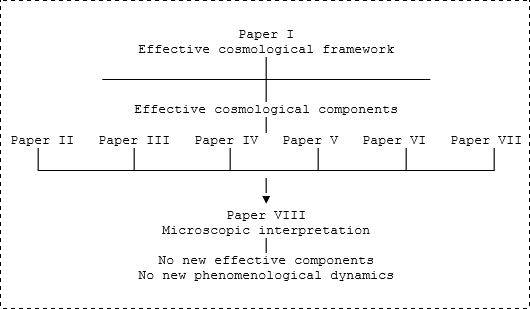
Although the present manuscript forms part of the broader HRDCC publication program, it has been written as a self-contained study addressing the microscopic interpretation of the Holographic Transition Core.
2 The Holographic Transition Core as the Microscopic Interface
2.1 Why a Microscopic Interface Is Required
The effective HRDCC framework developed throughout the previous papers describes cosmological evolution at the phenomenological level. Effective cosmological components, effective dynamical relations, and their observational consequences were introduced without assuming a unique microscopic realization. This separation was intentional. The effective description provides a consistent macroscopic framework, whereas the microscopic physical processes responsible for its emergence remained outside the scope of the earlier studies.
Nevertheless, the cumulative development of the HRDCC framework naturally raises a fundamental physical question. If effective physical degrees of freedom persist across successive cosmological cycles, a microscopic mechanism must exist through which this persistence is realized. Such a mechanism must simultaneously satisfy several physical requirements. It must preserve physical continuity across cosmological transitions, provide a consistent location for the inheritance of effective physical degrees of freedom, remain compatible with the regularized nonsingular transition introduced previously, and avoid modifying the phenomenological framework established in Paper I.
Within the HRDCC framework, these requirements motivate the introduction of a microscopic interface rather than a new cosmological component. The present work therefore investigates the physical interpretation of the Holographic Transition Core (HTC) as the microscopic region in which effective cosmological evolution and microscopic physical processes become connected.
Importantly, the introduction of such an interface should not be interpreted as the construction of a new fundamental theory. Instead, it represents the next level of physical interpretation within the existing HRDCC framework, extending the phenomenological description toward its possible microscopic foundations while preserving the conceptual hierarchy established throughout the publication program.
2.2 Physical Role of the Holographic Transition Core
The Holographic Transition Core is interpreted within the HRDCC framework as the central geometrical interface through which effective physical continuity is maintained across successive cosmological cycles. It is not introduced as an independent cosmological component, an additional material sector, or a localized microscopic object in the conventional particle-physics sense. Its role is instead relational: the HTC defines the physical transition region in which the macroscopic effective state of one cosmological cycle is connected to the initial effective state of the subsequent cycle.
This interpretation extends the geometrical role established in the earlier HRDCC studies. The HTC previously served as the regularized transition region associated with interior horizon dynamics, the nonsingular bounce, and the inheritance of effective physical degrees of freedom. The present work does not redefine those functions. It examines the microscopic architecture that may support them. In this sense, the HTC provides the interface between two descriptive levels:
effective cosmological evolution \(\longleftrightarrow\) microscopic physical organization
The macroscopic side of this relation contains the effective cosmological components and dynamical variables introduced throughout the HRDCC publication program. The microscopic side concerns the encoding, preservation, selection, and re-expression of physical degrees of freedom during the cosmological transition. The HTC is therefore not identified with any single proposed microscopic mechanism. Holographic encoding, quantum-information mappings, spin-network structures, higher-dimensional geometric sectors, and entanglement-based interpretations may contribute to its microscopic description, but none of these elements alone constitutes the HTC.
A defining property of the HTC is that no inherited sector acts independently of it. The inherited remnant population, the inherited neutrino sector, and any other persistent effective degree of freedom are interpreted as passing through the same regularized geometrical interface, even though their microscopic channels and subsequent phenomenological roles may differ. This common interface preserves the unity of the HRDCC framework and prevents inheritance from being treated as a set of unrelated transfer assumptions.
Physical continuity within this description does not imply the unchanged survival of complete classical structures. Nor does it require the direct transmission of an entire spacetime geometry between cosmological cycles. Instead, it refers to the persistence and transmission of effective physical degrees of freedom through the regularized HTC. The microscopic content may be compressed, reorganized, projected, or encoded during the transition, while the subsequent cosmological cycle receives an effective physical state that remains causally and dynamically connected to the preceding one.
The HTC consequently performs three conceptually distinct functions. First, it is a geometrical transition interface, separating the contracting and expanding branches of the effective cosmological evolution. Second, it is an encoding interface, at which selected physical information may be represented in a reduced or holographic form. Third, it is an inheritance interface, through which persistent effective degrees of freedom contribute to the initialization of subsequent cosmological cycles. These functions describe different aspects of the same scientific object and should not be treated as separate cores or transition mechanisms.
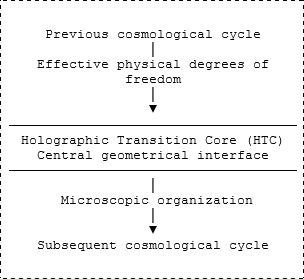
This interpretation establishes the physical foundation required for the microscopic analysis developed in the following sections. Having defined the HTC as a common geometrical and inheritance interface, we next distinguish the established effective description from the microscopic structures proposed to support it.
2.3 Effective versus Microscopic Descriptions
The HRDCC framework distinguishes explicitly between effective cosmological descriptions and their possible microscopic physical interpretations. This distinction has been maintained throughout the publication program and constitutes one of its principal methodological assumptions. Effective cosmological quantities are introduced to describe observable large-scale dynamics, whereas their microscopic physical origin may remain open until sufficient physical motivation exists for a dedicated interpretation.
Within this hierarchy, the effective framework introduced in Paper I is not modified by the microscopic considerations developed here. Effective cosmological components, effective dynamical relations, and effective evolutionary variables retain their original phenomenological meaning irrespective of the microscopic mechanisms that may ultimately support them. Consequently, the present work should not be interpreted as replacing the effective HRDCC framework by a microscopic theory. Rather, it provides one possible physical interpretation of the underlying microscopic organization that remains fully consistent with the established phenomenological description.
This separation is particularly important for concepts that appear throughout the HRDCC publication program. Effective dark matter, effective dark energy, the effective rotational sector, and the effective evolutionary state parameter \(\xi\) are defined at the phenomenological level. Their microscopic realization may involve multiple physical processes acting simultaneously within the HTC. No individual microscopic mechanism is therefore identified directly with any effective cosmological component.
Accordingly, microscopic concepts introduced in the present work—including holographic information encoding, operator-based mappings, spin-network structures, higher-dimensional compactification, and quantum-information processes—are interpreted as possible physical mechanisms that may contribute to the emergence of the effective framework. They do not redefine the phenomenological quantities themselves, nor do they imply a unique microscopic realization. Different microscopic sectors may contribute simultaneously to the same effective cosmological behaviour.
This methodological separation also determines the interpretation of physical inheritance. The persistence of effective physical degrees of freedom across successive cosmological cycles is established phenomenologically within the HRDCC framework. The microscopic mechanisms discussed in the present paper are intended to provide a consistent physical interpretation of this persistence rather than to replace its phenomenological definition. Consequently, microscopic inheritance should be understood as the physical realization of an already established effective concept.
The distinction between effective and microscopic descriptions provides the conceptual basis for the remainder of the paper. Having established the physical role of the HTC and the methodological hierarchy adopted throughout the HRDCC framework, the following sections examine individual microscopic mechanisms that may collectively support this interpretation without assuming a complete microscopic unification.
2.4 Scope of the Microscopic Interpretation
The objective of the present work is to develop a coherent microscopic interpretation of the Holographic Transition Core within the phenomenological HRDCC framework. Accordingly, the discussion is intentionally restricted to those microscopic concepts that may contribute to a consistent physical interpretation of the effective cosmological description established in the previous papers.
The present work does not propose a complete microscopic theory of gravity, nor does it attempt to derive the effective HRDCC framework from first principles. In particular, no fundamental Hilbert-space construction, Hamiltonian formulation, microscopic action principle, or ultraviolet-complete quantum-gravitational theory is introduced. Such developments remain outside the scope of the present investigation and are regarded as possible directions for future theoretical work.
Instead, the microscopic structures considered throughout this paper are interpreted as complementary physical ingredients that may collectively support the phenomenological architecture of the HRDCC framework. Holographic encoding, operator-based mappings, quantum-information processes, spin-network structures, higher-dimensional compactification, and related microscopic concepts are therefore discussed as components of a unified interpretative framework rather than as mutually exclusive alternatives or complete fundamental descriptions.
This methodological limitation also applies to the mathematical formalism employed throughout the paper. Whenever operator-based language or quantum-information concepts are introduced, they serve to organize the physical interpretation of the effective framework rather than to construct a complete microscopic quantum theory. The mathematical expressions presented below should therefore be understood as phenomenological representations of possible microscopic organization rather than as uniquely derived fundamental equations.
The following sections develop this microscopic interpretation progressively, beginning with holographic information encoding and continuing through microscopic physical continuity, topological information storage, and the unified microscopic architecture proposed for the Holographic Transition Core.
3 Microscopic Holographic Encoding
3.1 Holographic Information Encoding
Identifying the HTC as the microscopic interface raises the question of how physical information is represented during the cosmological transition. Effective degrees of freedom cannot simply disappear and later reappear without an intermediate organization. Some encoding must remain compatible with the regularized transition.
Holographic information encoding provides a natural phenomenological candidate. In gravitational physics, boundary descriptions can represent higher-dimensional physical systems [8–10, 20]. HRDCC does not assume that a specific known duality is realized exactly. Instead, holographic encoding is used as an organizational principle through which effective physical content may remain associated with the HTC while macroscopic spacetime geometry is reorganized.
The HTC is thus interpreted as an active encoding interface. The effective physical state inherited from one cycle becomes represented in a reduced microscopic form suitable for later reconstruction. What is encoded is the effective organization required by subsequent cosmological evolution, not a literal copy of every particle configuration or of the full classical geometry.
Kerr/CFT correspondence illustrates how near-horizon gravitational states may admit a lower-dimensional conformal description and reproduce black-hole entropy microscopically [11]. This result does not establish Kerr/CFT as the microscopic theory of the HTC; it demonstrates that horizon-associated information can, in principle, possess a reduced description compatible with a rotating black-hole setting.
3.2 Operator-Based State Mapping
Once information is encoded, the microscopic state must remain related to the effective cosmological description. This relation is represented phenomenologically by \[\begin{equation} S_{\rm micro} \longrightarrow S_{\rm eff} , \label{eq:state-map} \end{equation}\] where \(S_{\rm micro}\) denotes the encoded organization associated with the HTC and \(S_{\rm eff}\) denotes the effective state used by the phenomenological cosmological description.
Equation [eq:state-map] is not a fundamental microscopic operator equation. It is an organizational relation indicating that a microscopic representation must support reconstruction of the effective variables relevant to a subsequent cosmological cycle. The mapping need not preserve every microscopic degree of freedom individually and should be regarded as an effective projection rather than a one-to-one correspondence.
Stinespring dilation provides a standard mathematical statement that completely positive maps can be represented through an enlarged Hilbert space and an isometric embedding [14]. The present work invokes this result only as structural motivation: a reduced effective evolution may admit a larger microscopic realization even when the reduced description is not unitary by itself. No specific dilation, environment, or microscopic Hamiltonian is derived here.
Multiple microscopic sectors may contribute simultaneously to the same effective quantity. Holographic encoding, quantum-information processes, higher-dimensional structures, and topological organization may therefore participate in the mapping without requiring a unique microscopic representative for every phenomenological variable.
3.3 Information Preservation and Page Dynamics
The introduction of holographic encoding and operator-based state mappings naturally leads to the question of whether the encoded microscopic information may remain physically preserved throughout the cosmological transition. Within the HRDCC framework, this question is directly related to the requirement of effective physical continuity across successive cosmological cycles. If the microscopic organization established within the Holographic Transition Core were entirely destroyed during the transition, no consistent physical mechanism would remain through which inherited effective degrees of freedom could contribute to the subsequent cosmological evolution.
The present work interprets information preservation as the persistence of effective physical organization rather than the exact conservation of complete microscopic configurations. Consequently, the preservation discussed here should not be understood as requiring that every microscopic degree of freedom survives unchanged. Instead, the physically relevant requirement is that sufficient effective information remains available to reconstruct the macroscopic cosmological state associated with the subsequent cycle.
From this perspective, Page dynamics provides a useful phenomenological framework for interpreting the gradual redistribution of physical information during the cosmological transition. Within the present work, the Page picture is not adopted as a complete microscopic theory of black-hole evolution. Rather, it is regarded as a conceptual illustration that physical information need not disappear even if its microscopic representation changes substantially during the transition. [12] Information may instead become redistributed among different microscopic sectors while remaining available for subsequent effective reconstruction. [13]
This interpretation is fully consistent with the role assigned previously to the Holographic Transition Core. The HTC is not viewed as a passive storage surface but as an active microscopic interface in which encoded physical information may be reorganized before contributing to the effective initialization of the subsequent cosmological cycle. Information preservation therefore refers to the continuity of effective physical organization rather than to the persistence of individual microscopic states.
An important consequence of this viewpoint is that information preservation should be regarded as a collective property of the microscopic architecture rather than the responsibility of any single physical mechanism. Holographic encoding, operator-based mappings, microscopic topological organization, and additional quantum-information processes may all contribute simultaneously to maintaining effective physical continuity. None of these mechanisms is assumed to provide a complete description independently; together they form complementary elements of the microscopic interpretation developed throughout the present work.
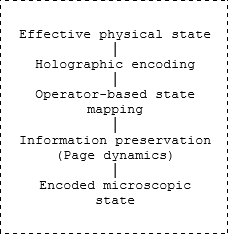
The discussion developed above establishes the first microscopic layer of the HRDCC framework. Physical information is interpreted as being encoded within the Holographic Transition Core, related to the effective cosmological description through operator-based mappings, and maintained through a phenomenological picture of microscopic information preservation. The following chapter extends this interpretation by examining how these microscopic structures may account for physical continuity and inheritance across successive cosmological cycles.
Information preservation is a collective property of the architecture. Holographic encoding, operator mappings, topological organization, and additional quantum-information processes may contribute simultaneously. Figure 3 summarizes the resulting chain.
4 Microscopic Physical Continuity
4.1 Physical Continuity through the HTC
The microscopic interpretation developed in the previous chapter establishes how effective physical information may remain represented throughout the cosmological transition. A second and equally important question concerns the physical significance of this encoded information. Within the HRDCC framework, microscopic organization acquires physical relevance only if it contributes to the continuity of the effective cosmological evolution across successive cosmological cycles.
Accordingly, physical continuity should not be interpreted as the uninterrupted persistence of classical spacetime geometry or of complete microscopic particle configurations. The cosmological transition associated with the Holographic Transition Core is expected to reorganize the microscopic physical state substantially. Nevertheless, the effective macroscopic cosmological description developed throughout the HRDCC framework assumes that selected physical degrees of freedom remain continuously related across the transition.
Within the present interpretation, the HTC provides the microscopic environment in which this continuity is realized. The encoded physical organization discussed previously is therefore viewed as an intermediate microscopic representation that connects the effective physical states of consecutive cosmological cycles. Physical continuity is interpreted as the persistence of effective physical organization rather than as the direct conservation of individual microscopic structures.
An important consequence of this viewpoint is that continuity becomes an emergent property of the complete microscopic architecture. Holographic encoding, operator-based mappings, information preservation, and the geometrical structure of the HTC together provide a phenomenological interpretation of how effective cosmological evolution may remain physically continuous despite the profound microscopic reorganization associated with the cosmological transition.
The following sections examine how this physical continuity may naturally lead to the inheritance of effective physical degrees of freedom throughout the long-term evolution of the HRDCC framework.
4.2 Microscopic Inheritance
The existence of physical continuity across successive cosmological cycles naturally implies that some effective physical degrees of freedom may contribute to the initialization of subsequent cosmological evolution. Within the HRDCC framework, this process has previously been described phenomenologically as inheritance through the regularized Holographic Transition Core. The present work examines the microscopic physical interpretation that may underlie this effective description.
Microscopic inheritance is therefore not introduced as an additional physical process independent of the HTC. Rather, it is interpreted as the microscopic realization of the physical continuity established in the previous section. Once effective physical information has been encoded, related consistently to the effective cosmological description, and preserved throughout the transition, inheritance emerges as the natural physical consequence of the complete microscopic organization.
Importantly, microscopic inheritance should not be understood as the direct transfer of complete physical objects or unchanged microscopic configurations from one cosmological cycle to the next. The cosmological transition may reorganize, compress, or redistribute microscopic structures substantially while preserving the effective physical organization required for subsequent cosmological evolution. Inheritance therefore concerns the persistence of effective physical degrees of freedom rather than the survival of individual microscopic states.
This interpretation also explains why different inherited sectors need not share identical microscopic mechanisms. The inherited remnant population, the inherited neutrino sector, and additional effective physical sectors considered throughout the HRDCC publication program may each possess distinct microscopic channels while remaining subject to the same geometrical transition through the HTC. The common element is therefore not the microscopic carrier itself but the physical continuity established by the transition interface.
Within this phenomenological picture, microscopic inheritance represents a collective property of the complete HTC architecture. No individual microscopic process is assumed to account for inheritance independently. Instead, holographic encoding, operator-based mappings, information preservation, and the geometrical organization of the HTC together provide a consistent physical interpretation of how effective physical degrees of freedom may persist across successive cosmological cycles.
The resulting picture preserves the phenomenological definition of inheritance introduced previously while providing a possible microscopic physical interpretation. The discussion therefore extends the HRDCC framework without modifying its effective cosmological foundations.
4.3 Effective Physical Degrees of Freedom
The microscopic interpretation developed throughout the preceding sections leads naturally to the concept of effective physical degrees of freedom. Within the HRDCC framework, these quantities do not represent individual microscopic particles, localized geometrical structures, or isolated quantum states. Instead, they correspond to macroscopic physical properties whose evolution remains meaningful across successive cosmological cycles despite the continuous microscopic reorganization associated with the Holographic Transition Core.
This distinction reflects the hierarchical structure adopted throughout the HRDCC publication program. Effective cosmological variables describe the large-scale phenomenology of cosmological evolution, whereas the microscopic architecture proposed in the present work provides one possible physical interpretation of how these effective quantities may remain physically connected during cosmological transitions. Effective physical degrees of freedom therefore represent the common descriptive level linking microscopic organization with effective cosmological dynamics.
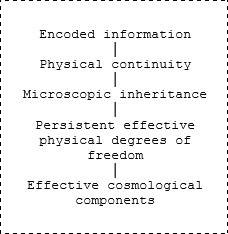
Within this interpretation, the persistence of effective physical degrees of freedom is understood as an emergent property of the complete microscopic architecture rather than the consequence of any isolated microscopic process. Holographic encoding, operator-based state mappings, information preservation, and microscopic inheritance together provide complementary contributions to the maintenance of effective physical continuity. The resulting effective cosmological state therefore reflects the collective behavior of the microscopic transition region rather than a direct projection of individual microscopic configurations.
This viewpoint also preserves the conceptual distinction established in the earlier HRDCC papers between effective cosmological quantities and their microscopic interpretation. Effective dark matter, the inherited neutrino sector, the effective rotational contribution, and the effective evolutionary state parameter \(\xi\) continue to retain their phenomenological definitions. The microscopic architecture discussed throughout the present work should therefore be regarded as providing a physical interpretation of these effective quantities rather than redefining them.
The physical picture developed in this chapter establishes the first complete microscopic layer of the HRDCC framework. Beginning with holographic information encoding, continuing through operator-based organization, information preservation, physical continuity, and microscopic inheritance, the discussion has progressively constructed a consistent interpretation of how effective physical degrees of freedom may persist throughout successive cosmological cycles. The following chapter extends this microscopic description by examining the topological structures that may provide the physical substrate supporting this organization.
5 Topological Information Storage
5.1 Topological Organization of Microscopic Information
The microscopic interpretation developed in the preceding chapters establishes how effective physical information may remain encoded, preserved, and physically connected throughout cosmological transitions. A remaining question concerns the physical substrate supporting this organization. If effective physical continuity is maintained across successive cosmological cycles, the microscopic architecture must possess structural properties that remain sufficiently robust despite the profound reorganization expected within the Holographic Transition Core.
Within the HRDCC framework, this requirement naturally motivates the consideration of topological organization. Unlike individual microscopic particle configurations, topological structures are characterized primarily by their relational properties rather than by the precise positions or identities of their microscopic constituents. Such robustness makes topological organization a plausible phenomenological candidate for supporting the effective continuity discussed throughout the previous chapters.
Accordingly, the present work does not assume that microscopic information is stored within isolated particles or localized physical objects. Instead, the information relevant for effective cosmological inheritance is interpreted as being distributed throughout the microscopic architecture of the Holographic Transition Core. The physical significance of this organization therefore lies in the collective structure of the microscopic degrees of freedom rather than in any individual microscopic constituent.
This interpretation is consistent with the effective philosophy adopted throughout the HRDCC publication program. The objective is not to identify a unique microscopic realization but to demonstrate that physically plausible classes of microscopic structures exist which naturally satisfy the requirements imposed by holographic encoding, information preservation, and physical continuity. Topological organization therefore represents one possible microscopic framework capable of supporting these effective processes.
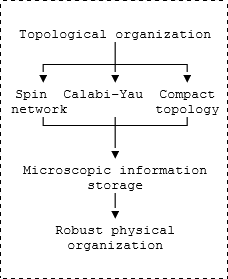
Within this phenomenological perspective, the precise mathematical description of the microscopic topology remains open. Nevertheless, several approaches developed in contemporary quantum gravity research suggest that relational topological structures may provide suitable candidates for describing the organization of microscopic physical information. Among these, spin-network descriptions offer a particularly natural starting point because they emphasize relational geometry rather than fixed classical spacetime.
The following section therefore examines spin-network structures as one possible microscopic interpretation of the topological organization associated with the Holographic Transition Core.
5.2 Spin-Network Interpretation
The requirement for a robust topological organization naturally motivates the consideration of relational microscopic geometries. Within the present work, spin-network descriptions are not introduced as a unique microscopic theory of quantum gravity but as a representative example of how physical information may be organized through relational connectivity rather than through a pre-existing classical spacetime manifold.
The physical relevance of this interpretation follows directly from the phenomenological requirements established throughout the previous chapters. The Holographic Transition Core is expected to undergo profound microscopic reorganization during the cosmological transition, making descriptions based on fixed classical geometry increasingly inadequate. In contrast, relational topological structures remain meaningful because they describe the connectivity among microscopic degrees of freedom rather than their embedding within an already established spacetime.
From this perspective, spin-network architectures provide a useful conceptual framework for interpreting how microscopic physical organization may remain sufficiently stable to support effective physical continuity [16, 17]. Individual nodes or links should not be identified with specific physical particles or localized cosmological objects. Instead, they represent abstract relational elements whose collective organization may encode the effective physical information inherited across successive cosmological cycles.
Within the HRDCC framework, the adoption of this interpretation does not imply that the microscopic dynamics of the Holographic Transition Core are governed directly by Loop Quantum Gravity. Rather, spin-network structures are employed phenomenologically to illustrate how relational topology could provide the robustness required for holographic encoding, operator-based mappings, information preservation, and microscopic inheritance. Their role is therefore interpretative rather than foundational.
An important consequence of this viewpoint is that microscopic topology becomes independent of any particular microscopic realization. Whether the underlying quantum degrees of freedom ultimately correspond to spin-network states, alternative discrete geometrical constructions, or presently unknown quantum gravitational structures remains beyond the scope of the present work. What is physically required is the existence of a relational microscopic organization capable of maintaining effective physical continuity throughout the cosmological transition.
The spin-network interpretation therefore represents one plausible realization of the topological architecture proposed for the Holographic Transition Core. The following section extends this discussion by considering additional compact topological structures that may complement this relational organization within a broader microscopic phenomenological framework.
5.3 Compact Topological Structures and Microscopic Capacity
The relational organization discussed in the previous section provides one possible interpretation of how microscopic physical information may remain connected throughout cosmological transitions. A complementary question concerns the microscopic capacity of the Holographic Transition Core. If effective physical degrees of freedom are preserved, reorganized, and inherited across successive cosmological cycles, the microscopic transition region must possess sufficient internal complexity to accommodate this organization without requiring an immediate modification of the effective macroscopic cosmological geometry.
Within the present phenomenological framework, compact topological structures provide a natural conceptual interpretation of this additional microscopic capacity. Rather than introducing new observable spatial dimensions into the effective cosmological description, such structures are regarded as internal microscopic degrees of freedom whose physical influence remains confined to the transition region itself. Their significance therefore lies in expanding the microscopic organizational capacity of the HTC while leaving the large-scale phenomenology of the HRDCC framework unchanged.
One illustrative example is provided by compact geometrical constructions similar to those considered in higher-dimensional approaches to quantum gravity, including Calabi–Yau compactifications [18, 19]. The present work does not adopt string theory or higher-dimensional gravity as the fundamental basis of the HRDCC framework. Instead, compact internal geometries are employed phenomenologically to demonstrate that microscopic architectures possessing large organizational capacity are already known to arise within contemporary theoretical physics.
From this viewpoint, compact topological structures may contribute additional microscopic degrees of freedom capable of supporting holographic encoding, relational organization, operator-based mappings, and microscopic information preservation. Their physical role is therefore complementary to that of the relational topology discussed previously. Whereas relational structures emphasize connectivity among microscopic states, compact internal structures illustrate how the microscopic transition region may possess sufficient internal capacity to accommodate increasingly complex physical organization throughout long-term cosmological evolution.
An important consequence of this interpretation is that the microscopic architecture of the Holographic Transition Core may be significantly richer than suggested by its effective macroscopic description. Effective cosmological variables remain insensitive to most of this internal complexity because they describe only the large-scale phenomenological evolution. The additional microscopic organization therefore becomes relevant primarily during the cosmological transition itself, where it may facilitate the preservation and reorganization of effective physical degrees of freedom.
The discussion presented here should therefore be understood as illustrating one possible class of microscopic topological architectures rather than establishing a unique physical realization. The essential requirement remains the existence of sufficient microscopic organizational capacity to support effective physical continuity throughout successive cosmological cycles.
6 Emergent Microscopic Architecture
6.1 Integrating the Microscopic Components
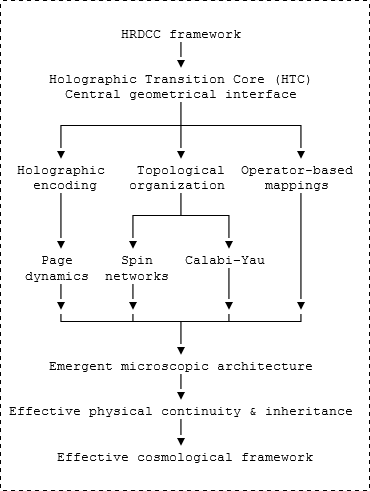
The preceding chapters have introduced individual microscopic concepts motivated by distinct physical requirements arising within the HRDCC framework. Considered separately, holographic encoding, operator-based mappings, information preservation, physical continuity, relational topology, and compact internal structures each address a particular aspect of the cosmological transition. Taken together, however, these concepts form a coherent phenomenological architecture describing how effective cosmological evolution may remain physically continuous despite the profound microscopic reorganization occurring within the Holographic Transition Core.
The present work does not propose that these microscopic elements represent independent physical mechanisms operating in isolation. Rather, they should be understood as complementary components of a unified microscopic interpretation. Holographic encoding provides a mechanism for representing effective physical information, operator-based mappings establish consistent relations between microscopic and effective descriptions, information preservation maintains the availability of physically relevant organization, while relational and compact topological structures supply the microscopic robustness and organizational capacity required to support these processes collectively.
Within this integrated picture, the Holographic Transition Core emerges as considerably more than a geometrical transition surface. It becomes the central microscopic architecture through which effective physical continuity is established across successive cosmological cycles. Importantly, this interpretation leaves the effective cosmological framework developed throughout the previous HRDCC papers unchanged. The microscopic architecture complements the phenomenological description rather than replacing it.
An important consequence of this unified interpretation is that no individual microscopic concept is required to provide a complete explanation independently. The overall consistency arises from the interaction among multiple complementary microscopic processes, each addressing a different physical requirement imposed by effective cosmological evolution. The resulting picture therefore remains intentionally phenomenological while demonstrating that the effective assumptions introduced throughout the HRDCC framework admit a coherent microscopic interpretation.
6.2 A Unified Phenomenological Picture
The microscopic concepts introduced throughout the present work are intended to address complementary physical requirements arising within the HRDCC framework rather than to represent independent theoretical proposals. Each component contributes a distinct element to the microscopic interpretation of the Holographic Transition Core, while the overall physical consistency emerges from their collective interaction. The resulting architecture should therefore be understood as a phenomenological synthesis rather than a complete microscopic theory.
Within this unified picture, the Holographic Transition Core serves as the central microscopic interface connecting consecutive cosmological cycles. Its primary role is geometrical: it provides the transition region in which the effective cosmological description remains physically meaningful despite the profound microscopic reorganization accompanying the cosmological turnaround.
Building upon this interface, holographic encoding provides the microscopic representation of effective physical information. Rather than storing complete microscopic configurations, the encoding process preserves the effective physical organization required for the subsequent cosmological evolution. This encoded information is then related consistently to the effective cosmological description through operator-based mappings, which establish the correspondence between microscopic organization and effective phenomenological variables without requiring a one-to-one microscopic reconstruction.
The persistence of this organization is interpreted through phenomenological information-preservation mechanisms inspired by Page dynamics. Within the present framework, preservation refers not to the exact conservation of individual microscopic states but to the maintenance of sufficient effective physical organization to support physical continuity across the cosmological transition.
Physical continuity naturally gives rise to microscopic inheritance. The inherited remnant population discussed in Paper II, the inherited neutrino sector developed in Paper III, and the evolutionary effective degrees of freedom introduced in Paper VII may therefore be regarded as distinct phenomenological manifestations of the same underlying microscopic continuity established within the Holographic Transition Core. Their physical origin need not be identical at the microscopic level; what unifies them is the common transition architecture through which effective physical organization is maintained.
The microscopic organization responsible for these processes is interpreted as possessing both relational and internal structural properties. Relational topology, illustrated phenomenologically through spin-network architectures, emphasizes the connectivity among microscopic degrees of freedom independently of classical spacetime geometry. Complementary compact internal structures, represented here by higher-dimensional compact geometrical models such as Calabi–Yau manifolds, illustrate how the transition region may accommodate a large microscopic organizational capacity while leaving the effective macroscopic cosmological description unchanged.
Taken together, these microscopic components form a coherent architectural hierarchy rather than a collection of unrelated theoretical concepts. Each element fulfills a specific physical function, while no single component is assumed to provide a complete microscopic explanation independently. The overall phenomenological consistency therefore emerges from the interaction among multiple complementary mechanisms operating within the Holographic Transition Core.
This unified interpretation preserves the effective foundations established throughout the previous HRDCC papers while providing a significantly richer microscopic perspective. The effective cosmological quantities introduced previously remain unchanged, whereas the present work offers one possible microscopic architecture through which those effective variables may acquire a consistent physical interpretation.
Within the proposed microscopic architecture:
The HTC defines the microscopic transition interface between cosmological cycles.
Holographic encoding represents the effective physical information required for cosmological evolution.
Operator-based mappings connect microscopic organization to effective phenomenological variables.
Information preservation maintains the effective organization throughout the transition.
Physical continuity provides the basis for microscopic inheritance.
Relational topology supplies structural robustness to the microscopic organization.
Compact internal structures increase the organizational capacity of the transition region.
The complete microscopic architecture emerges from the collective interaction of these complementary components.
Figure 6 integrates the complete chain.
6.3 Implications for the HRDCC Framework
The microscopic architecture developed throughout the present work extends the interpretative depth of the HRDCC framework while leaving its effective cosmological structure unchanged. None of the phenomenological assumptions introduced in the preceding papers require modification. Instead, the microscopic concepts proposed here provide a coherent physical context within which those effective assumptions may be understood as complementary manifestations of a common transition architecture associated with the Holographic Transition Core.
From this perspective, the HTC acquires a more comprehensive scientific role within the overall HRDCC publication program. Earlier papers introduced the HTC primarily as the effective interface responsible for regularized cosmological transitions and the continuity of successive cosmological cycles. The present work extends this interpretation by proposing that the HTC may also represent the central microscopic environment in which holographic encoding, relational organization, information preservation, and microscopic inheritance collectively emerge.
This unified microscopic interpretation also clarifies the physical relationship among several previously independent phenomenological components of the HRDCC framework. The inherited Planck-remnant population discussed in Paper II, the inherited cosmic neutrino background developed in Paper III, the effective primordial structures examined in Paper V, and the evolutionary rotational framework presented in Paper VII can now be viewed as distinct effective consequences of the same underlying microscopic transition architecture rather than as unrelated phenomenological assumptions.
An equally important implication concerns the conceptual position of the HRDCC framework with respect to existing approaches to quantum gravity. The microscopic interpretation developed here intentionally avoids adopting any single candidate theory as the fundamental basis of the model. Instead, concepts originating from holography, quantum information theory, Loop Quantum Gravity, higher-dimensional compact geometries, and related microscopic approaches are employed phenomenologically whenever they provide plausible physical interpretations of the effective cosmological framework. The resulting architecture therefore remains theory-independent while remaining compatible with multiple contemporary research directions.
The present work also establishes a clear methodological distinction between effective cosmological modeling and microscopic physical interpretation. The effective cosmological variables introduced throughout the HRDCC publication series retain their original phenomenological definitions and observational significance. The microscopic architecture proposed here should therefore be understood as an interpretative layer that complements the effective framework without altering its observational predictions or introducing additional phenomenological parameters.
Finally, the unified microscopic architecture developed throughout the present work proposes a natural foundation for future investigations of fundamental particle physics, microscopic interaction mechanisms, and quantum-field processes within the HRDCC framework. By establishing a coherent microscopic transition architecture while remaining independent of any particular ultraviolet-complete theory, the present work creates a consistent conceptual basis upon which subsequent studies may examine more specific microscopic physical processes without requiring modifications to the effective cosmological structure established throughout the HRDCC publication program [2, 3, 5, 7].
7 Discussion
7.1 From Effective Cosmology to Microscopic Interpretation
The HRDCC framework was originally formulated as an effective cosmological model describing the large-scale evolution of cyclic universes through phenomenological physical variables. This approach intentionally avoided committing to any particular microscopic theory, allowing the effective framework to remain independent of unresolved questions concerning quantum gravity and Planck-scale physics. While this strategy provided conceptual flexibility, it also left open the physical interpretation of the Holographic Transition Core and the microscopic origin of the effective continuity assumed throughout the previous papers.
The present work addresses this gap by introducing a coherent microscopic interpretation while preserving the effective cosmological formulation. Rather than modifying the phenomenological structure of the HRDCC framework, the proposed architecture provides a possible physical explanation for how effective physical continuity, inheritance, and long-term cosmological evolution may emerge from microscopic organization associated with the transition region.
An important consequence of this approach is the clear separation between phenomenological cosmological modeling and microscopic physical interpretation. The observational predictions of the HRDCC framework continue to originate from the effective cosmological description, whereas the microscopic architecture developed here serves primarily to provide physical plausibility and conceptual consistency. This distinction preserves the predictive structure of the model while significantly extending its physical interpretability.
7.2 Theory Independence and Interpretative Flexibility
A central methodological feature of the present work is its intentionally theory-independent character. The microscopic architecture proposed here does not rely exclusively on any individual candidate theory of quantum gravity or fundamental physics. Instead, concepts originating from holography, quantum information theory, relational quantum geometry, higher-dimensional compact topology, and related approaches are incorporated only insofar as they contribute to a coherent phenomenological interpretation of the effective cosmological framework.
This strategy reflects the current state of fundamental physics, where no universally accepted microscopic theory exists. Rather than selecting a single theoretical framework prematurely, the HRDCC approach emphasizes those structural concepts that appear repeatedly across multiple research directions. The resulting microscopic architecture should therefore be understood as a phenomenological synthesis of broadly compatible ideas rather than an attempt to establish a unique microscopic ontology.
Such interpretative flexibility also facilitates future theoretical developments. As microscopic theories continue to evolve, individual components of the proposed architecture may be refined, replaced, or expanded without requiring modifications to the effective cosmological description developed throughout the HRDCC publication program.
7.3 Position within the HRDCC Publication Program
The present work occupies a distinct position within the overall HRDCC publication series. Whereas the previous papers established the effective cosmological framework, its phenomenological consequences, and its observational implications, the current paper focuses on the microscopic interpretation underlying those effective descriptions.
Consequently, the objective of the present work is neither to introduce new cosmological observables nor to modify existing phenomenological predictions. Instead, it provides a conceptual framework through which previously independent effective components—including the Holographic Transition Core, inherited physical sectors, and the long-term evolutionary dynamics—may be interpreted as manifestations of a common microscopic transition architecture.
This perspective also establishes a natural foundation for subsequent investigations into fundamental particle physics and microscopic interaction mechanisms within the HRDCC framework. By separating the construction of the microscopic architecture from the study of specific microscopic interactions, the publication program maintains a clear methodological progression from effective cosmology toward increasingly detailed physical interpretation.
8 Limitations
The microscopic interpretation proposed in the present work is intentionally phenomenological. Its primary objective is not to construct a complete theory of quantum gravity or a fundamental microscopic description of spacetime, but rather to provide a physically consistent interpretative framework capable of supporting the effective cosmological structure developed throughout the HRDCC publication program.
Accordingly, the microscopic concepts discussed in this paper should not be interpreted as uniquely established physical mechanisms. Holographic encoding, operator-based mappings, information preservation, relational topology, compact internal geometries, and related microscopic structures are introduced as representative phenomenological candidates that satisfy the physical requirements imposed by effective cosmological continuity. Alternative microscopic realizations may exist and could equally provide consistent interpretations within the general HRDCC framework.
An important limitation concerns the absence of a complete microscopic dynamical formulation. The present work does not derive the proposed architecture from a fundamental action principle, Hamiltonian formalism, quantum field theory, or ultraviolet-complete theory of gravity. Instead, the discussion is restricted to identifying physically plausible microscopic structures capable of explaining the effective phenomenological assumptions introduced in the earlier HRDCC papers.
Similarly, the present work does not attempt to establish the microscopic uniqueness of the Holographic Transition Core. The HTC is interpreted as a phenomenological transition architecture whose internal organization remains only partially constrained by the effective cosmological framework. Consequently, different microscopic descriptions could potentially reproduce the same effective cosmological behavior while differing substantially in their detailed microscopic realization.
The observational implications of the microscopic architecture also remain indirect. Because the effective cosmological predictions of the HRDCC framework are intentionally preserved, the microscopic interpretation developed here does not introduce new independent observational parameters or immediate experimental signatures. Instead, its scientific value lies primarily in providing physical coherence, conceptual consistency, and a foundation for future theoretical developments.
Finally, the present work deliberately separates the construction of a microscopic transition architecture from the investigation of specific microscopic interaction mechanisms and particle-physics processes. Questions concerning fundamental interactions, quantum fields, symmetry breaking, particle generation, or detailed microscopic dynamics therefore remain beyond the scope of the present paper and constitute natural directions for subsequent investigations within the continuing HRDCC publication program.
9 Conclusion
The present work has developed a coherent microscopic interpretation of the HRDCC framework while preserving the effective cosmological formulation established throughout the preceding papers. Rather than introducing new phenomenological variables or modifying the existing cosmological dynamics, the proposed microscopic architecture provides a physically consistent context within which the effective assumptions of the HRDCC model may be understood.
Central to this interpretation is the Holographic Transition Core, which is viewed not merely as an effective geometrical interface but as the microscopic transition architecture through which physical continuity may be maintained across successive cosmological cycles. Within this framework, holographic encoding, operator-based state mappings, information preservation, relational topology, compact internal structures, and microscopic inheritance are interpreted as complementary components contributing to the same underlying physical picture. None of these concepts is assumed to provide a complete microscopic description independently; their scientific significance arises from their collective ability to account for the phenomenological continuity required by the effective cosmological framework.
An important outcome of the present work is the clear separation between effective cosmological modeling and microscopic physical interpretation. The observational predictions developed throughout the HRDCC publication program remain entirely associated with the effective phenomenological framework, whereas the microscopic architecture proposed here serves to provide conceptual coherence and physical plausibility without introducing additional observational parameters or altering previous predictions.
The microscopic architecture developed in this paper also unifies several concepts that previously appeared in different contexts throughout the HRDCC publication series. The inherited physical sectors, long-term evolutionary behavior, holographic continuity, and the phenomenological role of the Holographic Transition Core can now be interpreted as interconnected aspects of a common microscopic transition architecture rather than as independent phenomenological assumptions.
Finally, the present work establishes a methodological foundation for future investigations of microscopic physics within the HRDCC framework. By constructing a theory-independent phenomenological architecture that remains compatible with multiple contemporary approaches to quantum gravity and quantum information, the paper provides a consistent basis for subsequent studies of fundamental interactions, particle physics, and microscopic dynamical processes while preserving the effective cosmological framework that forms the core of the HRDCC model.
The principal achievements of the present work may be summarized as follows:
A coherent microscopic interpretation of the Holographic Transition Core has been established.
Effective physical continuity has been related to microscopic information organization and inheritance.
Previously independent phenomenological concepts have been unified within a common microscopic transition architecture.
The effective cosmological formulation of the HRDCC framework has been preserved without introducing additional phenomenological parameters.
A theory-independent microscopic foundation has been established for future investigations of particle physics and fundamental interactions within the HRDCC framework.
10 Summary of Symbols and Abbreviations
| Symbol | Meaning |
|---|---|
| HRDCC | Holographic Rotation-Driven Cyclic Cosmology |
| HTC | Holographic Transition Core, the central regularized geometrical interface |
| \(S_{\rm micro}\) | Encoded microscopic organization associated with the HTC |
| \(S_{\rm eff}\) | Effective physical state used in the phenomenological cosmological description |
| \(\xi_{\rm eff}\) | Effective evolutionary state parameter of a mature HRDCC cosmological cycle; not a time coordinate or microscopic variable |
| ER=EPR | Conjectured relation between Einstein–Rosen bridges and Einstein–Podolsky–Rosen entanglement |
| CFT | Conformal field theory |
| LQG | Loop quantum gravity |
| CNB | Cosmic neutrino background |
11 Bibliography