Main links
Main
HRDCC framework details
- HRDCC landing page
- The HRDCC Publication Program
-
Paper pages
- Paper I. - Holographic Rotation-Driven Cyclic Cosmology (HRDCC): A Unified Dynamical Framework for Cyclic Cosmology
- Paper II. - Planck Remnants and the Origin of Cold Dark Matter within the HRDCC Framework
- Paper III. - Inherited Cosmic Neutrino Background within the HRDCC Framework
- Paper IV. - Black Hole Interior Dynamics and Horizon Mechanics within the HRDCC Framework
- Paper V. - Primordial Perturbations, Chladni Resonances and Non-Gaussianity within the HRDCC Framework
- « Paper VI. - Observational Tests of the HRDCC Framework: Effective Cosmological Signatures from CMB to Next-Generation Surveys »
- Paper VII. - Rotational Dynamics and Phase Reversal within the HRDCC Framework
- Paper VIII. - Microscopic Foundations of the HRDCC Framework
- Paper IX. - Effective Particle Physics across Successive Cosmological Cycles within the HRDCC Framework
Research & Profiles
Paper VI. - Observational Tests of the HRDCC Framework: Effective Cosmological Signatures from CMB to Next-Generation Surveys


Abstract
Modern observational cosmology is entering an era in which multiple high-precision surveys simultaneously probe the cosmic microwave background, the large-scale distribution of matter, the expansion history of the Universe, and the formation of the earliest astrophysical structures. While these observations provide increasingly stringent tests of cosmological models, they are often interpreted independently within separate phenomenological contexts.
The present work examines these observational domains within the framework of the Holographic Rotation-Driven Cyclic Cosmology (HRDCC). Rather than focusing on individual anomalies or isolated observational signatures, the HRDCC framework is interpreted as an effective phenomenological architecture in which multiple cosmological observables originate from a common effective cosmological dynamics. This approach naturally motivates the interpretation of cosmic microwave background properties, large-scale structure, high-redshift galaxy formation, and future observational probes as correlated manifestations of the same underlying effective framework.
Particular attention is given to observational strategies involving current and next-generation experiments, including Planck, DESI, Euclid, the Vera C. Rubin Observatory Legacy Survey of Space and Time (LSST), the James Webb Space Telescope (JWST), LiteBIRD, and PTOLEMY. The discussion emphasizes consistency between independent observational probes rather than isolated parameter fitting, highlighting how complementary datasets may collectively constrain or support phenomenological extensions beyond the standard cosmological model.
The present paper therefore provides the observational synthesis of the HRDCC publication program by organizing the principal phenomenological predictions developed in the preceding papers into a unified observational framework. Within this perspective, the framework is intended to be evaluated through the overall consistency of multiple independent observational signatures rather than through any single observational discriminator.
1 Introduction
Modern precision cosmology has entered an era in which theoretical models are increasingly constrained by multiple independent observational probes rather than by individual datasets alone. Measurements of the cosmic microwave background (CMB), baryon acoustic oscillations (BAO), large-scale structure, weak gravitational lensing, gravitational-wave astronomy, and forthcoming next-generation surveys together provide an unprecedented opportunity to evaluate the internal consistency of cosmological frameworks across a wide range of physical scales.
The Holographic Rotation-Driven Cyclic Cosmology (HRDCC) framework has been developed throughout the preceding papers of this series as an effective phenomenological description of cyclic cosmological evolution. Paper I established the overall dynamical architecture of the model [1]. Paper II interpreted inherited Planck-scale remnants as an effective cold dark matter component [2]. Paper III introduced the inherited cosmic neutrino background as a cyclic relic population [3], while Paper IV examined effective black-hole interior dynamics and horizon information transfer [4]. Paper V proposed an effective description of primordial perturbations, resonance patterns, and non-Gaussian signatures generated through cyclic inheritance [5].
Collectively, these studies define a coherent phenomenological framework whose individual components naturally imply a range of observable consequences. The purpose of the present work is not to introduce additional fundamental assumptions, but rather to identify how the combined HRDCC framework may be confronted with current and forthcoming cosmological observations.
Rather than predicting exact numerical values for cosmological observables, HRDCC is formulated as an effective phenomenological model in which several quantities depend on the physical properties of previous cosmological cycles. Consequently, many observable signatures are expected to appear as correlated consistency patterns across multiple datasets instead of unique parameter predictions. This philosophy distinguishes HRDCC from conventional parameter-fitting cosmological models while maintaining compatibility with existing observational constraints.
Particular attention is devoted to observational signatures associated with the cosmic microwave background, primordial non-Gaussianity, baryon acoustic oscillations, large-scale structure, weak gravitational lensing, relic neutrino backgrounds, stochastic gravitational-wave backgrounds, and the observational capabilities of nextgeneration missions including LiteBIRD, Euclid, DESI, and the Vera C. Rubin Observatory.
The objective of this paper is therefore to provide a unified observational roadmap for the HRDCC framework, identifying those signatures that are expected to be most diagnostic of cyclic inheritance while clearly distinguishing established observational consistency from phenomenological expectations that remain to be tested. Throughout the discussion, emphasis is placed on observational falsifiability, internal consistency, and compatibility with existing cosmological measurements.
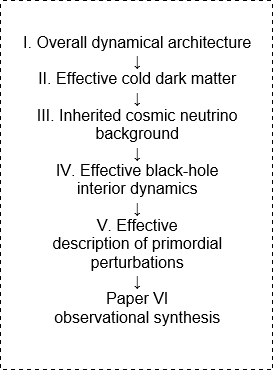
2 Observational Strategy
The observational philosophy of the HRDCC framework differs from that of conventional cosmological models that seek to determine a unique set of fundamental parameters through global parameter estimation. Because the effective evolution of each cosmological cycle depends on inherited information transmitted through the Holographic Transition Core (HTC), several observable quantities cannot be predicted as fixed numerical constants from first principles alone.
Instead, HRDCC predicts that the cumulative effects of cyclic inheritance should manifest themselves as coherent observational patterns simultaneously present across multiple independent cosmological probes. Consequently, the primary objective of observational testing is not the verification of isolated signatures but the identification of mutually consistent phenomenological correlations.
Within this framework, no individual observation is expected to constitute definitive evidence for HRDCC. Rather, confidence in the model would increase if independent measurements consistently exhibit deviations or systematic tendencies compatible with the effective cyclic interpretation proposed throughout Papers I–V.
This observational strategy naturally motivates the combined use of complementary datasets. Measurements of the cosmic microwave background constrain primordial perturbations and large-scale isotropy. Galaxy surveys probe the evolution of large-scale structure and baryon acoustic oscillations. Weak gravitational lensing traces the integrated matter distribution, while gravitational-wave observations may provide indirect information about relic populations inherited from previous cosmological cycles. Together, these observational windows sample different epochs of cosmic evolution while remaining sensitive to common underlying phenomenological mechanisms.
An important feature of the HRDCC framework is that its observational signatures are expected to be correlated rather than independent. Effective modifications associated with cyclic inheritance may simultaneously influence primordial perturbation statistics, relic particle populations, dark matter phenomenology, and the late-time evolution of cosmic structure. The simultaneous consistency of these independent observations therefore constitutes a stronger test than any individual measurement considered in isolation.
Throughout this paper, observational predictions are classified according to three categories:
Observational consistency, referring to phenomena already compatible with existing measurements.
Expected signatures, representing qualitative consequences that should emerge if the HRDCC framework provides an effective description of cosmological evolution.
Future observational tests, identifying measurements that forthcoming experiments may be capable of confirming or falsifying.
This classification emphasizes that HRDCC is intended as a phenomenological framework whose scientific value ultimately depends on observational consistency and future empirical tests rather than on mathematical completeness alone.
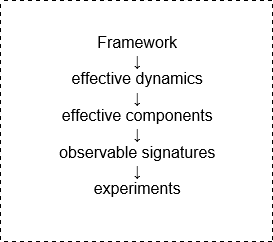
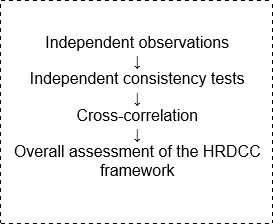
3 Cosmic Microwave Background Signatures
3.1 Motivation
The cosmic microwave background remains the most powerful observational probe of the early Universe. High-precision measurements obtained by COBE, WMAP, and Planck have established a remarkably consistent description of primordial density fluctuations while simultaneously providing stringent constraints on cosmological models. Consequently, any phenomenological framework intended to describe cosmic evolution must demonstrate compatibility with the principal observational properties of the CMB [6].
Within the HRDCC framework, the CMB is interpreted as the observable imprint of the current cosmological cycle, while its statistical properties may retain indirect information inherited from previous cycles through the effective dynamics of the Holographic Transition Core (HTC). This interpretation does not replace the standard phenomenology of photon decoupling but instead provides an alternative effective origin for the initial conditions from which the observed anisotropies subsequently evolved.
Consequently, HRDCC does not predict large deviations from the observed \(\Lambda\)CDM description of the CMB. Instead, it suggests that subtle deviations, if present, are more likely to appear as higher-order statistical effects or weak correlations that become observable only through increasingly precise measurements.
3.2 Large-Scale Anomalies
Several large-scale anomalies have been discussed in the CMB literature, including hemispherical power asymmetry, the alignment of low-order multipoles, parity asymmetries, and the so-called Cold Spot. Although none of these features individually provides compelling evidence for physics beyond the standard cosmological model, their continued presence motivates consideration of phenomenological explanations that extend beyond purely statistical fluctuations.
Within HRDCC these anomalies are interpreted cautiously as possible manifestations of incomplete statistical isotropization inherited from previous cosmological cycles. Residual large-scale correlations transmitted through the effective cyclic transition could naturally generate weak preferred orientations or large-scale modulation without requiring violations of local physical laws.
This interpretation remains intentionally conservative. HRDCC does not claim that the observed anomalies necessarily originate from cyclic inheritance. Rather, the framework allows such effects to emerge as phenomenologically plausible consequences should future observations establish that the anomalies possess genuine physical significance.
3.3 Primordial Non-Gaussianity
Paper V introduced an effective phenomenological description of primordial perturbations generated through cyclic inheritance and resonance processes. Within that framework, deviations from purely Gaussian statistics arise naturally as effective consequences of inherited perturbation patterns rather than from a separate inflationary mechanism.
Consequently, HRDCC predicts that any observable primordial non-Gaussianity should remain small and statistically consistent with current observational limits while potentially exhibiting characteristic scale dependence or spatial correlations associated with cyclic resonance. The framework therefore remains compatible with existing Planck constraints [7] while allowing limited departures that may become detectable by future high-sensitivity observations.
The principal observational objective is therefore not the detection of large non-Gaussian amplitudes but the identification of subtle statistical structures whose collective properties are consistent with cyclic inheritance.
3.4 CMB Polarization
Measurements of CMB polarization provide an independent observational window into primordial perturbations and early-Universe physics. Future polarization missions [8] are expected to improve constraints on tensor perturbations, primordial non-Gaussianity, and large-scale statistical isotropy well beyond the current observational precision.
Within HRDCC, polarization measurements are particularly valuable because they probe the same primordial perturbation field through observables largely independent of temperature anisotropies. Any systematic consistency between temperature, \(E\)-mode polarization, and future \(B\)-mode observations would therefore provide significantly stronger constraints on effective cyclic scenarios than temperature measurements alone.
The framework does not require the existence of a unique primordial tensor signal. Instead, polarization observations are interpreted as one component of a broader observational consistency test in which multiple independent datasets collectively constrain the effective dynamics of cyclic cosmological evolution.
4 Large-Scale Structure
4.1 Motivation
The large-scale distribution of galaxies provides one of the principal observational probes of cosmic structure formation. Modern galaxy surveys have mapped the three-dimensional matter distribution over an unprecedented range of redshifts, enabling increasingly precise studies of cosmic evolution, structure growth, and the statistical properties of the matter distribution.
Within the standard cosmological framework, the observed large-scale structure is understood to emerge from the gravitational amplification of primordial density perturbations. The resulting galaxy distribution reflects both the statistical properties of the initial perturbation field and the subsequent dynamical evolution of dark matter and baryonic matter throughout cosmic history.
Within the HRDCC framework, large-scale structure represents the cumulative outcome of primordial perturbations, inherited relic populations, and effective cyclic evolution developed throughout Papers II–V. Consequently, the observed matter distribution is interpreted not as the product of a single cosmological beginning but as the effective realization of perturbations whose initial conditions may partially reflect cyclic inheritance.
4.2 Structure Growth
HRDCC preserves the standard picture of gravitational instability as the dominant mechanism responsible for the growth of cosmic structure. The framework therefore remains compatible with the observed hierarchical formation of galaxies, clusters, and the cosmic web.
The principal distinction lies in the origin of the initial perturbation spectrum. Rather than assuming entirely stochastic primordial fluctuations generated during a single inflationary epoch, HRDCC allows the effective perturbation field to inherit statistical properties accumulated through previous cosmological cycles. The subsequent gravitational evolution proceeds according to the established phenomenology of structure formation.
Accordingly, the framework predicts that observable deviations from the standard cosmological model, if present, should primarily appear in higher-order statistical properties rather than in the overall morphology of the cosmic web.
4.3 Correlated Signatures
Because HRDCC attributes several cosmological observables to common inherited initial conditions, multiple large-scale observables are expected to exhibit correlated phenomenological behaviour. Small deviations in primordial perturbation statistics, relic matter distributions, and effective dark matter evolution may collectively influence the clustering properties of galaxies while remaining individually consistent with existing observational constraints.
Consequently, the framework emphasizes cross-correlation analyses rather than isolated observational anomalies. Consistency between galaxy clustering, weak gravitational lensing, baryon acoustic oscillations, and CMB-derived perturbation statistics would provide a substantially stronger assessment of HRDCC than any individual dataset considered independently.
This emphasis on observational coherence reflects the phenomenological nature of the framework and avoids reliance upon any single potentially ambiguous observational feature.
4.4 Future Surveys
The next generation of cosmological surveys is expected to improve measurements of large-scale structure by increasing both observational volume and statistical precision. High-density galaxy catalogues, extended redshift coverage, and improved measurements of cosmic evolution will substantially strengthen tests of phenomenological cosmological models.
Within HRDCC, these surveys are expected to provide the most sensitive observational constraints on possible signatures of cyclic inheritance in the statistical properties of the large-scale matter distribution. Particular emphasis is placed on measurements capable of simultaneously probing galaxy clustering, growth rates, higher-order correlation functions, and cross-correlations with independent cosmological datasets.
Rather than seeking a single definitive observational signature, HRDCC anticipates that future large-scale surveys will gradually establish or exclude the collective consistency pattern expected from effective cyclic cosmological evolution.
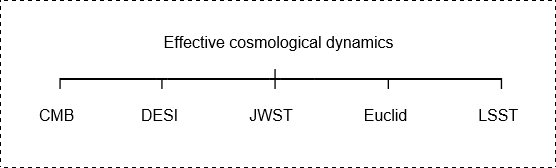
5 Baryon Acoustic Oscillations
5.1 BAO as a Cosmological Standard Ruler
Baryon acoustic oscillations constitute one of the most robust observational probes of cosmic expansion. Originating from acoustic waves propagating through the tightly coupled photon–baryon plasma prior to recombination, the characteristic BAO scale provides an effective standard ruler that has been measured with increasing precision by modern galaxy surveys [9].
Together with observations of the cosmic microwave background, BAO measurements play a central role in constraining the expansion history of the Universe and testing the consistency of cosmological models over a broad range of redshifts.
5.2 Interpretation within HRDCC
Within the HRDCC framework, the physical origin of baryon acoustic oscillations remains identical to the standard cosmological description. The acoustic horizon established prior to photon decoupling continues to determine the characteristic BAO scale observed in the large-scale distribution of galaxies.
The distinction introduced by HRDCC concerns the effective initial conditions from which the primordial plasma evolved. Because the perturbation spectrum may inherit statistical properties from previous cosmological cycles, subtle modifications could influence the detailed realization of the acoustic pattern while preserving the overall BAO scale required by current observations.
Consequently, HRDCC does not predict significant deviations in the existence or physical interpretation of baryon acoustic oscillations but instead allows only small higher-order phenomenological effects that remain compatible with present observational constraints.
5.3 Expected Observational Signatures
If cyclic inheritance contributes to the effective primordial perturbation spectrum, small correlated deviations may appear in the statistical properties of the BAO signal. Such effects are expected to remain significantly below the dominant acoustic feature and therefore require high-precision statistical analyses for detection.
Possible observational manifestations include weak scale-dependent correlations, subtle modifications of higher-order clustering statistics, or coherent consistency with independent probes such as CMB anisotropies, weak gravitational lensing, and large-scale structure growth.
Importantly, HRDCC does not identify any individual BAO anomaly as unique evidence for cyclic cosmology. Rather, BAO observations contribute one component of a broader observational consistency framework in which multiple independent probes collectively constrain the phenomenology of cyclic evolution.
5.4 Future BAO Measurements
Forthcoming spectroscopic surveys will substantially improve measurements of baryon acoustic oscillations across an extended range of cosmic epochs. Increased observational volume, improved redshift precision, and reduced statistical uncertainties are expected to strengthen constraints on subtle departures from the standard cosmological model.
Within HRDCC, these observations are particularly valuable because they provide an independent consistency test of the primordial perturbation framework developed in Paper V while simultaneously probing the late-time evolution of cosmic structure discussed in the preceding section.
Future BAO measurements are therefore expected to contribute to the cumulative observational assessment of HRDCC through their consistency with other cosmological probes rather than through the discovery of a single decisive observational signature.
6 Weak Gravitational Lensing
6.1 Motivation
Weak gravitational lensing provides a direct observational probe of the projected matter distribution in the Universe. Unlike galaxy clustering, which depends on luminous tracers and galaxy bias, weak lensing measures the cumulative gravitational influence of all gravitating matter along the line of sight. Consequently, it offers one of the most powerful observational tests of dark matter and cosmic structure formation.
Recent surveys have achieved increasingly precise measurements of cosmic shear over large sky areas, while forthcoming observations are expected to improve both statistical precision and control of systematic uncertainties [10, 11].
6.2 Interpretation within HRDCC
Within the HRDCC framework, weak gravitational lensing probes the integrated gravitational effects produced by both baryonic matter and the inherited Planck-remnant population introduced in Paper II. The framework therefore preserves the standard interpretation of gravitational light deflection while providing an alternative phenomenological origin for part of the effective dark matter component.
Since HRDCC does not modify the local laws of gravitational lensing, the observable lensing signal is expected to remain consistent with the predictions of General Relativity. Any departures from the standard cosmological picture would instead arise through differences in the underlying matter distribution generated by cyclic inheritance.
6.3 Expected Signatures
Because the inherited dark matter population evolves continuously through successive cosmological cycles, weak lensing observations may provide indirect constraints on the cumulative matter distribution predicted by HRDCC. These effects are expected to appear primarily through correlated modifications of the matter power spectrum rather than through qualitative changes in lensing physics itself.
Consequently, the framework predicts that future high-precision weak lensing surveys may detect subtle consistency patterns linking cosmic shear measurements with CMB anisotropies, galaxy clustering, baryon acoustic oscillations, and relic matter populations. Such correlations would constitute a considerably stronger observational test than any individual lensing measurement considered in isolation.
6.4 Future Surveys
Next-generation weak lensing surveys will significantly increase the precision of cosmic shear measurements over large fractions of the sky. Improved photometric redshifts, deeper observations, and larger galaxy samples will enable increasingly sensitive tests of the evolution of the cosmic matter distribution.
Within HRDCC, these surveys are expected to provide one of the most direct observational assessments of the inherited dark matter scenario developed throughout the preceding papers. Their principal value lies in combining independent measurements of matter distribution with complementary cosmological probes, thereby strengthening the overall phenomenological consistency analysis of the framework.
7 Gravitational-Wave Background
7.1 Motivation
The direct detection of gravitational waves has established gravitational-wave astronomy as a major observational pillar of modern cosmology. Compact-object mergers observed by ground-based interferometers have demonstrated the existence of gravitational radiation predicted by General Relativity [12], while future observatories are expected to probe stochastic gravitational-wave backgrounds originating from a broad range of cosmological and astrophysical processes.
Because gravitational waves propagate largely unimpeded across cosmological distances, they provide a unique observational window into epochs and physical environments that are otherwise inaccessible through electromagnetic observations. Consequently, searches for stochastic gravitational-wave backgrounds have become increasingly important in testing models of the early Universe and alternative cosmological scenarios.
7.2 Interpretation within HRDCC
Within the HRDCC framework, gravitational waves are expected to arise through the same physical mechanisms recognized in standard astrophysics, including compact-object mergers and other relativistic dynamical processes. The framework therefore introduces no modification to the generation or propagation of gravitational waves within General Relativity.
However, cyclic cosmological evolution may contribute additional phenomenological signatures through the inherited structure of the Universe. Effective relic populations, recurrent black-hole formation, and cyclic perturbation dynamics developed throughout the preceding papers may collectively influence the statistical properties of the stochastic gravitational-wave background without requiring new gravitational physics.
Accordingly, HRDCC predicts that potential observational signatures are more likely to appear in the global statistical properties of the gravitational-wave background than in individual gravitational-wave events.
7.3 Expected Observational Signatures
The phenomenological framework developed throughout Papers II–V suggests several possible observational consequences relevant to future gravitational-wave measurements. Cyclic inheritance may influence the accumulated population of compact remnants, the distribution of black-hole mergers, and the statistical properties of relic gravitational-wave backgrounds generated over multiple cosmological cycles.
These effects are not expected to produce unique or easily identifiable observational features. Instead, HRDCC anticipates subtle correlations between gravitational-wave observations and other cosmological probes, including the cosmic microwave background, large-scale structure, weak gravitational lensing, and relic particle backgrounds.
Consequently, gravitational-wave observations are interpreted as one component of a broader multi-probe observational strategy rather than as an isolated test of the framework.
7.4 Future Observatories
The coming generation of gravitational-wave observatories will substantially extend the accessible observational frequency range and improve sensitivity to stochastic gravitational-wave backgrounds. Spacebased interferometers, third-generation ground-based detectors, and pulsar timing arrays together will probe complementary frequency domains associated with different physical processes throughout cosmic history.
Within HRDCC, these facilities are expected to provide increasingly stringent tests of the framework by constraining the statistical consistency of relic gravitational-wave populations with other cosmological observations. Their principal scientific value lies in expanding the multi-probe observational framework through an entirely independent messenger capable of probing otherwise inaccessible aspects of cosmic evolution.
Future gravitational-wave observations therefore represent an important component of the long-term empirical assessment of the HRDCC framework while remaining fully compatible with established gravitational-wave phenomenology.
8 Relic Backgrounds
8.1 Motivation
Relic backgrounds preserve valuable information about the physical conditions of the early Universe and therefore constitute important observational probes of cosmological evolution. While the cosmic microwave background provides the most extensively studied relic radiation field, additional cosmological relic populations—including the cosmic neutrino background and potential stochastic relic backgrounds—offer complementary observational windows into the history of the Universe.
Although several of these backgrounds remain observationally challenging, ongoing technological developments are expected to improve their accessibility in the coming decades. Consequently, relic backgrounds represent an important component of any comprehensive observational assessment of cosmological models.
8.2 Interpretation within HRDCC
Within the HRDCC framework, relic backgrounds naturally arise through the cumulative phenomenology of cyclic cosmological evolution. Rather than representing exclusively the products of a single cosmological beginning, certain relic populations may partially reflect inherited physical information transmitted across successive cosmological cycles through the Holographic Transition Core (HTC).
Paper III introduced this concept in the context of the inherited cosmic neutrino background, while Papers II and V discussed complementary inherited relic populations associated with dark matter remnants and primordial perturbations. The present work considers these components collectively from the perspective of observational cosmology.
HRDCC therefore interprets relic backgrounds as complementary observational tracers of cyclic inheritance rather than as isolated cosmological phenomena.
8.3 Expected Observational Signatures
Because relic backgrounds originate from different physical processes while remaining sensitive to the same underlying cosmological evolution, they provide valuable opportunities for multi-probe consistency analyses. The framework anticipates that future observations may reveal statistically consistent relationships between relic neutrino populations, primordial perturbation properties, dark matter phenomenology, and other cosmological observables.
In particular, future measurements of the cosmic neutrino background [13], together with improved constraints on the effective number of relativistic species and related cosmological parameters, may provide indirect observational tests of the inherited relic scenario proposed in Paper III.
HRDCC does not require any individual relic background to exhibit unique observational anomalies. Instead, the framework predicts that the collective consistency of multiple relic observables will provide a more reliable assessment of cyclic inheritance.
8.4 Future Prospects
Direct observations of several cosmological relic backgrounds remain beyond the capabilities of current observational facilities. Nevertheless, planned experiments and increasingly precise cosmological measurements are expected to improve constraints on relic particle populations, primordial radiation fields, and related cosmological parameters.
Within HRDCC, future relic background observations are regarded as long-term tests of the framework that complement measurements of the cosmic microwave background, large-scale structure, weak gravitational lensing, and gravitational-wave backgrounds. Together these observations contribute to an increasingly comprehensive phenomenological evaluation of cyclic cosmological evolution.
Accordingly, relic backgrounds represent an essential component of the integrated observational strategy developed throughout this paper, despite the significant experimental challenges that remain.
9 Next-Generation Surveys
9.1 Motivation
The next decade is expected to witness a substantial expansion of observational cosmology through a new generation of space missions and large-scale astronomical surveys. Improved observational precision, broader wavelength coverage, and unprecedented statistical power will enable increasingly stringent tests of cosmological models across multiple independent observational probes.
Rather than relying on a single experiment, future cosmology will increasingly depend on the combined interpretation of complementary datasets. This observational philosophy closely matches the phenomenological strategy adopted throughout the HRDCC framework.
9.2 Cosmic Microwave Background Missions
Future CMB experiments are expected to improve measurements of temperature anisotropies, polarization, and primordial non-Gaussianity beyond the precision achieved by Planck. In particular, LiteBIRD and future CMB polarization experiments [8] will significantly strengthen observational constraints on primordial perturbations and statistical isotropy.
Within HRDCC, these observations provide direct tests of the effective perturbation framework introduced in Paper V and discussed in the present work. Particular emphasis is placed on the consistency between temperature fluctuations, polarization measurements, and higher-order statistical properties rather than on any single cosmological parameter.
9.3 Large-Scale Structure Surveys
Upcoming galaxy surveys, including Euclid, DESI, and the Vera C. Rubin Observatory Legacy Survey of Space and Time (LSST) [9–11], will map the three-dimensional distribution of galaxies over unprecedented cosmological volumes. These observations will substantially improve measurements of structure growth, baryon acoustic oscillations, galaxy clustering, and weak gravitational lensing.
Within HRDCC, these surveys collectively probe the evolution of inherited perturbations and relic matter populations developed throughout Papers II–V. Their scientific importance lies in providing multiple independent consistency tests of the same underlying phenomenological framework.
9.4 Multi-Messenger Cosmology
Future cosmology will increasingly combine electromagnetic observations with gravitational-wave astronomy, relic particle searches, and complementary astrophysical datasets. This multi-messenger approach extends the observational basis of cosmology beyond traditional electromagnetic probes and enables increasingly comprehensive tests of theoretical models.
HRDCC naturally benefits from such an observational strategy because its phenomenological predictions are distributed across multiple independent observables rather than concentrated in a single measurable quantity.
9.5 Observational Outlook
The principal scientific significance of next-generation observational programmes lies not merely in improving measurement precision but in enabling increasingly robust cross-correlation analyses between independent cosmological probes. Such analyses are expected to become one of the most powerful methods for evaluating phenomenological cosmological frameworks.
Within HRDCC, future surveys therefore represent a progressive observational programme capable of confirming or excluding the collective consistency patterns discussed throughout this paper. Rather than seeking a single decisive experiment, the framework anticipates that empirical assessment will emerge from the combined interpretation of multiple complementary observations.
10 Combined Observational Framework
10.1 Multi-Probe Philosophy
The preceding chapters have examined the principal observational probes relevant to the HRDCC framework individually. Each observational window provides valuable information about a particular aspect of cosmic evolution, yet none is expected to constitute an independent verification or falsification of the framework.
This reflects the phenomenological nature of HRDCC. Since several effective cosmological quantities depend upon inherited information accumulated through previous cosmological cycles, the framework does not generally predict unique numerical values for individual observables. Instead, it predicts that independent cosmological probes should collectively exhibit a mutually consistent phenomenological pattern compatible with cyclic cosmological evolution.
Accordingly, the observational assessment of HRDCC relies upon the simultaneous consistency of multiple independent datasets rather than upon any single measurement.
10.2 Complementarity of Observational Probes
Each observational probe constrains a different physical aspect of the cosmological framework while remaining connected through the same underlying effective evolution.
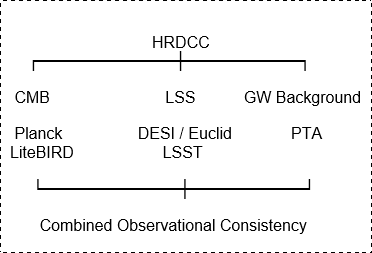
The cosmic microwave background constrains primordial perturbations and large-scale isotropy. Large-scale structure and baryon acoustic oscillations probe the subsequent gravitational evolution of matter. Weak gravitational lensing directly measures the integrated matter distribution, while relic backgrounds preserve information regarding inherited particle populations developed throughout previous papers. Gravitational-wave observations provide an independent messenger capable of probing compact-object populations and stochastic backgrounds beyond electromagnetic astronomy.
Although each probe investigates different physical processes, HRDCC interprets them as complementary manifestations of the same effective cyclic cosmological evolution.
10.3 Consistency Matrix
The principal observational prediction of HRDCC is therefore not a single measurable quantity but the existence of a coherent consistency matrix connecting multiple independent cosmological observations.
Within this framework, the simultaneous agreement of CMB observations, large-scale structure, baryon acoustic oscillations, weak gravitational lensing, relic particle backgrounds, and gravitational-wave measurements constitutes a substantially stronger assessment of the model than any isolated observational result.
Future cosmological surveys are expected to strengthen this consistency matrix through increasingly precise cross-correlation analyses and independent observational verification across multiple cosmological scales.
| Observational probe | \(\Lambda\)CDM interpretation | HRDCC interpretation |
|---|---|---|
| CMB | Primordial fluctuations from early-Universe physics | Effective primordial perturbations inherited through cyclic evolution |
| BAO | Standard ruler constraining expansion history | Same standard ruler; consistency test of inherited initial conditions |
| Large-scale structure | Growth from primordial perturbations | Growth from an inherited effective perturbation spectrum |
| Weak lensing | Total gravitating matter distribution | Same observable with an inherited remnant contribution |
| Gravitational-wave background | Astrophysical and primordial sources | Same sources plus possible cyclic consistency patterns |
| Relic backgrounds | Early-Universe relic populations | Possible inherited relic populations across successive cycles |
| Next-generation surveys | Precision parameter estimation | Multi-probe consistency testing of the effective framework |
10.4 Cross-Correlation Strategy
Cross-correlation analyses occupy a central position within the observational methodology of HRDCC. Rather than interpreting individual datasets independently, the framework emphasizes the consistency of observational relationships among multiple cosmological probes.
Examples include correlations between primordial perturbation statistics inferred from the cosmic microwave background and the subsequent evolution of large-scale structure, consistency between weak gravitational lensing and inherited dark matter populations, or agreement between relic particle backgrounds and independent cosmological constraints.
This strategy substantially reduces the dependence upon any individual observational anomaly while simultaneously increasing the robustness of phenomenological model assessment.
10.5 Toward an Integrated Observational Programme
The observational framework developed throughout this paper defines a long-term empirical programme for evaluating the HRDCC model. Rather than proposing isolated observational tests, it establishes a coordinated strategy in which present and future cosmological observations collectively constrain the phenomenology of cyclic cosmological evolution.
As observational precision continues to improve through next-generation surveys and multi-messenger astronomy, the cumulative consistency of independent cosmological probes will provide increasingly stringent tests of the framework. Consequently, the long-term scientific assessment of HRDCC is expected to emerge progressively from the integration of complementary observations rather than from any single decisive experiment.
11 Discussion
The preceding chapters have presented an integrated observational assessment of the Holographic Rotation-Driven Cyclic Cosmology (HRDCC) framework by examining multiple independent cosmological probes within a unified phenomenological perspective. Rather than considering individual observations in isolation, the present work emphasizes the collective interpretation of complementary datasets that probe different stages of cosmic evolution.
This observational philosophy represents a natural extension of the framework developed throughout Papers I–V. The effective cosmological architecture introduced in Paper I, together with the inherited dark matter scenario of Paper II, the inherited cosmic neutrino background of Paper III, the effective black-hole interior dynamics of Paper IV, and the primordial perturbation framework of Paper V collectively define a coherent set of physical assumptions whose empirical assessment requires a correspondingly integrated observational strategy.
Within HRDCC, no single cosmological observable is expected to provide definitive confirmation or refutation of the framework. Instead, scientific confidence is expected to increase progressively as independent observations consistently support the same phenomenological interpretation. This multi-probe methodology reduces dependence upon isolated observational anomalies while strengthening the robustness of empirical model evaluation.
The observational programme outlined in this paper is therefore intended as a long-term framework rather than a collection of isolated predictions. Future observations obtained through increasingly precise cosmological surveys, multi-messenger astronomy, and cross-correlation analyses will progressively determine whether the collective phenomenological consistency anticipated by HRDCC is supported by empirical evidence.
Accordingly, the principal contribution of the present work is not the proposal of new observational phenomena but the establishment of a coherent methodology through which the complete HRDCC framework may be systematically evaluated using present and future cosmological observations.
12 Limitations
The HRDCC framework remains an effective phenomenological model rather than a complete microscopic theory of cosmological evolution. Consequently, several aspects of the framework require further theoretical development before quantitative predictions comparable to those of fully parameterized cosmological models can be established.
In particular, the present work does not derive unique numerical predictions for individual cosmological parameters such as the Hubble constant, the scalar spectral index, the tensor-to-scalar ratio, or related precision observables. Instead, these quantities are regarded as effective manifestations of cosmological evolution that may depend upon inherited information accumulated throughout previous cosmological cycles.
Similarly, the framework does not presently provide a complete microscopic description of the Holographic Transition Core, the statistical evolution of inherited relic populations, or the detailed dynamics governing information transfer between successive cosmological cycles. These topics remain important directions for future theoretical investigation.
From an observational perspective, several signatures discussed throughout this paper remain beyond current experimental capabilities. Measurements of relic backgrounds, future stochastic gravitational-wave observations, and increasingly precise multi-probe correlation analyses will be required before many aspects of the framework can be subjected to comprehensive empirical evaluation.
Accordingly, the present paper should be regarded as establishing an observational roadmap rather than providing definitive observational confirmation of the HRDCC framework. Its scientific value ultimately depends upon the future consistency of independent cosmological observations with the phenomenological expectations presented here.
13 Conclusion
This paper has presented the first unified observational framework for evaluating the Holographic Rotation-Driven Cyclic Cosmology (HRDCC) model through multiple independent cosmological probes. Building upon the theoretical developments established throughout Papers I–V, the present work has integrated observations of the cosmic microwave background, large-scale structure, baryon acoustic oscillations, weak gravitational lensing, gravitational-wave backgrounds, relic cosmological backgrounds, and forthcoming observational surveys into a single phenomenological assessment strategy.
A central conclusion of this study is that HRDCC should not be evaluated through isolated cosmological observables or individual parameter estimates alone. Instead, the framework proposes that independent cosmological measurements should collectively exhibit a coherent pattern of phenomenological consistency if cyclic inheritance provides an effective description of cosmic evolution.
This multi-probe observational philosophy naturally aligns with the direction of contemporary precision cosmology, in which complementary observations increasingly constrain theoretical models through crosscorrelation and independent verification rather than through any single experimental result.
The present work therefore completes the initial HRDCC publication series by establishing an integrated empirical framework linking theoretical development with observational cosmology. Future improvements in observational precision, together with next-generation cosmological surveys and multi-messenger astronomy, will progressively determine the extent to which the phenomenological expectations of the HRDCC framework remain consistent with the observed Universe.
Rather than representing the conclusion of the HRDCC programme, this paper defines the beginning of its long-term observational evaluation. In this sense, the framework advances from theoretical construction toward systematic empirical assessment through the combined interpretation of independent cosmological observations.
14 Summary of Symbols and Abbreviations
| Symbol or abbreviation | Meaning |
|---|---|
| BAO | Baryon acoustic oscillations |
| CMB | Cosmic microwave background |
| CNB | Cosmic neutrino background |
| DESI | Dark Energy Spectroscopic Instrument |
| GW | Gravitational wave |
| HRDCC | Holographic Rotation-Driven Cyclic Cosmology |
| HTC | Holographic Transition Core |
| JWST | James Webb Space Telescope |
| LSST | Legacy Survey of Space and Time |
| PTA | Pulsar timing array |
| PTOLEMY | Princeton Tritium Observatory for Light, Early-Universe, Massive-Neutrino Yield |
| \(\Lambda\)CDM | Standard cosmological model with a cosmological constant and cold dark matter |
15 Bibliography