Main links
Main
HRDCC framework details
- HRDCC landing page
- The HRDCC Publication Program
-
Paper pages
- Paper I. - Holographic Rotation-Driven Cyclic Cosmology (HRDCC): A Unified Dynamical Framework for Cyclic Cosmology
- Paper II. - Planck Remnants and the Origin of Cold Dark Matter within the HRDCC Framework
- Paper III. - Inherited Cosmic Neutrino Background within the HRDCC Framework
- Paper IV. - Black Hole Interior Dynamics and Horizon Mechanics within the HRDCC Framework
- « Paper V. - Primordial Perturbations, Chladni Resonances and Non-Gaussianity within the HRDCC Framework »
- Paper VI. - Observational Tests of the HRDCC Framework: Effective Cosmological Signatures from CMB to Next-Generation Surveys
- Paper VII. - Rotational Dynamics and Phase Reversal within the HRDCC Framework
- Paper VIII. - Microscopic Foundations of the HRDCC Framework
- Paper IX. - Effective Particle Physics across Successive Cosmological Cycles within the HRDCC Framework
Research & Profiles
Paper V. - Primordial Perturbations, Chladni Resonances and Non-Gaussianity within the HRDCC Framework


Abstract
The origin of primordial cosmological perturbations remains one of the central questions in modern cosmology. In the standard picture, these perturbations are commonly attributed to quantum fluctuations amplified during an inflationary epoch. Within the HRDCC framework, the same observational problem is approached from a different phenomenological perspective.
The present work investigates whether primordial perturbations may phenomenologically emerge from the effective geometric state established during a regularized cosmological transition. Rather than introducing additional microscopic fields, the framework considers the possibility that resonance patterns associated with the evolving effective geometry contribute to the modulation of an effective primordial perturbation spectrum. In this context, effective Chladni resonances are introduced as phenomenological standing geometric patterns that may imprint phase correlations on large-scale perturbations.
Within the effective cosmological framework established in earlier papers of the HRDCC publication program, the present work introduces an effective description of resonance-induced perturbation generation and discusses how such resonances may contribute to effective primordial non-Gaussianity. The proposed relations remain phenomenological throughout this work. A microscopic resonance theory is intentionally left for future studies.
The resulting phenomenological framework is compatible with a range of observational signatures commonly discussed in modern cosmology, including large-scale CMB phase correlations and departures from purely Gaussian primordial statistics. Quantitative confrontation with cosmological observations is intentionally deferred to subsequent investigations.
1 Introduction
1.1 Modern cosmological context
Primordial cosmological perturbations determine the initial conditions from which galaxies, galaxy clusters, and the large-scale structure of the Universe subsequently develop. Measurements of the cosmic microwave background (CMB) have established these perturbations as one of the most important observational windows into the earliest accessible stages of cosmological evolution [1, 2].
Within the standard cosmological framework, their origin is commonly interpreted in terms of quantum fluctuations stretched to astrophysical scales during inflation [3–5]. This interpretation has been remarkably successful, yet several aspects of the primordial perturbation sector - including the physical origin of phase correlations, the possible presence of primordial non-Gaussianity, and the interpretation of certain large-scale anomalies - remain active areas of investigation [6–8].
1.2 Open questions
These open questions do not diminish the success of the standard cosmological model. Instead, they motivate the exploration of alternative physical interpretations capable of producing phenomenologically similar observables through different underlying mechanisms.
Cyclic cosmological scenarios provide one possible direction. Because cosmological evolution is interpreted as a sequence of subsequent cosmological cycles rather than a single isolated beginning, the physical origin of primordial perturbations need not coincide with the mechanism usually associated with inflation. Different cyclic frameworks address this issue in different ways, ranging from bounce-induced perturbations to inherited pre-bounce structures [9, 10].
1.3 HRDCC background
The HRDCC framework approaches cyclic cosmology as an effective phenomenological framework. Previous papers introduced its effective cosmological dynamics, interpreted the effective dark-matter sector in terms of inherited Planck remnants, examined the inherited neutrino sector, and developed the effective geometrical role of the regularized Holographic Transition Core (HTC) [11–14]. These studies establish the physical background required for the perturbation problem considered here.
1.4 Scope of the present work
The question addressed in this paper is deliberately narrower than the broader cosmological program. Rather than constructing a complete perturbation theory, we examine whether the effective geometric state developed within the HRDCC framework may naturally support resonance phenomena capable of contributing to primordial perturbation generation.
The discussion therefore remains intentionally phenomenological. Effective Chladni resonances are introduced as a physical interpretation of resonance patterns associated with the effective geometric state, while their microscopic origin, perturbation evolution, and quantitative comparison with cosmological observations are deferred to subsequent investigations. The following section examines the physical motivation for resonance-supported perturbation generation within this effective geometric picture.
1.5 Organization of the paper
We first examine the physical motivation for effective geometric perturbation generation before introducing the phenomenological perturbation framework adopted throughout this work. The subsequent sections discuss the role of Chladni resonances, their possible connection with effective primordial non-Gaussianity, and the corresponding observational implications. The paper concludes with a discussion of the limitations of the present phenomenological description and directions for future work.
2 Physical motivation
2.1 Why a geometric origin?
A standard cosmological picture associates primordial perturbations with quantum fluctuations generated during inflation. Within the HRDCC framework, the question is approached from a different direction. Once cosmological evolution is interpreted as a sequence of subsequent cosmological cycles connected through a regularized HTC, the large-scale geometry itself becomes part of the physical initial conditions inherited by each new cycle.
This observation changes the role of geometry. Instead of acting solely as the background on which perturbations evolve, the effective geometric state may itself participate in establishing the conditions from which perturbations emerge. The present work explores this possibility at the phenomenological level without assuming a microscopic resonance theory or modifying the effective cosmological framework established previously.
2.2 The effective geometric state
The effective geometric state introduced in earlier HRDCC studies represents the macroscopic configuration established during the regularized cosmological transition. It should not be interpreted as a static geometrical object or as a separate physical field. Rather, it summarizes the effective geometrical conditions inherited across successive cosmological cycles through the regularized HTC.
Because this state reflects the cumulative outcome of multiple coupled physical processes, small spatial variations are expected to arise naturally. Within the present phenomenological description these variations are not yet identified with primordial perturbations themselves. Instead, they provide the physical environment in which perturbation generation may occur.
2.3 Why resonances?
Resonance phenomena are common whenever extended physical systems support characteristic modes of oscillation. The precise microscopic mechanism depends on the underlying physics, but the existence of preferred resonance patterns does not. From this perspective, it is reasonable to ask whether an evolving effective geometric state may also support resonance structures during a cosmological transition.
The HRDCC framework does not assume that such resonances originate from a specific microscopic interaction. Instead, it considers them as an effective manifestation of the macroscopic geometric configuration. Their role is therefore interpretative rather than fundamental: they describe how the effective geometry may influence the distribution of primordial perturbations without specifying the microscopic dynamics responsible for their formation.
2.4 Why Chladni resonances?
The term Chladni resonances is adopted because standing-wave systems naturally organize into characteristic nodal patterns. Within the HRDCC framework this analogy is used only at the phenomenological level. No direct mechanical equivalence is implied between acoustic standing waves and cosmological geometry.
The analogy instead emphasizes a structural property. If resonance modes develop within the effective geometric state, they may preferentially amplify some spatial configurations while suppressing others. Such behaviour provides a natural phenomenological picture for resonance-induced modulation of an effective primordial perturbation field and motivates the terminology adopted throughout this work.
2.5 Towards primordial perturbations
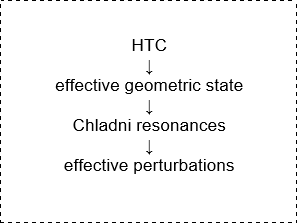
Once the possibility of resonance-supported geometric structures has been established, the transition to primordial perturbations becomes straightforward. The effective geometric state provides the macroscopic environment, resonance phenomena introduce spatial modulation, and the resulting configuration may be interpreted as the origin of an effective primordial perturbation spectrum.
At this stage no mathematical description is required. The purpose of the present section is only to establish the physical motivation connecting the effective geometric state with resonance-induced perturbation generation. The corresponding phenomenological framework is developed in the following section.
3 Effective perturbation generation
3.1 From geometry to perturbations
The previous section established the physical motivation for considering resonance phenomena within the effective geometric state. The next step is to identify how such resonant structures may be reflected in the primordial perturbation sector.
In the standard cosmological picture, primordial perturbations are typically introduced as fluctuations generated by quantum fields during inflation. The HRDCC framework does not replace that description with an alternative microscopic mechanism. Instead, it asks whether the macroscopic geometric configuration established during the regularized cosmological transition may already contain the conditions required for an effective perturbation spectrum to emerge.
The distinction is important. The present framework is concerned with the effective description of perturbation generation rather than with the microscopic dynamics responsible for individual fluctuation modes.
3.2 Effective primordial perturbation spectrum
If resonance patterns are present within the effective geometric state, their influence may be represented phenomenologically as a modulation of an underlying perturbation spectrum. We therefore introduce the Effective Primordial Perturbation Spectrum, which serves as the central phenomenological relation of the present work: \[\begin{equation} P_{\rm eff}(k,\xi)=P_{0}(k)\,\mathcal{R}(k,\xi). \label{eq:effective_perturbation_spectrum} \end{equation}\] Here, \(P_{\rm eff}(k,\xi)\) is the effective primordial perturbation spectrum, \(P_{0}(k)\) denotes the background perturbation spectrum, \(\mathcal{R}(k,\xi)\) represents the effective resonance modulation, \(k\) is the comoving wavenumber, and \(\xi\) is the effective evolutionary state parameter.
Equation [eq:effective_perturbation_spectrum] is intended exclusively as an effective phenomenological relation within the present work. Its microscopic derivation is deferred to subsequent investigations.
3.3 Physical interpretation
Equation [eq:effective_perturbation_spectrum] does not describe the creation of perturbations from first principles. Instead, it separates two conceptually different ingredients.
The first is the background perturbation spectrum, representing the large-scale perturbation field before any resonance effects are taken into account. The second is the resonance modulation, which captures how the evolving effective geometric state may redistribute perturbation amplitudes across different spatial scales.
Viewed in this way, the resonance term does not introduce a new physical component. It modifies the phenomenological appearance of an already existing perturbation spectrum. This interpretation remains fully consistent with the effective character of the HRDCC framework and avoids attributing microscopic dynamics to a relation that is intentionally macroscopic.
3.4 Effective perturbation inheritance
The HRDCC framework interprets inheritance as the persistence and transmission of effective physical degrees of freedom across successive cosmological cycles through the regularized HTC. The perturbation sector can be viewed in the same spirit.
The present work therefore introduces the concept of effective perturbation inheritance. The term does not imply that individual perturbation modes survive unchanged from one cosmological cycle to the next. Rather, it refers to the persistence of effective geometric properties capable of influencing the statistical character of primordial perturbations after each regularized cosmological transition.
Under this interpretation, the perturbation spectrum is linked to the inherited effective geometric state rather than to the detailed history of individual microscopic fluctuations.
3.5 Preparing the resonance description
Equation [eq:effective_perturbation_spectrum] leaves one quantity intentionally unspecified: the resonance modulation \(\mathcal{R}(k,\xi)\). This function summarizes the phenomenological influence of resonance structures on the effective perturbation spectrum, but its physical interpretation has not yet been discussed.
We now examine how resonance patterns may arise within the effective geometric state and why the Chladni analogy provides a useful phenomenological description of their large-scale structure.
4 Chladni resonances
4.1 Resonance as a geometric property
The perturbation framework developed in the previous section leaves one question unanswered. If the effective perturbation spectrum is modulated by the evolving geometric state, what physical mechanism is responsible for that modulation?
At the phenomenological level, resonance provides a natural candidate. Extended physical systems often support preferred modes whose spatial structure is determined by the geometry of the system itself. The detailed microscopic origin of those modes depends on the underlying physics, but the emergence of resonance patterns is a much more general phenomenon.
The HRDCC framework adopts this viewpoint. It does not assume that the effective geometric state behaves as a mechanical resonator. Rather, it explores whether the macroscopic geometry established during the regularized cosmological transition may naturally support resonance structures capable of influencing the primordial perturbation field.
4.2 From resonance modes to standing patterns
An evolving geometric configuration does not necessarily generate observable signatures. Resonance becomes physically relevant only when preferred modes produce stable spatial patterns instead of transient fluctuations.
Within the present phenomenological description, the effective geometric state is interpreted as providing precisely such an environment. Small variations need not remain completely random. Instead, resonance may preferentially organize them into characteristic large-scale structures whose statistical properties differ from those expected for an entirely uncorrelated perturbation field.
This interpretation does not depend on the detailed microscopic dynamics of the transition. It follows from the general observation that resonance tends to amplify particular configurations while suppressing others.
4.3 Effective Chladni resonances
The previous discussion motivates the terminology adopted throughout this work. When resonance-supported standing patterns are considered within the effective geometric state, we refer to them as effective Chladni resonances. The name emphasizes their structural similarity to standing-wave nodal patterns rather than any direct mechanical analogy.
Accordingly, effective Chladni resonances are interpreted as large-scale resonance structures associated with the macroscopic geometry established during the regularized cosmological transition. Their physical role is not to generate the perturbation field from first principles, but to modulate its spatial organization through resonance-induced geometric structure. This interpretation is consistent with the phenomenological scope of the HRDCC framework and preserves the distinction between effective and microscopic descriptions.
4.4 Effective resonance modulation
The phenomenological influence of resonance patterns introduced above is represented by the Effective Resonance Modulation Relation \[\begin{equation} \mathcal{R}(k,\xi)=1+\mathcal{C}(k,\xi). \label{eq:effective_resonance_modulation} \end{equation}\] Here, \(\mathcal{R}(k,\xi)\) denotes the effective resonance modulation and \(\mathcal{C}(k,\xi)\) represents the effective Chladni contribution. The variables \(k\) and \(\xi\) retain the meanings introduced below Eq. [eq:effective_perturbation_spectrum].
Equation [eq:effective_resonance_modulation] is intended exclusively as an effective phenomenological relation within the present work. Its microscopic derivation is deferred to subsequent investigations.
4.5 Physical interpretation and Chladni contribution
Equation [eq:effective_resonance_modulation] introduces only one new physical idea. The resonance modulation is treated as a correction to the background perturbation spectrum rather than as an independent perturbation source. The corresponding Effective Chladni Resonance Relation may be written as \[\begin{equation} \mathcal{C}(k,\xi)\equiv \frac{P_{\rm eff}(k,\xi)}{P_{0}(k)}-1. \label{eq:effective_chladni_resonance} \end{equation}\] This relation defines the effective Chladni contribution directly as the fractional resonance-induced departure from the background spectrum. It uses only quantities already introduced and therefore adds no microscopic degrees of freedom.
In practical terms, \(\mathcal{C}(k,\xi)\) summarizes the cumulative influence of resonance-supported geometric structures on the effective perturbation field. Different values of the effective evolutionary state parameter may correspond to different degrees of resonance modulation without implying any specific microscopic resonance process.
Equations [eq:effective_resonance_modulation] and [eq:effective_chladni_resonance] are intended exclusively as effective phenomenological relations within the present work. Their microscopic derivation is deferred to subsequent investigations.
4.6 From resonance to phase correlations
Resonance affects more than perturbation amplitudes. Whenever preferred modes become statistically significant, they also introduce correlations between the phases of different perturbation modes.
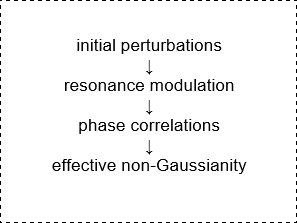
Within the HRDCC framework these phase correlations are interpreted as the natural macroscopic consequence of effective Chladni resonances. They therefore provide the conceptual bridge between resonance modulation and the effective primordial non-Gaussianity discussed in the following section.
At this stage no quantitative statistical model is introduced. The purpose of the present discussion is only to establish the physical sequence connecting resonance structures with phase-correlated perturbations.
5 Effective non-Gaussianity
5.1 From resonance to statistics
Resonance does more than modify amplitudes. Once preferred modes become statistically significant, the perturbation field no longer behaves as a collection of completely independent fluctuations. Phase information begins to matter.
In a purely random field, neighbouring modes remain statistically uncorrelated. Resonance changes that picture. Certain configurations become slightly more probable than others, introducing correlations that extend beyond the amplitude of individual perturbations.
The present framework interprets these correlations as the natural statistical consequence of resonance-supported geometric structure rather than as evidence for a separate physical component.
5.2 Effective primordial non-Gaussianity
The previous section established how resonance patterns may organize the perturbation field. A phenomenological departure from an ideal Gaussian distribution then follows naturally.
Within the HRDCC framework, effective primordial non-Gaussianity denotes statistical deviations associated with resonance-induced phase correlations emerging from the effective geometric state during the regularized cosmological transition.
The emphasis is deliberate. The present work does not derive a primordial bispectrum, nor does it attempt to calculate observational non-Gaussianity parameters. It introduces an effective phenomenological description linking resonance structures with the statistical properties of the perturbation field.
5.3 Effective primordial non-Gaussianity relation
The phenomenological connection between resonance structure and statistical behaviour is represented by the Effective Primordial Non-Gaussianity Relation \[\begin{equation} \mathcal{N}_{\rm NG}^{\rm eff}(k,\xi)=\mathcal{F}\!\left[\mathcal{C}(k,\xi)\right]. \label{eq:effective_non_gaussianity} \end{equation}\] Here, \(\mathcal{N}_{\rm NG}^{\rm eff}(k,\xi)\) denotes the effective primordial non-Gaussian contribution, \(\mathcal{F}\) represents the effective phenomenological mapping, and \(\mathcal{C}(k,\xi)\) is the effective Chladni contribution.
Equation [eq:effective_non_gaussianity] is intended exclusively as an effective phenomenological relation within the present work. Its microscopic derivation is deferred to subsequent investigations.
5.4 Physical interpretation
Equation [eq:effective_non_gaussianity] should not be interpreted as a prediction of observable non-Gaussianity parameters such as \(f_{\rm NL}\). The quantity introduced here serves a different purpose.
It summarizes how resonance-supported geometric structure may influence the statistical organization of primordial perturbations. Whether that influence eventually produces observable signatures depends on the detailed perturbation dynamics, transfer functions, and cosmological evolution considered beyond the scope of the present work.
This distinction preserves the phenomenological character of the framework while leaving room for future quantitative developments.
5.5 Possible observational consequences
Although the present description remains qualitative, several observational directions naturally follow. If resonance-induced phase correlations persist after the regularized cosmological transition, they may contribute to phenomena frequently discussed in observational cosmology, including
departures from purely Gaussian primordial statistics,
large-scale phase correlations,
anomalous low-multipole alignments, and
hemispherical asymmetries in the CMB.
The present framework does not claim that such observations uniquely identify resonance phenomena. Rather, it suggests that they provide a suitable observational environment in which the phenomenological interpretation proposed here may eventually be tested [7, 8]. This distinction is consistent with the observational hierarchy adopted throughout the HRDCC publication program.
5.6 Closing the phenomenological chain
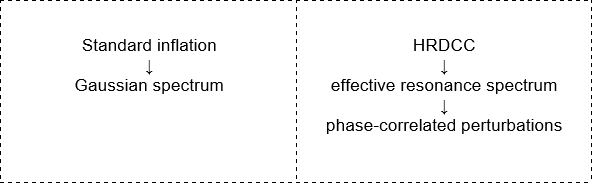
The physical picture developed throughout this paper is now complete. Beginning with the effective geometric state established during the regularized cosmological transition, we have introduced a phenomenological sequence in which resonance structures modify the effective perturbation spectrum, generate phase correlations, and may contribute to effective primordial non-Gaussianity.
Whether these resonance signatures can be quantified through cosmological observations remains a separate problem. Addressing that question requires direct comparison with observational data and therefore lies beyond the scope of the present work. A dedicated subsequent investigation is reserved for that observational step.
6 Observational implications
6.1 From phenomenology to observation
The phenomenological framework developed in the preceding sections is not intended to provide direct observational predictions. Its primary purpose is to establish a physically consistent interpretation linking the effective geometric state, resonance structures, and primordial perturbations within the HRDCC framework.
Even so, any viable cosmological model must ultimately confront observations. The effective relations introduced here therefore acquire significance only if they can, at least in principle, influence measurable properties of the large-scale Universe.
6.2 Cosmic microwave background
The CMB provides the most direct observational window into primordial perturbations. Consequently, it also represents the natural testing ground for the phenomenological ideas developed in the present work.
Within the HRDCC framework, resonance-supported geometric structures may influence statistical properties of the primordial perturbation field before photon decoupling. Such effects could, in principle, appear through subtle modifications of large-scale anisotropy patterns or departures from ideal Gaussian statistics [7, 8].
The present work does not attempt to calculate CMB power spectra or polarization signatures. Those quantitative predictions require a complete perturbation evolution model beyond the phenomenological scope adopted here.
6.3 Large-scale structure
Primordial perturbations provide the initial conditions for cosmic structure formation. Any systematic modification of their statistical properties therefore propagates naturally into the subsequent evolution of galaxies, clusters, and the cosmic web.
Within the HRDCC framework, resonance-induced modulation may leave weak statistical imprints on the large-scale matter distribution. At present, however, no quantitative prediction is made regarding correlation functions, halo statistics, or baryon acoustic oscillations. Such calculations require numerical cosmological modelling that has not yet been developed for the HRDCC framework [15, 16].
6.4 Future observational opportunities
Several ongoing and future observational programmes may eventually provide useful environments for testing phenomenological predictions associated with resonance-supported perturbation structures. Examples include increasingly precise measurements of
CMB temperature and polarization,
primordial non-Gaussianity,
large-scale galaxy clustering,
weak gravitational lensing, and
large-scale statistical anomalies.
Rather than identifying a single decisive experiment, the HRDCC framework anticipates that multiple independent observations will collectively determine whether resonance-based phenomenological descriptions remain compatible with cosmological data [15–17].
6.5 Position within the HRDCC publication program
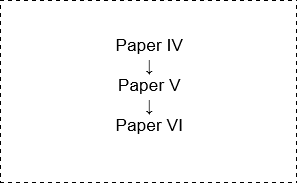
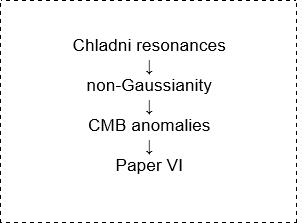
The observational discussion presented here should be viewed as preparatory rather than conclusive. The purpose of Paper V is to establish the phenomenological chain connecting effective geometry with resonance-supported primordial perturbations. A systematic comparison with observational constraints - including CMB anisotropies, large-scale structure surveys, and future precision cosmology experiments - is reserved for the next stage of the HRDCC publication program.
Accordingly, the present paper provides the conceptual framework, while the quantitative observational assessment is deferred to Paper VI.
7 Discussion
7.1 The role of the present work
The objective of the present paper is deliberately limited. Rather than proposing a complete microscopic theory of primordial perturbation generation, it establishes a phenomenological framework in which the effective geometric state developed within the HRDCC framework may support resonance structures capable of influencing primordial perturbations.
This distinction defines the scope of the paper. The emphasis is placed on physical consistency and logical continuity rather than on deriving a complete perturbation theory.
7.2 Relation to inflationary cosmology
The HRDCC framework should not be interpreted as a direct replacement for inflationary cosmology. Inflation remains the standard framework for describing the origin of primordial perturbations and has achieved remarkable observational success [2–5].
Instead, the present work investigates whether an alternative phenomenological interpretation can be constructed within a cyclic cosmological framework. In this interpretation, resonance-supported geometric structure supplements the effective description of primordial perturbations without attempting to reproduce every aspect of inflationary dynamics.
Accordingly, the relationship between HRDCC and inflation is best regarded as complementary rather than purely competitive.
7.3 Relation to other cyclic cosmologies
Many cyclic cosmological models attribute primordial perturbations to processes associated with cosmological contraction, bounce dynamics, or quantum gravitational effects [9, 10].
The HRDCC framework follows a different route. Successive cosmological cycles are connected through the regularized HTC, while the evolving effective geometric state provides the phenomenological environment in which resonance structures may emerge.
The novelty of the present interpretation therefore lies not in cyclicity itself, but in identifying effective resonance-supported geometry as the intermediate physical link between cosmological transition and primordial perturbations.
7.4 Internal consistency within HRDCC
One of the principal objectives of the HRDCC publication program is to construct a coherent phenomenological architecture in which individual physical sectors remain mutually compatible.
The perturbation framework developed here follows the same philosophy. The effective geometric state introduced in earlier papers naturally precedes the resonance structures discussed in the present work, while the resulting statistical signatures provide the conceptual bridge toward future observational investigations.
Viewed in this broader context, Paper V occupies the position connecting the effective interior dynamics established previously with the observational analyses planned in Paper VI.
7.5 Scientific perspective
The phenomenological character of the present work should not be interpreted as a substitute for a microscopic derivation. It is instead a methodological first step that identifies the physical relations and observational questions that a more complete theory must address.
By first establishing a logically consistent phenomenological description, it becomes possible to specify the mathematical and observational developments required for future work. Whether resonance-supported perturbation generation ultimately admits a microscopic derivation remains an open question. The present paper provides a coherent framework within which that question can be investigated.
8 Limitations
8.1 Phenomenological scope
The present work is formulated entirely at the phenomenological level. No microscopic description of resonance formation is proposed, and no quantum-field-theoretic derivation is attempted.
8.2 Mathematical limitations
The effective relations introduced throughout this paper are intended to organize the physical interpretation of resonance-supported perturbation generation. They should not be regarded as solutions of the Einstein-Boltzmann equations or as replacements for numerical cosmological perturbation theory.
8.3 Observational limitations
Although several potential observational consequences have been discussed, the present work does not calculate CMB angular power spectra, polarization observables, transfer functions, bispectra, or large-scale structure statistics.
Such quantitative analyses require dedicated numerical implementations that remain outside the scope of the current study.
8.4 Future developments
Several natural directions follow directly from the phenomenological framework presented here. These include
a microscopic resonance theory,
perturbation evolution,
Einstein-Boltzmann implementation,
numerical cosmological simulations, and
confrontation with precision observational data.
The CLASS and CAMB infrastructures provide established methodological points of comparison for such future numerical work [18, 19]. These topics are intentionally reserved for subsequent stages of the HRDCC research program.
9 Conclusion
The physical origin of primordial cosmological perturbations remains one of the central open questions in modern cosmology. While inflation successfully describes many observational properties of the early Universe, the possibility of alternative phenomenological interpretations continues to motivate theoretical investigation.
The present work has developed an effective phenomenological framework in which the evolving geometric state established during the regularized cosmological transition may support resonance structures capable of modulating the primordial perturbation spectrum.
Within this interpretation, effective Chladni resonances provide the conceptual mechanism linking geometry, perturbation modulation, phase correlations, and effective primordial non-Gaussianity.
Paper V extends the internal consistency of the HRDCC framework by introducing the perturbation sector without modifying the phenomenological foundations established in the preceding papers. The resulting architecture preserves the unified interpretation adopted throughout the publication program, in which successive physical sectors emerge from a common effective cosmological framework connected through the HTC.
The present work does not attempt to establish the observational validity of resonance-supported perturbation generation. Instead, it provides the phenomenological foundation required for such investigations. This foundation naturally prepares the transition to Paper VI, where the effective perturbation framework developed here will be examined in the context of cosmological observations, including the CMB, large-scale structure surveys, and future precision cosmology experiments.
10 Summary of symbols
Table 1 summarizes the mathematical symbols used in the principal phenomenological relations of this work.
| Symbol | Meaning |
| \(P_{\rm eff}(k,\xi)\) | Effective primordial perturbation spectrum |
| \(P_{0}(k)\) | Background perturbation spectrum |
| \(\mathcal{R}(k,\xi)\) | Effective resonance modulation |
| \(\mathcal{C}(k,\xi)\) | Effective Chladni contribution |
| \(\mathcal{N}_{\rm NG}^{\rm eff}(k,\xi)\) | Effective primordial non-Gaussian contribution |
| \(\mathcal{F}\) | Effective phenomenological mapping |
| \(k\) | Comoving wavenumber |
| \(\xi\) | Effective evolutionary state parameter |
11 Bibliography