Main links
Main
HRDCC framework details
- HRDCC landing page
- The HRDCC Publication Program
-
Paper pages
- Paper I. - Holographic Rotation-Driven Cyclic Cosmology (HRDCC): A Unified Dynamical Framework for Cyclic Cosmology
- « Paper II. - Planck Remnants and the Origin of Cold Dark Matter within the HRDCC Framework »
- Paper III. - Inherited Cosmic Neutrino Background within the HRDCC Framework
- Paper IV. - Black Hole Interior Dynamics and Horizon Mechanics within the HRDCC Framework
- Paper V. - Primordial Perturbations, Chladni Resonances and Non-Gaussianity within the HRDCC Framework
- Paper VI. - Observational Tests of the HRDCC Framework: Effective Cosmological Signatures from CMB to Next-Generation Surveys
- Paper VII. - Rotational Dynamics and Phase Reversal within the HRDCC Framework
- Paper VIII. - Microscopic Foundations of the HRDCC Framework
- Paper IX. - Effective Particle Physics across Successive Cosmological Cycles within the HRDCC Framework
Research & Profiles
Paper II. - Planck Remnants and the Origin of Cold Dark Matter within the HRDCC Framework


Abstract
The microscopic origin of cold dark matter remains one of the principal open problems of modern cosmology. While the standard \(\Lambda\)CDM model successfully describes the large-scale evolution of the Universe, it does not identify the physical nature of the dominant non-baryonic matter component. Among the numerous candidates proposed over the past decades, stable Planck remnants produced by Hawking evaporation of primordial black holes represent one of the most physically motivated compact-object scenarios.
Within the Holographic Rotation-Driven Cyclic Cosmology (HRDCC) framework, we develop a phenomenological interpretation in which the effective cold-dark-matter sector introduced previously is interpreted in terms of an inherited population of stable Planck remnants. In contrast to conventional remnant scenarios, where the present relic abundance originates within a single cosmological history, the HRDCC framework interprets the effective remnant population as the cumulative consequence of inherited compact gravitational relics persisting across successive mature cosmological cycles through the regularized Holographic Transition Core (HTC).
Beginning with primordial black-hole formation and Hawking evaporation, we formulate the effective cosmological evolution of the inherited remnant population and introduce its contribution to the effective cold-dark-matter sector. The cumulative evolution is parameterized by the effective evolutionary state parameter \(\xi\), which characterizes the macroscopic inherited cosmological state rather than a microscopic time coordinate or cycle counter. The resulting phenomenological description remains fully consistent with the effective cosmological framework established in Paper I while providing a physically motivated microscopic interpretation of its effective cold-dark-matter component.
The present work intentionally remains phenomenological. It does not derive the microscopic quantum-gravitational mechanism responsible for remnant stability, inheritance through the HTC, or black-hole interior dynamics. These questions are reserved for dedicated subsequent papers within the HRDCC publication program.
1 Introduction
The physical nature of cold dark matter remains one of the central open problems of modern cosmology. Although the standard \(\Lambda\)CDM model provides an exceptionally successful phenomenological description of the large-scale Universe, it does not identify the microscopic origin of the dominant non-baryonic matter component [1, 2]. Cosmological observations consistently require a gravitationally interacting and effectively collisionless component that governs structure formation, yet no experimentally confirmed fundamental particle or compact-object population has been established as its unique physical realization.
The existence of dark matter is supported by a broad range of independent observations, including galactic rotation curves, galaxy-cluster dynamics, gravitational lensing, cosmic microwave background anisotropies, baryon acoustic oscillations, and large-scale structure formation. Together, these observations impose increasingly stringent phenomenological constraints on the abundance, clustering properties, and cosmological evolution of the dark sector while remaining comparatively insensitive to its microscopic composition. The evidence therefore strongly supports an additional gravitational component without uniquely determining its physical origin.
Numerous particle and compact-object interpretations have consequently been proposed. Primordial black holes and stable black-hole remnants occupy a distinctive position among these possibilities because they arise within gravitational physics and connect early-Universe cosmology directly to semiclassical and quantum-gravitational black-hole evolution [3, 4]. The detailed candidate landscape is reviewed in Sec. 2; the present section focuses on the specific scientific problem addressed by the HRDCC interpretation.
Most existing remnant scenarios assume that the present relic abundance originates within a single cosmological history. Under this assumption, the final abundance depends primarily on the primordial black-hole formation efficiency, the initial mass spectrum, the subsequent Hawking evaporation history, and the survival probability of individual remnants. Reproducing the observed present-day dark-matter density may therefore require restrictive conditions on primordial production and evaporation within one expansion history.
The Holographic Rotation-Driven Cyclic Cosmology (HRDCC) framework adopts a different phenomenological perspective. Rather than treating the remnant population as an isolated product of a single cosmological epoch, it interprets the effective cold-dark-matter sector as the cumulative consequence of an inherited population of stable Planck remnants. These effective physical degrees of freedom are assumed to persist across successive mature cosmological cycles through the regularized Holographic Transition Core (HTC), the geometrical interface introduced in Paper I to preserve physical continuity between successive cosmological cycles [5].
Within this interpretation, the present effective remnant population need not be generated exclusively during the current cosmological cycle. Its macroscopic abundance may instead reflect the cumulative inheritance of compact gravitational relics produced during preceding mature cycles. This proposal does not redefine the effective dark-matter component established in Paper I. It provides a phenomenological microscopic interpretation of that component while preserving its established role within the effective cosmological dynamics.
The present work does not derive the quantum-gravitational stability, internal structure, or complete black-hole interior dynamics of individual Planck remnants. Nor does it derive the microscopic mechanism by which remnant degrees of freedom persist through the HTC. Stable remnants and their inheritance are adopted as phenomenological assumptions whose cosmological consequences can be formulated independently of a complete microscopic realization. Detailed investigations of the transition region and black-hole interior dynamics are reserved for later studies.
The primary objective of this paper is to develop the physical interpretation of the effective cold-dark-matter sector within the HRDCC framework. Beginning with primordial black-hole formation, we examine the conditions under which Hawking evaporation may produce a surviving remnant population, formulate its cumulative evolution across successive mature cosmological cycles, and incorporate its effective contribution into the cosmological matter budget. The resulting description establishes a direct phenomenological connection between primordial black-hole evolution, inherited Planck remnants, and the effective cold-dark-matter component introduced in Paper I.
The paper is organized as follows. Section 2 reviews the physical motivation for remnant-based dark-matter scenarios and places the HRDCC interpretation within the broader dark-matter candidate landscape. Section 3 considers primordial black-hole formation and the physical conditions relevant to remnant production. Section 4 develops the inherited remnant population and its cumulative effective evolution. Section 5 formulates its contribution to the effective cold-dark-matter sector. Section 6 examines compatibility with current cosmological and astrophysical constraints. The final sections discuss the interpretation, its limitations, and the principal conclusions.
2 Physical Motivation
Despite decades of experimental and observational effort, the microscopic identity of cold dark matter remains unknown. While the \(\Lambda\)CDM model accurately reproduces the large-scale evolution of the Universe, it does not specify the physical origin of the dominant non-baryonic matter component. Consequently, numerous theoretical candidates have been proposed, each motivated by different extensions of gravitational physics, particle physics, or quantum gravity.
The historically dominant paradigm has been based on Weakly Interacting Massive Particles (WIMPs). In thermal freeze-out scenarios, WIMPs naturally produce a relic abundance comparable to the observed cosmological dark-matter density, leading to the well-known “WIMP miracle” [2, 6]. This theoretical attractiveness motivated extensive direct-detection, indirect-detection, and collider searches over several decades. However, increasingly stringent experimental limits have substantially reduced the viable parameter space without yielding conclusive evidence for a fundamental WIMP particle.
Axions and axion-like particles constitute a second major class of dark-matter candidates. Originally introduced to resolve the strong CP problem in quantum chromodynamics, axions may also account for the observed cosmological dark-matter abundance under suitable production mechanisms [7–10]. Numerous laboratory experiments, astrophysical observations, and cosmological analyses continue to explore the remaining parameter space. Although axion models remain theoretically well motivated, no unambiguous detection has yet been achieved.
Sterile neutrinos provide an alternative framework in which the dark sector is associated with weakly coupled fermions beyond the Standard Model [11, 12]. Depending on their production history and mass scale, sterile neutrinos may behave as warm dark matter, modifying structure formation below galactic scales. Their phenomenology differs significantly from that of cold dark matter, particularly regarding small-scale clustering, making them complementary rather than directly equivalent to conventional cold-dark-matter scenarios.
Compact gravitational objects constitute a conceptually different class of candidates. Primordial black holes (PBHs), formed through gravitational collapse of sufficiently large primordial density fluctuations, require no new particle species and arise naturally within gravitational physics [3, 13, 14]. Their abundance is constrained by microlensing, gravitational-wave observations, cosmic microwave background measurements, Hawking evaporation, and numerous astrophysical probes. Nevertheless, significant regions of parameter space continue to be investigated, particularly for extended mass functions and non-standard formation histories.
Among compact-object scenarios, stable Planck remnants have attracted increasing attention as possible end products of black-hole evaporation. In many approaches to quantum gravity, Hawking evaporation is expected to deviate from the purely semiclassical description as the black-hole mass approaches the Planck scale. Rather than evaporating completely, the process may terminate in a stable or extremely long-lived compact remnant. Although the microscopic stabilization mechanism differs among individual theories, the phenomenological possibility of remnant formation appears in a broad variety of independent approaches, suggesting that it deserves consideration independently of any single quantum-gravity framework [4, 15].
From a cosmological perspective, however, remnant scenarios face two fundamental challenges. The first concerns the production efficiency required to generate the observed present-day dark-matter abundance without conflicting with existing observational limits on primordial black holes. The second concerns the long-term cosmological evolution of the remnant population itself. Most existing models treat the relic abundance as the outcome of a single cosmological history, thereby linking the present dark-matter density exclusively to processes occurring within one expansion history of the Universe.
The HRDCC framework adopts a broader phenomenological interpretation. Instead of regarding the remnant population as originating entirely within the present cosmological cycle, the framework considers the possibility that stable remnants constitute inherited effective physical degrees of freedom transmitted across successive cosmological cycles through the regularized HTC. Within this interpretation, the observed effective cold-dark-matter density reflects not only remnant production during the present cycle but also the cumulative inheritance of compact gravitational relics generated throughout the long-term cyclic cosmological evolution.
This interpretation does not modify the observational phenomenology required of cold dark matter. At the level of cosmological background evolution and large-scale structure formation, the effective dark-matter sector remains phenomenologically equivalent to the component introduced in Paper I. The difference lies entirely in its proposed physical interpretation. Rather than introducing a new elementary particle, the HRDCC framework interprets the effective cold-dark-matter sector as the macroscopic manifestation of an inherited remnant population whose cumulative evolution extends across successive cosmological cycles.
Having established the physical motivation, we next examine the gravitational origin of the inherited remnant population through primordial black-hole formation.
3 Primordial Black Holes
Primordial black holes (PBHs) constitute one of the few dark-matter candidates that arise entirely within gravitational physics and therefore require no extension of the Standard Model particle content. Unlike stellar black holes, which form through the gravitational collapse of massive stars during the late stages of stellar evolution, primordial black holes may originate during the earliest phases of cosmological evolution through the direct collapse of sufficiently large primordial density fluctuations [3, 13].
The physical mechanism is conceptually straightforward. During the radiation-dominated epoch, overdense regions continuously re-enter the cosmological horizon as the Hubble radius expands. If the density contrast of a given perturbation exceeds a critical threshold, pressure gradients become unable to counteract gravitational collapse, allowing the overdense region to form a black hole instead of dispersing with the surrounding radiation background.
The characteristic primordial black-hole mass is determined primarily by the cosmological horizon mass at the epoch of formation, \[\begin{equation} M_{\rm PBH}\sim M_H(t_{\rm form}), \label{eq:pbh_mass} \end{equation}\] where \(M_{\rm PBH}\) denotes the primordial black-hole mass, \(M_H\) is the cosmological horizon mass, and \(t_{\rm form}\) is the formation time. The characteristic primordial black-hole mass is therefore determined primarily by the cosmological horizon mass at the epoch of formation.
Consequently, different formation epochs naturally generate different characteristic mass scales, producing either narrow or extended mass distributions depending on the underlying primordial perturbation spectrum. Numerous formation scenarios have therefore been investigated, including inflationary enhancement of primordial curvature perturbations, cosmological phase transitions, collapse of topological defects, and other mechanisms capable of generating sufficiently large density contrasts during the early Universe.
From the perspective of cosmology, primordial black holes occupy a unique position because they simultaneously represent gravitational objects, possible dark-matter candidates, and potential laboratories for quantum-gravitational physics. Their cosmological abundance is constrained by gravitational microlensing, gravitational-wave observations, cosmic microwave background measurements, large-scale structure, gamma-ray backgrounds, Hawking evaporation, and numerous additional astrophysical probes. Although these constraints exclude substantial regions of parameter space, they do not eliminate primordial black holes as viable cosmological components across all masses and formation histories [3, 14].
An additional feature distinguishes primordial black holes from conventional particle candidates. Their long-term evolution is governed not only by classical gravitation but also by semiclassical quantum effects. Hawking radiation gradually reduces the mass of sufficiently small black holes, implying that their cosmological role depends not only on their initial formation but also on their subsequent evaporation history [16]. This naturally establishes the physical connection between primordial-black-hole cosmology and stable remnant scenarios.
Within the HRDCC framework, primordial black holes are therefore not introduced as the final constituents of the dark sector. Instead, they represent the progenitor population from which the inherited remnant sector may subsequently emerge. In this interpretation, primordial black holes should be regarded primarily as the evolutionary starting point of the effective cold-dark-matter sector rather than as the dominant dark-matter population itself.
We now consider the Hawking evolution of primordial black holes and examine the physical conditions under which evaporation may terminate in a stable inherited remnant population.
4 Planck Remnant Population
If Hawking evaporation does not proceed to complete disappearance, the final stage of black-hole evolution may leave behind a stable compact gravitational remnant. Although the microscopic mechanism responsible for such stabilization remains uncertain, the possibility has been investigated within several independent approaches to quantum gravity. The common phenomenological feature shared by these models is the existence of a characteristic minimum mass below which further semiclassical evaporation is suppressed [4, 15].
Within the present work, the existence of stable Planck remnants is adopted as a phenomenological assumption rather than derived from a specific microscopic quantum-gravitational theory. The purpose of this paper is not to establish the internal structure of individual remnants but to investigate their cosmological consequences once such objects are assumed to exist.
From the viewpoint of cosmological evolution, the transition from an evaporating primordial black hole to a stable remnant fundamentally changes the nature of the dark sector. Before evaporation terminates, the population evolves primarily through Hawking mass loss. After stabilization, the population behaves as a long-lived gravitational component whose subsequent evolution is governed predominantly by cosmological expansion rather than internal quantum processes.
This distinction allows the remnant population to be treated as an effective macroscopic cosmological component. Its effective energy density is represented by the Effective Remnant Density Relation, \[\begin{equation} \rho_{\rm rem}=n_{\rm rem}m_{\rm rem}c^2, \label{eq:remnant_density} \end{equation}\] where \(\rho_{\rm rem}\) denotes the effective energy density of the inherited remnant population, \(n_{\rm rem}\) its effective number density, and \(m_{\rm rem}\) the effective mass of an individual inherited Planck remnant. Individual remnants need not interact strongly with either baryonic matter or radiation; their collective gravitational influence is described statistically through this effective density and abundance.
The principal conceptual difference introduced by the HRDCC framework concerns the cosmological origin of this remnant population. Conventional remnant scenarios generally assume that all surviving remnants originate within the present cosmological history. Their present abundance therefore depends exclusively on primordial black-hole formation and evaporation occurring during a single expansion history of the Universe.
Within HRDCC, this assumption is relaxed. Successive cosmological cycles remain physically connected through the regularized HTC, allowing effective physical degrees of freedom to persist across cosmological transitions. Stable Planck remnants are therefore interpreted as inherited compact gravitational relics whose population evolves cumulatively across successive mature cosmological cycles rather than being regenerated independently during every cosmological initialization.
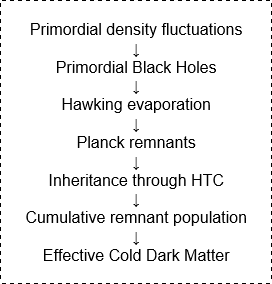
This cumulative interpretation modifies the physical origin of the effective remnant population without altering its phenomenological behavior at cosmological scales. At any given stage of cosmological evolution, the effective dark-matter sector reflects the total inherited remnant population available within the current cosmological cycle. Consequently, the observed effective cold-dark-matter density is interpreted as the macroscopic manifestation of the cumulative remnant population rather than the outcome of a single primordial production episode.
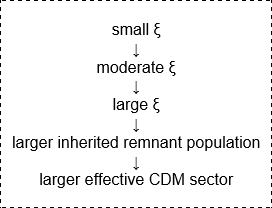
Within the present phenomenological description, the cumulative evolution of the inherited remnant population is characterized by the Effective Remnant Population Evolution Equation, \[\begin{equation} \frac{\mathop{}\!\mathrm{d}\rho_{\rm rem}}{\mathop{}\!\mathrm{d}\xi}=\Gamma_{\rm inh}-\Gamma_{\rm loss}, \label{eq:remnant_evolution} \end{equation}\] where \(\Gamma_{\rm inh}\) represents the effective inheritance rate, \(\Gamma_{\rm loss}\) denotes the effective remnant-loss rate, and \(\xi\) is the effective evolutionary state parameter introduced in Paper I. The parameter does not count individual cosmological cycles or represent a microscopic time coordinate. Instead, it summarizes the effective macroscopic evolutionary state resulting from the cumulative inheritance of effective physical degrees of freedom across successive cosmological cycles.
The inherited remnant population developed above now provides the physical interpretation of the effective cold-dark-matter sector introduced in Paper I. The following section incorporates this interpretation into the effective cosmological framework.
5 Effective Cold Dark Matter
The effective cold-dark-matter sector established in Paper I acquires its first phenomenological microscopic interpretation through the inherited Planck-remnant population developed in the preceding sections [5]. Rather than introducing an additional elementary particle species, the HRDCC framework interprets the dominant non-luminous gravitational component as the cumulative macroscopic manifestation of stable compact gravitational relics inherited across successive cosmological cycles.
Within the effective cosmological description, the detailed microscopic properties of individual remnants remain intentionally unresolved. Their internal quantum structure, stabilization mechanism, and possible microscopic interactions are not required in order to formulate the large-scale cosmological dynamics. Instead, the collective remnant population contributes through an effective energy density that enters the cosmological background equations in precisely the same phenomenological manner as any other effective cosmological component.
The distinction between microscopic interpretation and effective cosmological description is central to the HRDCC framework. Individual Planck remnants represent the proposed microscopic constituents of the inherited dark sector, whereas the effective cold-dark-matter component corresponds to the coarse-grained macroscopic description governing cosmological evolution. The effective cosmological equations therefore remain insensitive to the internal structure of individual remnants and depend only upon the cumulative properties of the inherited population.
Within the present phenomenological framework, this relation is expressed by the Effective Cold-Dark-Matter Interpretation, \[\begin{equation} \rho_{\rm edm}\equiv\rho_{\rm rem}, \label{eq:effective_cdm} \end{equation}\] where \(\rho_{\rm edm}\) is the effective cold-dark-matter energy density and \(\rho_{\rm rem}\) is the effective energy density of the inherited remnant population. Equation [eq:effective_cdm] represents a phenomenological interpretation within the present framework rather than a fundamental microscopic identity. Future developments may incorporate additional inherited microscopic sectors contributing to the effective dark-matter budget.
The normalized contribution is given by the Effective Remnant Density Parameter, \[\begin{equation} \Omega_{\rm edm}=\frac{\rho_{\rm rem}}{\rho_{\rm crit}}, \label{eq:remnant_density_parameter} \end{equation}\] where \(\rho_{\rm crit}\) denotes the critical cosmological energy density. This relation connects the inherited remnant population directly to the effective density parameter appearing in the background cosmological dynamics established in Paper I.
This distinction is particularly important because the effective cosmological framework intentionally separates phenomenology from microscopic interpretation. Observable cosmological evolution depends upon the total effective gravitational contribution rather than upon the detailed composition of the inherited microscopic sector. Consequently, the effective background dynamics remain unchanged provided that the total inherited remnant population reproduces the required cosmological energy density.
The cumulative evolution of the remnant population is summarized phenomenologically by the effective evolutionary state parameter \(\xi\). As discussed previously, \(\xi\) characterizes the macroscopic evolutionary state of the inherited cosmological background rather than the properties of individual remnants. Changes in \(\xi\) therefore describe modifications of the effective remnant population as a whole, not the evolution of isolated compact objects.
Within this interpretation, the effective cold-dark-matter component naturally participates in the modified cosmological dynamics introduced in Paper I while preserving the phenomenological behavior required for successful structure formation. The framework therefore maintains compatibility with the large-scale observational role traditionally attributed to cold dark matter while replacing its microscopic interpretation with an inherited remnant population emerging through long-term cyclic cosmological evolution.
The following section examines the observational consistency of this interpretation and discusses its relationship to existing astrophysical and cosmological constraints.
6 Observational Consistency
The phenomenological interpretation developed in the preceding sections is required to remain consistent with the extensive body of observational evidence supporting the existence of cold dark matter. Since the present work proposes a different microscopic interpretation rather than a modification of the large-scale cosmological background itself, its primary observational requirement is compatibility with the successful phenomenology already described by the standard cosmological model [1].
At cosmological scales, the inherited remnant population behaves as an effectively collisionless gravitational component. Consequently, the background expansion history and the formation of large-scale structure remain governed by the same effective cosmological equations introduced in Paper I. The observational distinction therefore does not arise from the existence of an additional cosmological component but from its proposed microscopic physical origin.
An immediate consequence of this interpretation is that existing constraints on primordial black holes do not necessarily translate directly into equivalent constraints on the inherited remnant population. Conventional primordial-black-hole scenarios generally relate the present-day dark-matter abundance to black holes formed and evolved within a single cosmological history. Within the HRDCC framework, however, the effective remnant population represents the cumulative outcome of successive mature cosmological cycles. Accordingly, the observational implications of primordial-black-hole constraints should be interpreted within this broader phenomenological context rather than transferred directly to the inherited remnant population [3, 14].
The present interpretation therefore shifts the observational problem from the production of individual remnants within a single cosmological history toward the cumulative inherited remnant population developed through long-term cyclic cosmological evolution. This distinction does not remove existing observational constraints. Rather, it modifies the physical interpretation of how those constraints relate to the effective cold-dark-matter sector.
At the phenomenological level, the inherited remnant population remains compatible with the principal observational properties required of cold dark matter. Its effective gravitational influence supports large-scale structure formation while remaining non-luminous and effectively collisionless on cosmological scales. Consequently, the present framework preserves the successful phenomenology of the standard cosmological model while proposing an alternative microscopic interpretation for one of its effective cosmological components.
Future increasingly precise cosmological surveys, gravitational-wave observations, and improved constraints on primordial black-hole populations may provide additional tests capable of distinguishing among alternative microscopic interpretations of the dark sector. Within the present work, however, such possibilities are regarded as prospective observational discriminators rather than as existing confirmations of the HRDCC framework.
The phenomenological consistency established above provides the observational context for the broader interpretation discussed in the following section.
7 Discussion
The discussion presented below places the phenomenological interpretation developed in the present work into the broader context of remnant-based dark-matter scenarios and the overall HRDCC framework. The principal contribution of the present work lies not in proposing stable Planck remnants as dark-matter candidates, but in reinterpreting their cosmological role through cumulative inheritance across successive mature cosmological cycles within the effective HRDCC framework. Conventional remnant scenarios generally relate the present-day dark-matter abundance to primordial black holes formed and evolved within a single cosmological history. The HRDCC framework instead interprets the effective cold-dark-matter sector as the macroscopic manifestation of an inherited remnant population accumulated across successive mature cosmological cycles.
Although stable Planck remnants have been investigated in several approaches to quantum gravity, most existing cosmological scenarios consider their relic abundance to originate entirely within a single cosmological history. The HRDCC framework adopts a different phenomenological perspective by interpreting the effective remnant population as the cumulative outcome of inheritance across successive mature cosmological cycles.
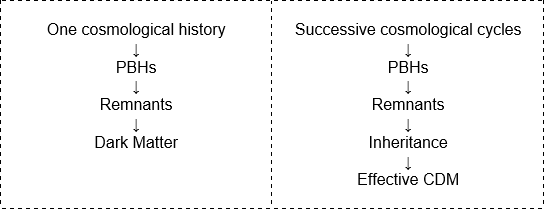
This distinction changes the abundance problem conceptually. In a single-history model, the present relic density must be produced entirely through primordial-black-hole formation and evaporation within one expansion history. In the HRDCC interpretation, the effective abundance may instead encode a cumulative inherited state. This does not eliminate the need for viable production, survival, and loss mechanisms, but it changes the cosmological boundary conditions under which those mechanisms are assessed.
The present work intentionally preserves the effective cosmological framework established in Paper I. Neither the effective cosmological dynamics nor the phenomenological role of the effective cold-dark-matter sector is modified. Instead, Paper II provides its first phenomenological microscopic interpretation while maintaining compatibility with the effective cosmological description introduced previously.
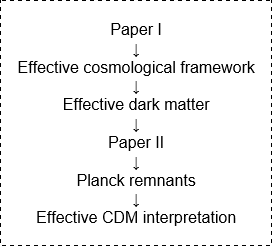
The role of the effective evolutionary state parameter \(\xi\) is central to this separation. It provides a macroscopic parameterization of the inherited state without being identified with coordinate time, proper time, or a discrete cycle counter. Consequently, the framework can describe changes in the cumulative remnant sector without assuming identical histories, equal cycle durations, or monotonic microscopic evolution across successive cosmological cycles.
The present framework remains intentionally phenomenological. It does not determine the internal quantum structure of individual remnants, derive the stabilization mechanism, or specify the microscopic dynamics of inheritance through the HTC. The equations introduced here instead provide the minimal effective relations required to connect the inherited remnant population to the effective cold-dark-matter sector.
The phenomenological interpretation developed in the present work should therefore be regarded as a physically motivated extension of the effective cosmological framework established in Paper I rather than as a replacement of its effective cosmological description.
8 Limitations
The present work intentionally remains within the phenomenological scope established for Paper II of the HRDCC publication program. Its objective is to develop a physically motivated microscopic interpretation of the effective cold-dark-matter sector introduced in Paper I rather than to construct a complete microscopic theory of Planck remnants or quantum-gravitational black-hole evolution.
Accordingly, the existence of stable Planck remnants is introduced as a phenomenological assumption. The present work does not derive the microscopic mechanism responsible for remnant stabilization, nor does it identify the underlying quantum-gravitational theory from which such stability may emerge. Different approaches to quantum gravity may provide distinct microscopic realizations while remaining compatible with the phenomenological framework developed here.
Similarly, the Holographic Transition Core is treated exclusively as the regularized geometrical interface responsible for maintaining physical continuity across successive mature cosmological cycles. The microscopic physical processes governing inheritance through the HTC are intentionally left unspecified and therefore do not constitute part of the present investigation.
The cumulative inherited remnant population is formulated at the level of effective cosmological phenomenology. The present work does not derive its abundance from first principles, nor does it calculate the primordial black-hole mass spectrum, remnant production efficiency, or the detailed evolution of individual remnants. These problems require dedicated microscopic modelling beyond the scope of the present paper.
Likewise, the observational discussion remains qualitative. The framework is required to remain compatible with current cosmological observations, but no quantitative parameter estimation, numerical cosmological evolution, or statistical comparison with observational datasets is attempted here. Such analyses require dedicated numerical implementations and will be addressed separately.
The phenomenological interpretation developed here therefore represents one component of the broader HRDCC publication program. Its principal objective is to establish a physically consistent interpretation of the effective cold-dark-matter sector while providing a foundation for subsequent investigations of remnant microphysics, black-hole interior dynamics, inherited neutrino sectors, primordial perturbations, and quantitative observational constraints.
The present work intentionally does not derive the microscopic mechanism responsible for remnant inheritance through the Holographic Transition Core. This question is reserved for dedicated later studies addressing black-hole interior dynamics and the microscopic realization of the transition region.
9 Conclusion
The present work developed a phenomenological microscopic interpretation of the effective cold-dark-matter sector established in Paper I. Beginning with primordial-black-hole formation and Hawking evaporation, we formulated the effective remnant population and connected its cumulative inherited abundance to the large-scale cosmological component required of cold dark matter.
Rather than interpreting the present dark-matter abundance as the outcome of a single cosmological history, the HRDCC framework interprets the effective cold-dark-matter sector as the cumulative macroscopic manifestation of an inherited remnant population evolving across successive mature cosmological cycles. The regularized Holographic Transition Core provides the geometrical interface through which the persistence of effective physical degrees of freedom is assumed, while the effective evolutionary state parameter \(\xi\) characterizes the resulting macroscopic inherited state without functioning as a time coordinate or cycle counter.
The principal mathematical relations introduced in this paper provide a deliberately minimal phenomenological description: the effective remnant density, its evolution with \(\xi\), its interpretation as the effective cold-dark-matter energy density, and its normalized cosmological contribution. The effective cosmological framework itself remains unchanged; Paper II extends its physical interpretation rather than redefining its dynamics.
Within the broader HRDCC publication program, the present work establishes the physical interpretation of one effective cosmological component while preserving the phenomenological consistency of the effective framework. Subsequent studies will extend this program by investigating the remaining inherited sectors, their microscopic realization, and their quantitative observational consequences.
The HRDCC framework therefore provides a phenomenological foundation upon which progressively more detailed microscopic and observational investigations may be constructed.
10 Summary of Symbols
Table summarizes the principal symbols used in the present work. Only quantities appearing explicitly in the manuscript are included.
| Symbol | Meaning | Primary role in the present work |
|---|---|---|
| \(a\) | Cosmological scale factor | Background cosmological evolution |
| \(H=\dot{a}/a\) | Hubble parameter | Effective expansion rate |
| \(M_{\rm PBH}\) | Primordial black-hole mass | Macroscopic progenitor mass |
| \(M_H(t_{\rm form})\) | Horizon mass at the formation epoch | Characteristic PBH formation scale |
| \(t_{\rm form}\) | Primordial black-hole formation time | Cosmological coordinate time at formation |
| \(m_{\rm rem}\) | Effective mass of an individual inherited Planck remnant | Microscopic constituent mass |
| \(n_{\rm rem}\) | Effective remnant number density | Coarse-grained remnant abundance |
| \(\rho_{\rm rem}\) | Effective energy density of the inherited remnant population | Macroscopic remnant contribution |
| \(\rho_{\rm edm}\) | Effective cold-dark-matter energy density | Phenomenological cosmological component |
| \(\rho_{\rm crit}\) | Critical cosmological energy density | Normalization of density parameters |
| \(\Omega_{\rm edm}\) | Effective cold-dark-matter density parameter | Normalized remnant contribution |
| \(\xi\) | Effective evolutionary state parameter | Macroscopic inherited state of a mature cycle |
| \(\Gamma_{\rm inh}\) | Effective inheritance rate | Contribution to the inherited remnant population |
| \(\Gamma_{\rm loss}\) | Effective remnant-loss rate | Reduction of the inherited remnant population |
| \(c\) | Speed of light | Conversion between mass and energy |
11 Bibliography