Main links
Main
HRDCC framework details
- HRDCC landing page
- The HRDCC Publication Program
-
Paper pages
- Paper I. - Holographic Rotation-Driven Cyclic Cosmology (HRDCC): A Unified Dynamical Framework for Cyclic Cosmology
- Paper II. - Planck Remnants and the Origin of Cold Dark Matter within the HRDCC Framework
- Paper III. - Inherited Cosmic Neutrino Background within the HRDCC Framework
- Paper IV. - Black Hole Interior Dynamics and Horizon Mechanics within the HRDCC Framework
- Paper V. - Primordial Perturbations, Chladni Resonances and Non-Gaussianity within the HRDCC Framework
- Paper VI. - Observational Tests of the HRDCC Framework: Effective Cosmological Signatures from CMB to Next-Generation Surveys
- « Paper VII. - Rotational Dynamics and Phase Reversal within the HRDCC Framework »
- Paper VIII. - Microscopic Foundations of the HRDCC Framework
- Paper IX. - Effective Particle Physics across Successive Cosmological Cycles within the HRDCC Framework
Research & Profiles
Paper VII. - Rotational Dynamics and Phase Reversal within the HRDCC Framework


Abstract
The Holographic Rotation-Driven Cyclic Cosmology (HRDCC) framework interprets cosmological evolution as the cumulative consequence of effective physical processes inherited across successive cosmological cycles. Earlier papers of the HRDCC publication program established the effective cosmological framework, developed phenomenological interpretations of its principal physical sectors, and examined their potential observational signatures. However, one essential phenomenological component has remained only qualitatively described: the effective dynamical connection between the rotational properties of the parent black hole and the large-scale evolution of the embedded cosmological spacetime.
The present work develops this missing macroscopic dynamical layer. Within the phenomenological HRDCC framework, the conserved parent-black-hole parameters are assigned distinct physical roles, with particular emphasis on the rotational degree of freedom as the macroscopic energy reservoir governing long-term cosmological evolution. An effective sequence is proposed in which the inherited rotational energy is represented through an effective rotational coupling, contributes to the effective cosmological background, and gradually modifies the conditions supporting cosmic expansion. As the available rotational support evolves, the framework naturally admits a transition from expansion to contraction through an effective phase-reversal criterion, providing a phenomenological interpretation of the transition toward the Crounches phase without invoking additional microscopic assumptions.
The resulting description closes an important conceptual gap within the HRDCC publication program by connecting previously introduced effective cosmological components into a coherent macroscopic dynamical framework. The analysis remains intentionally phenomenological: no microscopic quantum-gravitational derivation is assumed, and the proposed relations are interpreted as effective descriptions whose detailed physical origin is deferred to future microscopic investigations. Within these limitations, the framework offers a consistent rotation-driven phenomenological interpretation of cosmological phase evolution while preserving compatibility with the broader effective architecture developed throughout the HRDCC publication program.
1 Introduction
The Holographic Rotation-Driven Cyclic Cosmology (HRDCC) publication program develops the framework through a sequence of self-contained studies that progressively extend its phenomenological description. The initial paper established the effective cosmological framework and introduced its principal effective components without assigning unique microscopic origins. Subsequent studies examined the effective dark- matter sector through inherited Planck remnants, the inherited neutrino sector, black-hole interior dynamics and horizon mechanics, primordial perturbations generated by Chladni resonances, and the observational consequences of the framework across multiple cosmological probes. Together, these investigations provide a coherent phenomenological architecture in which individual physical sectors can be interpreted consistently while remaining compatible with the overall effective description. [1–6]
Despite this development, one important element has intentionally remained only qualitatively formulated. The HRDCC framework has consistently identified inherited rotation as a fundamental ingredient of the cosmological evolution, introducing concepts such as the rotational energy reservoir, the effective flywheel mechanism, the effective rotational coupling parameter, and the effective cosmological background. However, the macroscopic dynamical relations connecting these elements have not previously been presented as a unified phenomenological description. Consequently, although the framework has been described as rotation-driven from its inception, the effective dynamical chain linking the parent black-hole parameters to the large-scale cosmological evolution has remained implicit throughout the previous publications.
The objective of the present work is to develop this missing macroscopic dynamical layer. Rather than introducing additional cosmological components or modifying the phenomenological framework established previously, the paper examines how the conserved parameters of the parent black hole may be interpreted at the effective cosmological level. Particular attention is devoted to the rotational degree of freedom, which is interpreted as the macroscopic energy reservoir governing the long-term evolution of the effective cosmological background. Within this phenomenological interpretation, the effective rotational coupling provides the dynamical connection between the inherited rotational sector and the large-scale expansion history, ultimately allowing an effective description of the transition from cosmological expansion toward contraction.
The scope of the present work is intentionally restricted to the phenomenological level. No microscopic transfer operators, quantum-gravitational action principle, Hamiltonian formulation, or detailed Holographic Transition Core (HTC) microphysics are introduced. Likewise, no attempt is made to derive the effective rotational dynamics directly from a fundamental theory of quantum gravity. Instead, the proposed relations should be understood as effective macroscopic descriptions whose microscopic origin remains the subject of subsequent investigations. This separation between phenomenological dynamics and microscopic interpretation follows the methodological principles adopted throughout the HRDCC publication program and preserves the distinction between effective cosmological quantities and their possible physical realization.
The remainder of this paper is organized as follows. Section 2 establishes the effective interpretation of the parent black-hole parameters and their cosmological roles. Section 3 develops the effective rotational dynamics governing the macroscopic evolution of the framework. Section 4 introduces the effective description of rotation-driven phase reversal, while Section 5 examines the long-term evolution of the rotational sector across successive cosmological cycles. Sections 6 and 7 discuss the physical interpretation of the proposed framework and its relation to previously established observational signatures. The paper concludes with a discussion of its limitations and its position within the broader HRDCC publication program.
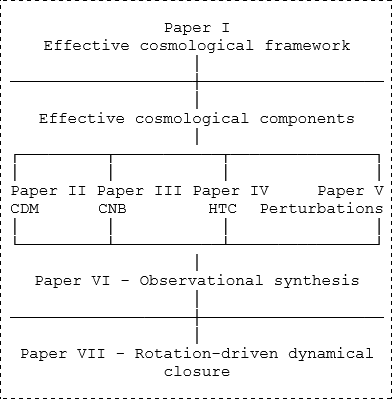
2 Parent Black-Hole Parameters and Effective Cosmological Degrees of Freedom
2.1 Physical Roles of the Parent Black-Hole Parameters
The HRDCC framework assumes that each mature cosmological cycle emerges within the interior spacetime of a parent rotating black hole. Earlier papers introduced the parent Kerr-Newman geometry as the physical origin of the effective cosmological framework, while intentionally postponing a detailed discussion of how its conserved parameters contribute to the large-scale cosmological evolution. The present work addresses this remaining phenomenological question by clarifying the distinct macroscopic roles of the parent black-hole parameters without introducing additional microscopic assumptions.
Within the classical Kerr-Newman solution [7, 8], the global spacetime is characterized by three conserved quantities: the gravitational mass \(M\), the angular momentum \(J\), and the electric charge \(Q\). Although these parameters jointly determine the parent spacetime geometry, their cosmological interpretations within the HRDCC framework are fundamentally different and should not be regarded as equivalent dynamical variables.
The gravitational mass \(M\) defines the overall energetic scale available to the parent system. Within the effective phenomenological description adopted here, it establishes the macroscopic energy budget from which successive cosmological cycles emerge. It therefore provides the global energetic normalization of the effective cosmological framework rather than acting as a direct driver of the subsequent cosmological evolution.
The angular momentum \(J\) plays a fundamentally different role. Instead of being interpreted merely as a conserved astrophysical quantity, it represents the physical origin of the inherited rotational energy reservoir introduced previously in the HRDCC publication program. The present work interprets this rotational reservoir as the principal macroscopic resource governing the long-term evolution of the effective cosmological background. Rather than contributing directly to the cosmological expansion, the inherited rotational sector modifies the effective background dynamics through an effective rotational coupling developed in the following sections.
The electric charge \(Q\) occupies a more restricted position within the phenomenological framework. Although it forms an essential part of the parent Kerr-Newman geometry, its primary significance is associated with the effective transition geometry characterizing the parent spacetime rather than with the long-term evolution of mature cosmological cycles. Consequently, the present work does not treat the electric charge as an independent macroscopic evolutionary variable but as part of the geometrical boundary conditions inherited by the effective cosmological description.
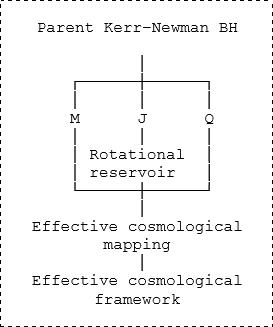
This separation of physical roles provides an important conceptual distinction within the HRDCC framework. The parent black-hole parameters are not interpreted as independent cosmological degrees of freedom acting on equal footing. Instead, they define complementary aspects of the effective framework: the overall energetic scale through \(M\), the long-term rotational dynamics through \(J\), and the effective geometrical transition conditions through \(Q\). This phenomenological interpretation establishes the foundation for the effective cosmological mapping developed in the following subsection.
2.2 Effective Cosmological Mapping
The phenomenological interpretation established above naturally leads to an effective mapping between the conserved properties of the parent black hole and the large-scale cosmological degrees of freedom employed throughout the HRDCC framework. This mapping should not be understood as a microscopic transformation between Kerr-Newman variables and cosmological observables. Instead, it provides an effective macroscopic correspondence that connects the inherited physical state of the parent system with the subsequent evolution of the cosmological background.
Within this interpretation, the three conserved parent parameters contribute to the effective cosmological description through distinct physical pathways. The total gravitational mass determines the overall energetic scale inherited by the newly emerging cosmological cycle. The electric charge contributes to the effective transition geometry associated with the Holographic Transition Core and therefore defines part of the inherited geometrical boundary conditions. In contrast, the angular momentum provides the physical origin of the inherited rotational sector that subsequently governs the dynamical evolution of the effective cosmological background.
This distinction is particularly important because the HRDCC framework does not identify the conserved angular momentum itself as the direct cosmological driver. Rather, the inherited rotational state is represented phenomenologically through effective macroscopic quantities that characterize the cumulative influence of rotation on cosmological evolution. The conserved quantity \(J\) therefore serves as the physical origin of the effective rotational sector, while the cosmological dynamics are described by effective parameters introduced at the phenomenological level.
Accordingly, the effective cosmological evolution is interpreted as a hierarchical process. The parent Kerr-Newman configuration establishes the initial physical conditions inherited across the cosmological transition. These inherited properties determine the effective rotational sector, which subsequently modifies the effective cosmological background through the rotational coupling developed in the following section. In this picture, the large-scale expansion history is governed by effective macroscopic dynamics rather than by the direct evolution of the conserved Kerr-Newman parameters themselves.
This hierarchical interpretation also preserves the conceptual separation between astrophysical and cosmological descriptions. The parent black hole remains an astrophysical object characterized by the conserved quantities \((M,J,Q)\), whereas the emerging universe is described by effective cosmological variables appropriate for large-scale dynamics. The phenomenological mapping therefore serves as an intermediate interpretative layer linking these two physical descriptions without requiring a direct microscopic derivation.
The effective mapping introduced here forms the conceptual basis for the rotational dynamics developed in the next section. In particular, it motivates the introduction of an effective rotational coupling that encapsulates the macroscopic influence of the inherited rotational sector on the evolution of the cosmological background while remaining independent of the detailed microscopic processes operating within the Holographic Transition Core.
2.3 Effective versus Microscopic Description
The effective cosmological mapping introduced in the preceding subsections should be interpreted strictly within the phenomenological philosophy adopted throughout the HRDCC publication program. Its purpose is not to establish a microscopic derivation linking the Kerr-Newman solution to cosmological evolution, but rather to provide a consistent macroscopic framework in which inherited physical properties can be related to effective cosmological degrees of freedom.
Accordingly, the proposed mapping does not imply that the conserved parent parameters evolve directly into cosmological observables. Instead, the mapping represents an effective interpretative layer connecting two distinct physical descriptions. On one side lies the parent black hole characterized by the conserved quantities \((M,J,Q)\), while on the other lies the emergent cosmological background described by effective phenomenological variables appropriate for large-scale evolution. The correspondence established here therefore operates at the level of effective dynamics rather than at the level of fundamental microscopic physics.
This distinction is particularly important for the rotational sector. Throughout the present work, the inherited angular momentum is regarded as the physical origin of an effective rotational background, but no attempt is made to derive the associated coupling parameters from first principles. The effective rotational quantities introduced in the following sections should therefore be understood as phenomenological descriptors of the large-scale cosmological dynamics rather than as fundamental dynamical fields.
Consequently, the present paper does not introduce a quantum-gravitational action, Hamiltonian formulation, transfer operator, or microscopic description of the Holographic Transition Core. Likewise, no field equations governing the internal evolution of the parent black hole are proposed. These questions remain beyond the scope of the present study and constitute natural directions for future microscopic investigations aimed at developing a foundation of the HRDCC framework.
Within these intentionally defined limits, the effective mapping developed in this section provides the conceptual bridge required for the phenomenological treatment of rotation-driven cosmological evolution presented in the remainder of this paper.
3 Effective Rotational Dynamics
3.1 The Rotational Energy Reservoir
The effective cosmological mapping established in the previous section identifies the inherited rotational sector as the principal dynamical component governing the long-term evolution of the HRDCC framework. Unlike the total gravitational mass, which primarily defines the global energetic scale of the cosmological system, the inherited rotational state provides a persistent reservoir capable of influencing the effective cosmological background throughout successive stages of cosmic evolution.
Within the phenomenological interpretation adopted here, this rotational reservoir should not be regarded as a localized source of mechanical energy. Instead, it represents the cumulative macroscopic influence of the angular momentum inherited from the parent Kerr-Newman black hole. The rotational energy is therefore interpreted as a global background property whose influence is distributed throughout the effective cosmological description rather than concentrated within a specific physical region.
An important consequence of this interpretation is that the rotational reservoir is not consumed through individual astrophysical processes. Rather, its effective contribution to the cosmological dynamics evolves continuously as the global rotational state of the inherited background changes. The reservoir therefore serves as a long-term dynamical resource whose macroscopic influence gradually modifies the effective expansion history.
This phenomenological picture naturally motivates the introduction of an effective rotational coupling capable of describing how the inherited rotational background contributes to the large-scale cosmological evolution. The purpose of such a coupling is not to quantify the microscopic angular momentum itself but to characterize its effective cosmological influence within the HRDCC framework.
3.2 Effective Flywheel Mechanism
A central concept introduced throughout the HRDCC framework is the effective flywheel mechanism, which provides an intuitive phenomenological interpretation of how inherited rotation influences cosmological evolution over extremely long timescales. The terminology does not imply the existence of a rigid mechanical structure within the parent black hole or the Holographic Transition Core. Instead, the flywheel analogy represents the persistence of rotational support inherited from the parent Kerr-Newman spacetime and its gradual influence on the effective cosmological background.
Within this interpretation, the inherited rotational energy is not released impulsively during the formation of a new cosmological cycle. Rather, it contributes continuously to the effective dynamics as a long-lived macroscopic background component. The flywheel analogy therefore emphasizes the sustained generation of effective rotational support rather than transient energy transfer processes. Within the HRDCC framework, the inherited rotational reservoir continuously maintains this macroscopic rotational support, which subsequently modifies the effective cosmological background throughout the evolution of a cosmological cycle. The effective rotational support thus represents the physical intermediary between the inherited rotational reservoir and the phenomenological coupling introduced in the following subsection.
An important feature of the effective flywheel mechanism is the separation between conserved angular momentum and effective cosmological influence. Although the parent black hole is characterized by a well-defined angular momentum, the expanding universe is described by effective quantities that summarize the cumulative dynamical consequences of the inherited rotational state. Consequently, the flywheel mechanism should be regarded as an emergent macroscopic description rather than a direct manifestation of the conserved Kerr-Newman parameter itself.
The effective flywheel interpretation also provides a natural explanation for why the influence of inherited rotation evolves gradually instead of remaining constant throughout cosmic history. As the effective cosmological background changes, the dynamical contribution of the rotational sector changes accordingly, leading to a continuous evolution of the effective rotational support. This evolution does not require a violation of angular momentum conservation within the parent spacetime; instead, it reflects the changing macroscopic influence of the inherited rotational background on the effective cosmological dynamics.
Within the HRDCC framework, the effective flywheel mechanism therefore serves as the phenomenological bridge between the inherited rotational reservoir and the effective rotational coupling introduced in the following subsection. It is this coupling, rather than the conserved angular momentum itself, that governs the macroscopic evolution of the cosmological background.
3.3 Effective Rotational Coupling
The effective flywheel mechanism developed above establishes how the inherited rotational reservoir continuously maintains an effective rotational support throughout the cosmological evolution. The remaining task is to describe phenomenologically how this macroscopic rotational support influences the effective cosmological background. Within the HRDCC framework, this role is fulfilled by the effective rotational coupling parameter, denoted by \(\beta\).
The parameter \(\beta\) should not be interpreted as the angular momentum of the parent Kerr-Newman black hole, nor as a direct measure of rotational velocity or spin. Instead, it represents an effective macroscopic quantity that characterizes the dynamical influence of the inherited rotational support on the large-scale cosmological evolution. In this sense, \(\beta\) summarizes the cumulative cosmological consequences of the inherited rotational sector rather than the microscopic rotational state itself.
Since the present work is restricted to an effective phenomenological description, no microscopic derivation of \(\beta\) is proposed. Instead, the coupling is regarded as an emergent quantity whose value reflects the global rotational state of the effective cosmological background. Its evolution therefore follows the phenomenological evolution parameter \(\xi\) introduced throughout the HRDCC framework, leading to the effective relation \[\begin{equation} \beta=\beta(\xi), \label{eq:beta} \end{equation}\] where \(\xi\) denotes the effective evolutionary state of the cosmological cycle rather than physical time or the conserved angular momentum itself.
Equation [eq:beta] should therefore be interpreted as a phenomenological constitutive relation describing the evolution of effective rotational support during successive stages of cosmological evolution. It does not specify the microscopic origin of the coupling, nor does it imply a unique functional form for \(\beta(\xi)\).
Different microscopic realizations may produce the same effective macroscopic behaviour, provided that they generate an equivalent evolution of the rotational support.
Within this interpretation, \(\beta\) constitutes the primary dynamical quantity linking the inherited rotational sector to the effective cosmological background developed in the following subsection. Consequently, the subsequent evolution of the effective cosmological dynamics is governed not directly by the conserved angular momentum \(J\), but by the evolving phenomenological influence of the effective rotational support represented through the coupling parameter \(\beta\).
3.4 Coupling to the Effective Cosmological Background
The effective rotational coupling introduced above provides the phenomenological link between the inherited rotational sector and the large-scale cosmological evolution. Within the HRDCC framework, the effective rotational support does not influence individual astrophysical systems directly. Instead, its cumulative macroscopic contribution modifies the effective cosmological background that governs the global expansion history of the universe.
This interpretation extends the effective framework established in Paper I by identifying the rotational sector as one of the principal contributors to the evolution of the effective cosmological background. Rather than introducing an additional fundamental interaction, the present work interprets the rotational contribution as a phenomenological correction that evolves together with the global state of the cosmological cycle.
Accordingly, the effective cosmological background is described by an effective cosmological quantity, \[\begin{equation} \Lambda_{\rm eff}=\Lambda_{\rm eff}(\beta,\xi), \label{eq:lambdaeff} \end{equation}\] where \(\beta\) characterizes the effective rotational support introduced in the previous subsection and \(\xi\) denotes the effective evolutionary state of the cosmological cycle. Equation [eq:lambdaeff] should be understood as a constitutive phenomenological relation rather than a fundamental field equation. Its purpose is to express that the effective cosmological background depends on both the inherited rotational state and the macroscopic evolutionary stage of the universe.
An important consequence of this formulation is that the effective cosmological background is no longer interpreted as a fixed quantity throughout the entire cosmological evolution. Instead, it evolves continuously as the effective rotational support changes during successive stages of the cosmological cycle. The resulting evolution remains entirely phenomenological and does not require a microscopic description of the processes operating within the Holographic Transition Core.
Within this framework, the gradual evolution of the effective rotational support naturally induces a corresponding evolution of the effective cosmological background. The expansion history is therefore governed by a continuously evolving macroscopic state rather than by a strictly constant cosmological term. This evolving background provides the phenomenological foundation for the rotation-driven phase reversal developed in the next section.
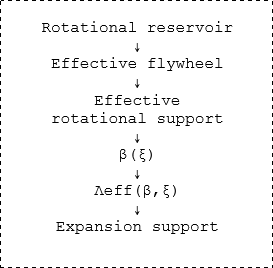
Together, Eqs. [eq:beta]) and eq:lambdaeff] establish the phenomenological dynamical chain developed in this work. The inherited rotational state is represented by the effective rotational coupling, whose evolution determines the corresponding evolution of the effective cosmological background. This macroscopic framework provides the basis for the rotation-driven phase reversal discussed in the following section.
4 Rotation-Driven Phase Reversal
4.1 Rotational Support of Cosmological Expansion
The effective dynamical framework developed in the previous section provides a phenomenological interpretation of how inherited rotation influences the large-scale evolution of the universe. Rather than acting as a direct mechanical driver of expansion, the inherited rotational sector continuously maintains the effective cosmological background through the effective rotational support represented by the coupling parameter \(\beta\). Within the HRDCC framework, the persistence of cosmological expansion is therefore interpreted as a consequence of sustained rotational support rather than as the manifestation of a strictly constant cosmological component.
This interpretation differs conceptually from models in which cosmic acceleration is attributed exclusively to a constant vacuum-energy density. In the HRDCC phenomenological description, the effective cosmological background evolves together with the inherited rotational state. Consequently, the expansion history reflects the evolving macroscopic influence of the rotational sector instead of remaining governed by an immutable background parameter.
The effective rotational support should not be understood as an additional force acting on cosmological matter. Instead, it represents a global property of the effective cosmological background that determines the extent to which inherited rotation contributes to the maintenance of large-scale expansion. As long as this rotational support remains sufficiently strong, the effective cosmological background continues to sustain the expanding phase of the cosmological cycle.
Within this picture, the expansion of the universe is interpreted as a dynamically maintained state rather than a permanently self-sustaining one. The inherited rotational sector continuously provides the macroscopic support required to preserve the effective background conditions established during the emergence of the cosmological cycle. Consequently, the persistence of expansion depends on the long-term evolution of the effective rotational support introduced in the previous section.
4.2 Evolution and Progressive Decline of Effective Rotational Support
The effective rotational support introduced in the previous subsection should not be regarded as a static property of the cosmological background. Instead, it evolves continuously throughout the lifetime of a cosmological cycle as the effective background itself undergoes long-term dynamical evolution. Within the HRDCC framework, this evolution reflects changes in the macroscopic influence of the inherited rotational sector rather than any violation of the conservation laws governing the parent Kerr-Newman spacetime.
An essential distinction must therefore be made between the conserved angular momentum of the parent black hole and the effective rotational support acting at the cosmological level. While the conserved quantity \(J\) characterizes the physical state of the parent spacetime, the effective rotational support describes how strongly the inherited rotational sector contributes to maintaining the large-scale cosmological background. The gradual evolution discussed here refers exclusively to this phenomenological macroscopic quantity.
As the cosmological cycle progresses, the effective rotational support is assumed to evolve continuously through its dependence on the phenomenological evolutionary parameter \(\xi\). Consequently, the effective rotational coupling introduced in the previous section also evolves, leading to a gradual modification of the effective cosmological background. No specific functional form is assumed for this evolution, since the present work is intentionally restricted to a phenomenological description independent of any particular microscopic realization. For the late-cycle branch studied in the present work, the progressive weakening of effective rotational support is adopted as a defining phenomenological assumption; it is not derived from the state dependence \(\beta=\beta(\xi)\) alone.
A natural consequence of this framework is that the inherited rotational sector does not provide an indefinitely constant contribution to the cosmological dynamics. Instead, its effective macroscopic influence progressively weakens relative to the evolving background. The expansion history therefore remains dynamically sustained only while the effective rotational support exceeds the level required to maintain the existing cosmological regime.
This gradual decline should not be interpreted as an abrupt transition or catastrophic loss of rotational energy. Rather, it represents a continuous phenomenological evolution of the effective cosmological state. As the rotational support approaches a critical regime, the stability of the expansion phase progressively decreases, naturally preparing the conditions for the subsequent phase reversal discussed in the following subsection.
4.3 Effective Phase-Reversal Criterion
The progressive evolution of the effective rotational support naturally implies that the expansion phase cannot be maintained indefinitely. Within the phenomenological framework developed in this work, the transition between expansion and contraction is therefore interpreted as the consequence of a gradual change in the macroscopic dynamical state rather than as the result of a singular physical event.
Since the present description remains intentionally independent of a specific microscopic realization, no unique critical value of the effective rotational coupling is derived. Instead, the HRDCC framework assumes that the cosmological evolution approaches an effective critical regime in which the inherited rotational support becomes insufficient to maintain the previously established expansion history. The onset of phase reversal is therefore determined phenomenologically rather than by a fundamental field equation.
This behaviour may be expressed through the effective criterion \[\begin{equation} \beta(\xi)\approx\beta_{\rm crit}, \label{eq:betacrit} \end{equation}\] where \(\beta_{\rm crit}\) denotes an effective critical rotational-support threshold associated with the transition between expansion and contraction. The quantity \(\beta_{\rm crit}\) should not be interpreted as a universal physical constant. Rather, it represents a phenomenological boundary separating two distinct macroscopic evolutionary regimes within the HRDCC framework.
Because both the effective rotational coupling and the effective cosmological background evolve continuously, the approach to the critical regime is likewise continuous. The phase reversal therefore emerges naturally from the long-term evolution of the effective cosmological state without requiring discontinuities, singular transitions, or externally imposed triggering mechanisms.
Within this phenomenological interpretation, the effective phase-reversal criterion provides the missing dynamical connection between the inherited rotational sector and the cyclic behaviour proposed throughout the HRDCC publication program. It identifies the gradual loss of effective rotational support as the macroscopic condition under which the expanding cosmological phase can no longer be sustained, thereby preparing the transition to the subsequent contraction phase.
4.4 Rotation-Driven Phase Reversal
Once the effective rotational support approaches the critical regime described in the previous subsection, the global cosmological evolution enters a qualitatively different dynamical state. Within the HRDCC framework, this transition is interpreted as a natural consequence of the long-term evolution of the effective cosmological background rather than as the result of an external trigger or a catastrophic instability.
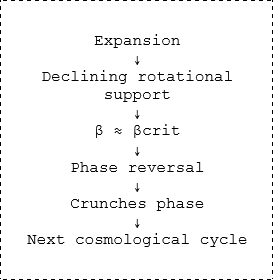
The onset of phase reversal does not imply an abrupt interruption of the cosmological evolution. Instead, the expanding phase gradually loses its dynamical stability as the effective rotational support becomes insufficient to sustain the previously established background conditions. The subsequent contraction phase therefore emerges continuously from the evolution of the effective cosmological state itself, preserving the phenomenological continuity of the cyclic framework.
This transition defines what is referred to throughout the HRDCC framework as the Crounches phase. The Crounches phase denotes the effective cosmological regime in which the inherited rotational support has evolved to the vicinity of its critical state, allowing the expanding cosmological background to transition naturally toward global contraction. It should therefore be understood as a macroscopic dynamical regime rather than as a singular physical event or a microscopic transition occurring within the Holographic Transition Core.
An important consequence of this interpretation is that the cyclic behaviour of the HRDCC framework follows directly from the evolution of the effective rotational sector. No additional cosmological fields, external collapse mechanisms, or discontinuous dynamical assumptions are required to initiate the transition. The gradual evolution of the effective rotational support provides the phenomenological mechanism through which one cosmological cycle naturally approaches its termination and prepares the conditions for the emergence of the next.
Within this picture, the complete phenomenological dynamical chain developed in the present work may be summarized as \[\begin{align} (M,J,Q) \longrightarrow \text{rotational reservoir}\nonumber \\ \longrightarrow \text{effective rotational support} \longrightarrow \beta(\xi) \longrightarrow \Lambda_{\rm eff}(\beta,\xi)\nonumber \\ \longrightarrow \text{phase reversal} \longrightarrow \text{next cosmological cycle}. \label{eq:dynamical-chain} \end{align}\] This chain represents the principal conceptual contribution of Paper VII. It establishes the previously missing macroscopic dynamical connection between the conserved properties of the parent Kerr-Newman black hole and the cyclic cosmological evolution described throughout the HRDCC publication program, while deliberately remaining independent of any particular microscopic realization.
5 Long-Term Rotational Evolution
5.1 Evolution Across Successive Cosmological Cycles
The phenomenological framework developed in the preceding sections describes the evolution of the effective rotational sector during a single cosmological cycle. The cyclic nature of the HRDCC framework, however, requires that this description be extended beyond an individual expansion-contraction sequence to encompass the long-term evolution of successive cosmological cycles. Within this broader context, inherited rotation represents a persistent cosmological property that is transferred from one cycle to the next through the effective transition process.
An important consequence of this interpretation is that the rotational reservoir should not be regarded as a quantity generated independently within each cosmological cycle. Instead, every emerging universe inherits an effective rotational state originating from its parent Kerr-Newman spacetime. The inherited rotational sector therefore provides the initial macroscopic conditions from which the effective rotational support, the phenomenological coupling parameter \(\beta\), and the corresponding effective cosmological background subsequently evolve.
Although each cosmological cycle follows the same phenomenological principles described in the previous sections, the inherited initial conditions need not be identical. Variations in the physical properties of the parent system may lead to different effective rotational states at the beginning of successive cycles. Consequently, the HRDCC framework does not require exact periodicity or complete dynamical repetition. Instead, it predicts a sequence of cosmological cycles connected by inheritance while allowing quantitative differences between individual evolutionary histories.
This interpretation naturally extends the concept of cosmological inheritance developed throughout the HRDCC publication program. Just as inherited Planck remnants and inherited relic neutrinos preserve physical information across cosmological transitions, the inherited rotational sector provides continuity for the large-scale dynamical evolution itself. The cyclic behaviour of the framework is therefore maintained not through exact repetition of identical universes but through the continuous inheritance of effective macroscopic physical properties.
The succession of cosmological cycles should therefore be interpreted as an evolutionary process rather than as a perfectly periodic oscillation. Each cycle inherits the effective rotational background established by its predecessor, evolves according to the same phenomenological dynamical principles, gradually approaches the critical rotational-support regime, undergoes phase reversal, and ultimately establishes the initial conditions for the following cosmological cycle. In this manner, the HRDCC framework describes a self- consistent sequence of dynamically connected universes without requiring identical initial conditions for every cycle.
5.2 The Evolutionary Interpretation of \(\xi\)
The phenomenological evolution developed throughout the HRDCC publication program is described using the dimensionless parameter \(\xi\). Although this quantity has appeared in previous papers as the principal evolutionary variable, its physical interpretation has intentionally remained general in order to avoid associating it with any specific microscopic realization. The present work clarifies its role within the context of rotation-driven cosmological dynamics.
The parameter \(\xi\) should not be interpreted as physical time, proper time, cosmic age, or the ordinal number of a cosmological cycle. Instead, it represents an effective evolutionary state variable that parametrizes the macroscopic dynamical state of the cosmological background. Its purpose is to describe the progression of the effective cosmological evolution independently of the underlying microscopic processes.
Within the HRDCC framework, all effective macroscopic quantities evolve through their dependence on \(\xi\). The effective rotational support, the phenomenological coupling parameter \(\beta\), and the effective cosmological background are therefore understood as evolutionary quantities whose behaviour is determined by the current macroscopic state of the cosmological cycle rather than by an externally imposed temporal coordinate.
This interpretation provides an important conceptual advantage. Because \(\xi\) characterizes the effective evolutionary state instead of physical time, the same phenomenological formalism remains applicable throughout successive cosmological cycles despite differences in their inherited initial conditions. Consequently, the HRDCC framework naturally accommodates an evolutionary cyclic cosmology in which individual cycles follow common dynamical principles without requiring identical histories.
The evolutionary interpretation of \(\xi\) therefore provides the common phenomenological language connecting all effective sectors of the HRDCC framework. Rather than describing when a cosmological system evolves, \(\xi\) describes where that system resides within its macroscopic evolutionary trajectory. This distinction becomes particularly important for the rotation-driven dynamics developed in the present work, where the evolution of the effective rotational support and the approach to the critical phase-reversal regime are both naturally expressed as functions of the evolutionary state variable \(\xi\).
5.3 Long-Term Evolution of the Effective Background
The phenomenological relations established in the previous sections describe the evolution of the effective rotational sector within an individual cosmological cycle. The same formalism naturally extends to the long-term evolution of the effective cosmological background across successive cycles, where the inherited rotational state continuously determines the macroscopic dynamical conditions of the emerging universe.
Within the HRDCC framework, the effective cosmological background is therefore not regarded as a permanently fixed quantity. Instead, it evolves together with the effective rotational support as both quantities follow the evolutionary state variable \(\xi\). The phenomenological dependence introduced previously, \[\begin{equation} \Lambda_{\rm eff}=\Lambda_{\rm eff}(\beta,\xi), \label{eq:backgroundevolution} \end{equation}\] should consequently be interpreted as describing a continuous evolutionary sequence rather than an isolated relation valid only during a single cosmological epoch.
Because the effective rotational coupling itself evolves through the macroscopic evolutionary state according to Eq. [eq:beta], the effective cosmological background likewise follows a corresponding long-term evolutionary trajectory. No assumption is made regarding the explicit functional form of this evolution. Instead, the present work emphasizes only the existence of a phenomenological relationship linking the inherited rotational sector to the global cosmological background throughout the complete cyclic evolution.
This evolutionary interpretation reinforces one of the central principles of the HRDCC framework. The effective cosmological background is neither static nor periodically reset to identical initial conditions. Rather, it continuously adapts to the inherited macroscopic properties of each successive cosmological cycle, thereby preserving both the cyclic continuity and the evolutionary character of the framework.
Consequently, the effective background should be understood as an evolving macroscopic state emerging from the cumulative influence of inherited rotational dynamics. The phenomenological relations introduced in the present work therefore remain applicable throughout the complete sequence of cosmological cycles without requiring exact periodic repetition or identical evolutionary histories.
5.4 Long-Term Dynamical Behaviour
The phenomenological framework developed in the present work describes the long-term cosmological evolution as a sequence of dynamically connected cycles governed by common effective principles. Although the same macroscopic relations apply throughout the HRDCC framework, successive cosmological cycles are not expected to reproduce identical evolutionary histories. Instead, each cycle inherits its effective physical state from its predecessor while evolving under its own inherited macroscopic conditions.
This interpretation distinguishes the HRDCC framework from models based on exact periodic repetition. The cyclic behaviour proposed here is evolutionary rather than strictly oscillatory. Variations in the inherited parent black-hole parameters, the accumulated remnant population, the inherited relic backgrounds, and the effective rotational state naturally lead to differences between individual cosmological cycles while preserving the same underlying phenomenological structure.
Consequently, the long-term evolution of the universe is characterized by continuity of effective physical principles rather than by exact recurrence of identical cosmological states. The inherited rotational sector provides dynamical continuity across successive cycles, while the effective rotational support, the phenomenological coupling parameter, and the effective cosmological background evolve according to the macroscopic evolutionary state represented by the parameter \(\xi\).
Within this evolutionary picture, the cyclic behaviour of the HRDCC framework emerges naturally from the repeated inheritance and subsequent evolution of effective macroscopic quantities. The transition from expansion to contraction, followed by the establishment of a new cosmological cycle, therefore represents a recurring evolutionary process rather than a perfectly periodic oscillation. In this sense, the HRDCC framework is more appropriately described as an evolutionary cyclic cosmology, in which common dynamical principles govern a succession of non-identical but physically connected cosmological cycles.
The long-term rotational evolution developed in this section therefore completes the phenomenological description introduced in the present work. The inherited rotational sector provides the dynamical continuity linking successive cosmological cycles, while the effective rotational support supplies the macroscopic mechanism through which the cosmological background evolves, approaches the critical phase-reversal regime, and establishes the initial conditions of the next evolutionary stage.
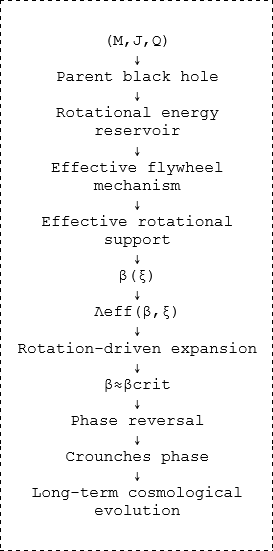
6 Physical Interpretation
6.1 Rotation as an Effective Cosmological Driver
The phenomenological framework developed in the preceding sections identifies inherited rotation as the principal macroscopic dynamical component governing the evolution of the effective cosmological background. This interpretation should not be understood as introducing rotation as a new fundamental interaction or as replacing gravity within the standard description of cosmological evolution. Instead, rotation acts as an effective cosmological driver whose influence is incorporated through the phenomenological evolution of the effective background.
Within the HRDCC framework, the conserved angular momentum of the parent Kerr-Newman black hole constitutes the physical origin of the inherited rotational sector, while the effective rotational support describes its macroscopic cosmological influence. The effective rotational coupling parameter \(\beta\) subsequently provides a phenomenological measure of this influence on the evolving cosmological background. Consequently, the rotational sector contributes indirectly to the cosmological dynamics through the effective background rather than through direct modification of local gravitational interactions.
This distinction represents one of the central conceptual features of the present work. The inherited rotational sector is not interpreted as an additional source term in the Einstein field equations, nor as an alternative explanation for gravitation itself. Instead, it provides an effective macroscopic contribution whose long-term evolution continuously modifies the global cosmological background throughout successive evolutionary stages.
The resulting phenomenological picture identifies inherited rotation as an effective cosmological driver operating at the largest cosmological scales. Its influence is expressed through the evolution of the effective cosmological background and ultimately through the expansion history, the approach to the phase-reversal regime, and the cyclic evolution of the universe.
6.2 Relation to Papers I-VI
The present work occupies a distinct position within the HRDCC publication program. While the previous papers introduced the principal phenomenological sectors of the framework, the objective of Paper VII is to establish the effective macroscopic dynamics connecting these individual components into a coherent cosmological description. Consequently, the present study should be regarded as complementary to the earlier publications rather than as an extension introducing an additional physical sector.
Paper I established the effective cosmological framework and introduced the principal phenomenological quantities employed throughout the HRDCC model. However, although inherited rotation was identified as a fundamental element of the framework, its macroscopic dynamical role remained intentionally qualitative. The present work develops this missing dynamical layer by providing an effective phenomenological description of how inherited rotation influences the evolution of the cosmological background.
Papers II and III examined the inherited dark-matter and relic-neutrino sectors, demonstrating how physical information may be preserved across successive cosmological cycles. These studies established the concept of cosmological inheritance for matter and relic backgrounds. The present paper extends the same phenomenological philosophy to the rotational sector by treating inherited rotation as a persistent macroscopic property governing the long-term dynamical evolution of the effective cosmological background.
Paper IV investigated the internal dynamics of the parent Kerr-Newman black hole and the phenomenological interpretation of the Holographic Transition Core. Those results provide the physical setting from which the inherited rotational state emerges, while the present work deliberately remains at the effective cosmological level without addressing the microscopic processes operating within the parent spacetime. In this sense, the two papers describe complementary aspects of the same phenomenological framework, connecting the internal black-hole description to the subsequent cosmological evolution.
Paper V developed the effective origin of primordial perturbations and demonstrated how rotationally induced Chladni-type resonances may contribute to the formation of cosmological structure. The macroscopic rotational dynamics introduced in the present work provide the broader evolutionary context within which these primordial perturbations are generated and subsequently evolve during the lifetime of a cosmological cycle.
Paper VI presented the principal observational consequences of the HRDCC framework across multiple cosmological probes, including the cosmic microwave background, large-scale structure, gravitational-wave backgrounds, relic cosmological backgrounds, and future observational surveys. Rather than introducing additional observational predictions, the present work supplies the phenomenological dynamical interpretation underlying those observational signatures. The effective rotational support, its evolution through the parameter \(\xi\), and the corresponding evolution of the effective cosmological background together provide the macroscopic physical framework within which the observational consequences discussed in Paper VI may be interpreted.
Taken together, Papers I-VII establish a coherent phenomenological architecture for the HRDCC framework. The first six papers define its principal physical sectors and observational consequences, whereas the present work establishes the macroscopic dynamical relationships connecting those sectors into a unified evolutionary cosmological description. Future studies may therefore build upon this phenomenological foundation by investigating the microscopic realization of the effective dynamical relations introduced here.
6.3 Unified Interpretation of the Effective Parameters
The phenomenological framework developed throughout Papers I-VII introduces a set of effective quantities that describe different aspects of the HRDCC cosmological evolution. Although these quantities were originally presented within the context of individual physical sectors, the present work demonstrates that they form a coherent macroscopic dynamical architecture. Their interpretation is therefore most naturally understood collectively rather than in isolation.
The parent Kerr-Newman parameters \((M,J,Q)\) describe the physical properties of the parent spacetime from which a new cosmological cycle emerges. Within the effective cosmological description, however, these conserved quantities are not treated as direct cosmological variables. Instead, they provide the inherited physical conditions from which the effective cosmological dynamics originate.
Among the parent parameters, the gravitational mass \(M\) determines the overall energetic scale available to the emerging cosmological cycle, while the electric charge \(Q\) contributes primarily to the effective transition geometry associated with the Holographic Transition Core. The angular momentum \(J\) occupies a distinct position by serving as the physical origin of the inherited rotational sector that governs the subsequent macroscopic evolution of the cosmological background.
The inherited rotational sector is represented phenomenologically through a hierarchy of effective quantities. The rotational reservoir characterizes the inherited macroscopic rotational energy, while the effective rotational support describes its dynamical influence on the cosmological background. This influence is quantified through the effective rotational coupling parameter \(\beta\), whose evolution follows the effective evolutionary state variable \(\xi\). The resulting evolution of \(\beta\) subsequently determines the evolution of the effective cosmological background represented by \(\Lambda_{\rm eff}\).
Within this unified interpretation, the effective parameters should therefore be regarded as successive levels of phenomenological description rather than as independent physical entities. Each quantity summarizes a specific aspect of the macroscopic cosmological dynamics while remaining connected to the inherited physical properties of the parent spacetime. Together they establish a continuous phenomenological chain extending from the conserved Kerr-Newman parameters to the observable large-scale evolution of the universe.
For clarity, the principal effective quantities employed throughout the HRDCC framework are summarized in Table 1.
| Quantity | Effective phenomenological interpretation |
|---|---|
| \(M\) | Global energetic scale of the parent system |
| \(J\) | Physical origin of the inherited rotational sector |
| \(Q\) | Effective transition geometry inherited from the parent spacetime |
| Rotational reservoir | Inherited macroscopic rotational energy |
| Effective rotational support | Macroscopic dynamical support of the cosmological background |
| \(\beta\) | Effective rotational coupling parameter |
| \(\Lambda_{\rm eff}\) | Effective cosmological background |
| \(\xi\) | Effective evolutionary state variable |
6.4 Position of Paper VII within the HRDCC Framework
The phenomenological developments presented in this work occupy a central position within the overall architecture of the HRDCC publication program. While the preceding papers established the principal physical sectors of the framework and explored their phenomenological consequences, the present study provides the effective macroscopic dynamics that connect these sectors into a unified description of cyclic cosmological evolution.
An important objective of Paper VII is therefore not the introduction of additional cosmological components, observational signatures, or microscopic physical mechanisms. Instead, its primary contribution consists of establishing the dynamical relationships linking the inherited rotational sector, the effective cosmological background, and the long-term evolution of successive cosmological cycles. In this sense, the present work completes the macroscopic phenomenological architecture initiated in Paper I and progressively extended throughout Papers II-VI.
The resulting framework naturally separates into three complementary phenomenological levels. The first level describes the physical properties of the parent Kerr-Newman black hole through its conserved quantities \((M,J,Q)\). The second level introduces the effective cosmological dynamics arising from the inherited rotational sector, including the rotational reservoir, the effective rotational support, the phenomenological coupling parameter \(\beta\), the effective cosmological background \(\Lambda_{\rm eff}\), and the evolutionary state variable \(\xi\). The third level consists of the observable cosmological evolution emerging from these effective dynamics, including the expansion history, phase reversal, cyclic evolution, and the observational consequences discussed in the previous papers of the HRDCC program.
This hierarchical organization emphasizes the phenomenological philosophy adopted throughout the HRDCC framework. The parent black-hole physics provides the inherited physical origin, the effective dynamical layer establishes the macroscopic cosmological evolution, and the observable universe represents the phenomenological manifestation of these effective processes. Each level therefore addresses a distinct physical description while remaining connected through a coherent chain of effective interpretations.
Within this context, Paper VII should be regarded as the work that establishes the phenomenological dynamical architecture of the HRDCC framework. It provides the macroscopic connections that allow the previously developed physical sectors to be interpreted as components of a single evolutionary cosmological model. This phenomenological foundation, in turn, provides a natural basis for future investigations aimed at developing microscopic realizations of the effective dynamical relations introduced in the present study.
7 Observational Implications
7.1 Observable Consequences of Rotation-Driven Dynamics
The observational implications of the HRDCC framework were presented comprehensively in Paper VI through a broad range of cosmological probes, including the cosmic microwave background, large-scale structure, baryon acoustic oscillations, weak gravitational lensing, relic cosmological backgrounds, gravitational-wave backgrounds, and future observational surveys. The purpose of the present section is therefore not to introduce additional observational predictions, but to provide the phenomenological dynamical interpretation underlying those previously established signatures.
Within the framework developed in the present work, the observational manifestations of HRDCC arise from the long-term evolution of the effective cosmological background. The inherited rotational sector, represented phenomenologically through the effective rotational support and the coupling parameter \(\beta\), continuously modifies the macroscopic cosmological state. Consequently, observable cosmological quantities are interpreted as indirect manifestations of the evolving effective background rather than as direct signatures of the parent Kerr-Newman spacetime itself.
An important consequence of this interpretation is that individual cosmological observables should not be regarded as independent tests of isolated physical mechanisms. Instead, each observable probes a different aspect of the same underlying phenomenological dynamical framework. The effective rotational sector therefore provides a common physical interpretation connecting otherwise distinct observational phenomena within a unified cosmological description.
This unified interpretation is particularly relevant for observations sensitive to the global evolution of the cosmological background. Measurements of expansion history, structure formation, relic cosmological backgrounds, and future high-precision cosmological surveys may therefore be understood as complementary probes of the same effective macroscopic dynamics rather than as unrelated observational constraints.
The phenomenological picture developed in the present work thus provides a consistent physical interpretation of the observational program proposed in Paper VI. Rather than generating new observable signatures, the effective rotational dynamics establish the macroscopic evolutionary framework within which those signatures naturally arise.
7.2 Relation to Previous Observational Predictions
The observational program presented in Paper VI was intentionally formulated in terms of measurable cosmological signatures rather than detailed dynamical mechanisms. The phenomenological framework developed in the present work now provides the macroscopic interpretation that connects those observational predictions to the inherited rotational dynamics of the HRDCC framework.
Within this interpretation, the various observational probes do not represent independent physical mechanisms requiring separate theoretical explanations. Instead, they are understood as complementary manifestations of a common evolutionary cosmological background governed by the inherited rotational sector. Consequently, the effective rotational support introduced in the present work provides the dynamical context within which the observational predictions of Paper VI may be interpreted consistently.
For example, observations of the cosmic microwave background probe the large-scale properties of the evolving effective cosmological background established during the early stages of a cosmological cycle. Large-scale structure and baryon acoustic oscillations reflect the subsequent evolution of this same background, while weak gravitational lensing traces its integrated influence on the distribution of matter and spacetime geometry. Likewise, relic cosmological backgrounds and stochastic gravitational-wave backgrounds preserve complementary information regarding the inherited evolutionary history of the universe.
This unified interpretation naturally links the observational sectors without requiring separate phenomenological mechanisms for each individual probe. Rather than representing isolated observational effects, the signatures discussed in Paper VI become different observational windows onto the same underlying macroscopic dynamical evolution developed in the present work.
The relationship between the principal observational probes discussed in Paper VI and their corresponding phenomenological interpretation within Paper VII is summarized in Table 2.
| Observational probe | Macroscopic interpretation within Paper VII |
|---|---|
| Cosmic Microwave Background (CMB) | Evolution of the effective cosmological background |
| Large-Scale Structure (LSS) | Long-term evolution of the inherited cosmological dynamics |
| Baryon Acoustic Oscillations (BAO) | Expansion history governed by the evolving effective background |
| Weak Gravitational Lensing | Integrated manifestation of the evolving macroscopic background |
| Relic Cosmological Backgrounds | Inheritance of effective cosmological sectors across cycles |
| Gravitational-Wave Background | Evolutionary history of the cyclic cosmological dynamics |
| Future Cosmological Surveys | Joint constraints on the effective dynamical framework |
7.3 Unified Physical Interpretation
One of the principal outcomes of the phenomenological framework developed in the present work is the recognition that the diverse observational consequences discussed throughout the HRDCC publication program admit a common physical interpretation. Rather than requiring separate dynamical mechanisms for each cosmological probe, the effective rotational dynamics provide a unified macroscopic framework within which the observational manifestations of the model may be understood consistently.
Within the HRDCC framework, the inherited rotational sector governs the long-term evolution of the effective cosmological background through the phenomenological evolution of the effective rotational support and the coupling parameter \(\beta\). Consequently, all cosmological observables sensitive to the global background evolution probe different aspects of the same underlying dynamical process. Individual observations therefore provide complementary information regarding a common macroscopic evolutionary history rather than independent evidence for unrelated physical mechanisms.
This interpretation naturally explains why apparently different cosmological observables remain mutually connected within the HRDCC framework. The cosmic microwave background reflects the early effective background established during the formation of the cosmological cycle, while large-scale structure, baryon acoustic oscillations, and weak gravitational lensing probe its subsequent evolution. Likewise, relic cosmological backgrounds preserve inherited information from previous evolutionary stages, and gravitational- wave backgrounds provide an additional observational window onto the long-term dynamical history of the effective cosmological background.
The phenomenological dynamical architecture developed in the present work therefore provides a common interpretative layer connecting all major observational sectors. Rather than assigning separate theoretical origins to each observational signature, the HRDCC framework interprets them as complementary manifestations of the same evolving macroscopic cosmological background. This unified perspective represents one of the principal conceptual advantages of the effective rotational dynamics introduced in Paper VII.
Accordingly, the observational program established throughout the HRDCC publication series should be regarded as a coordinated effort to probe different manifestations of a single phenomenological cosmological evolution. Future observational constraints obtained from multiple independent cosmological probes may therefore be interpreted jointly within one coherent dynamical framework rather than through isolated phenomenological descriptions.
7.4 Future Quantitative Tests
The phenomenological framework established in the present work provides the conceptual foundation for future quantitative investigations of the HRDCC model. While the effective rotational dynamics developed here identify the principal macroscopic relationships governing the cosmological evolution, the present study intentionally does not attempt to construct detailed numerical implementations or perform parameter estimation against current observational datasets.
Accordingly, the effective relations introduced for the rotational coupling and the effective cosmological background should be regarded as the starting point for future quantitative developments rather than as complete predictive models. Their explicit functional forms, numerical calibration, and implementation within cosmological simulation frameworks remain subjects for subsequent investigations.
In particular, future work may explore phenomenological realizations of the effective rotational dynamics within numerical cosmological calculations, including predictions for the expansion history, large-scale structure formation, relic cosmological backgrounds, and gravitational-wave signals. Such studies would enable direct comparison of the HRDCC framework with observational data obtained from present and forthcoming cosmological surveys.
An important advantage of the phenomenological formulation presented here is its flexibility with respect to microscopic realizations. Since the macroscopic framework remains independent of any specific quantum-gravitational mechanism, future microscopic models may be incorporated without altering the effective dynamical architecture established in the present work, provided that they reproduce the same phenomenological evolution of the effective rotational sector.
The present paper therefore represents an intermediate step between the qualitative phenomenological framework developed throughout the previous HRDCC publications and future quantitative cosmological implementations. By establishing the effective dynamical relationships connecting inherited rotation to the evolution of the cosmological background, Paper VII provides the theoretical basis upon which detailed observational modelling and numerical parameter studies may subsequently be constructed.
8 Discussion
8.1 Scientific Contribution
The principal objective of the present work has been to establish the phenomenological dynamical architecture of the HRDCC framework. While previous papers introduced the effective cosmological framework, its inherited physical sectors, and their observational consequences, the macroscopic dynamical relationships connecting these elements had not previously been formulated within a unified phenomenological description.
The effective rotational dynamics developed here identify inherited rotation as the macroscopic physical origin of the evolving effective cosmological background. By introducing the concepts of the rotational reservoir, effective rotational support, and the phenomenological rotational coupling, the present work establishes a continuous dynamical chain linking the conserved properties of the parent Kerr-Newman black hole to the long-term cosmological evolution of successive cycles.
An important consequence of this formulation is the emergence of a coherent evolutionary picture of cyclic cosmology. Rather than interpreting successive cosmological cycles as exact periodic repetitions, the HRDCC framework describes an evolutionary cyclic cosmology in which inherited macroscopic physical conditions continuously shape the subsequent evolution of the universe. This interpretation naturally connects the inherited physical sectors developed throughout the previous papers into a single phenomenological dynamical framework.
The scientific contribution of Paper VII therefore lies not in introducing additional cosmological components, but in establishing the macroscopic dynamical relationships that unify the phenomenological architecture of the HRDCC framework.
8.2 Relationship to Other Rotation-Based Cosmologies
The HRDCC framework belongs to the broader class of cyclic cosmological models [9–11] while adopting a phenomenological interpretation that differs from many previously proposed scenarios. Rather than attributing the cyclic behaviour of the universe to cosmological bounces, conformal transitions, or scalar-field dynamics, the present framework interprets the long-term evolution of the universe as a consequence of inherited macroscopic rotational dynamics originating from the parent Kerr-Newman spacetime.
Within this phenomenological picture, cyclic evolution is governed by the gradual evolution of the effective cosmological background through the inherited rotational sector. Consequently, the transition between successive cosmological phases is not interpreted as an externally imposed event or as the result of an independent cosmological component, but as the natural outcome of the evolving effective rotational support developed throughout the present work.
An additional conceptual distinction concerns the evolutionary character of the HRDCC framework. The phenomenological description developed here does not require successive cosmological cycles to reproduce identical physical conditions or observational histories. Instead, each cycle inherits its effective macroscopic state from its predecessor while evolving according to the same underlying phenomenological principles. The resulting cosmological picture is therefore evolutionary rather than strictly periodic.
These distinctions should not be interpreted as excluding alternative cyclic cosmologies. Instead, they illustrate that the HRDCC framework explores a different phenomenological route toward cyclic evolution, emphasizing inherited macroscopic dynamics and effective cosmological interpretation rather than a specific microscopic realization. Future quantitative investigations may provide a more detailed comparison between these phenomenological approaches and their respective observational consequences.
8.3 Future Developments
The phenomenological dynamical architecture established in the present work provides a natural foundation for subsequent developments of the HRDCC framework. One important direction concerns the microscopic realization of the effective rotational dynamics introduced here, including a detailed physical description of the Holographic Transition Core and the derivation of the effective rotational coupling from underlying dynamical principles.
A second direction involves the quantitative implementation of the phenomenological framework within numerical cosmological calculations. Explicit realizations of the effective functions introduced in the present work would enable predictions for cosmological expansion history, structure formation, relic cosmological backgrounds, and gravitational-wave signals, thereby allowing direct comparison with observational data.
Finally, the unified phenomenological architecture established by Papers I-VII provides a coherent foundation upon which future theoretical developments may be constructed. The effective macroscopic framework introduced here therefore serves as an intermediate step toward a more complete physical description of cyclic cosmology within the HRDCC program.
9 Limitations
The present work is intentionally restricted to an effective phenomenological description of rotation-driven cosmological dynamics within the HRDCC framework. Its objective is to establish the macroscopic dynamical architecture connecting the inherited rotational sector to the evolution of the effective cosmological background rather than to derive these relations from a fundamental microscopic theory.
Accordingly, no quantum-gravitational action, Hamiltonian formulation, transfer operator, or microscopic description of the Holographic Transition Core is introduced. Likewise, the phenomenological relations developed for the effective rotational coupling and the effective cosmological background are not derived from first principles but are proposed as effective macroscopic descriptions of the long-term cosmological evolution.
The present study also does not attempt to estimate the quantitative parameters or to implement numerically the effective dynamical relations proposed. Explicit functional forms for the evolution of the effective rotational coupling and the effective cosmological background remain intentionally unspecified, allowing future microscopic realizations to reproduce the same phenomenological behaviour through different physical mechanisms.
Finally, the observational consequences discussed throughout the HRDCC publication program are interpreted here within the proposed dynamical framework, but no new observational predictions are introduced beyond those presented previously. The principal contribution of Paper VII is therefore the establishment of a unified phenomenological dynamical architecture rather than the development of a complete quantitative cosmological model.
These limitations define the intended scope of the present work and identify several natural directions for future theoretical and numerical investigations within the HRDCC research program.
10 Conclusion
The present work establishes the phenomenological dynamical architecture of the HRDCC framework by developing the previously missing macroscopic connection between the inherited rotational sector and the effective cosmological evolution. Building upon the effective framework introduced in Paper I and the physical sectors developed throughout Papers II-VI, the present study formulates a unified phenomenological description linking the conserved parameters of the parent Kerr-Newman black hole to the long-term evolution of successive cosmological cycles.
The effective concepts introduced in this work - including the rotational reservoir, effective rotational support, phenomenological rotational coupling, and the resulting evolution of the effective cosmological background - provide a coherent dynamical interpretation of rotation-driven cyclic cosmology. Within this framework, the transition from cosmological expansion to contraction emerges naturally from the gradual evolution of the effective rotational sector, while successive cosmological cycles are interpreted as components of an evolutionary cyclic cosmology connected through inherited macroscopic physical conditions.
Taken together, Papers I-VII establish a coherent phenomenological foundation for the HRDCC framework. The present work completes this first stage of the publication program by providing the macroscopic dynamical relationships connecting its principal physical sectors into a unified evolutionary cosmological model. This phenomenological foundation provides a natural starting point for future investigations aimed at developing microscopic realizations, quantitative cosmological implementations, and detailed comparisons with observational data.
11 Summary of Symbols
| Symbol | Meaning |
|---|---|
| \(M\) | Parent black-hole mass; global energetic scale |
| \(J\) | Parent angular momentum; origin of the inherited rotational sector |
| \(Q\) | Parent electric charge; contribution to inherited transition geometry |
| \(\beta\) | Effective rotational coupling parameter |
| \(\beta_{\rm crit}\) | Effective critical rotational-support parameter |
| \(\Lambda_{\rm eff}\) | Effective cosmological background |
| \(\xi\) | Effective evolutionary state parameter |
12 Bibliography