Main links
Main
HRDCC framework details
- HRDCC landing page
- The HRDCC Publication Program
-
Paper pages
- Paper I. - Holographic Rotation-Driven Cyclic Cosmology (HRDCC): A Unified Dynamical Framework for Cyclic Cosmology
- Paper II. - Planck Remnants and the Origin of Cold Dark Matter within the HRDCC Framework
- Paper III. - Inherited Cosmic Neutrino Background within the HRDCC Framework
- « Paper IV. - Black Hole Interior Dynamics and Horizon Mechanics within the HRDCC Framework »
- Paper V. - Primordial Perturbations, Chladni Resonances and Non-Gaussianity within the HRDCC Framework
- Paper VI. - Observational Tests of the HRDCC Framework: Effective Cosmological Signatures from CMB to Next-Generation Surveys
- Paper VII. - Rotational Dynamics and Phase Reversal within the HRDCC Framework
- Paper VIII. - Microscopic Foundations of the HRDCC Framework
- Paper IX. - Effective Particle Physics across Successive Cosmological Cycles within the HRDCC Framework
Research & Profiles
Paper IV. - Black Hole Interior Dynamics and Horizon Mechanics within the HRDCC Framework


Abstract
The Holographic Rotation-Driven Cyclic Cosmology (HRDCC) framework introduced in earlier papers assumes that successive cosmological cycles remain physically connected through a regularized Holographic Transition Core (HTC). While this effective phenomenological description provides a consistent cosmological framework, its microscopic interior dynamics have not yet been examined.
In the present work, we investigate the physical mechanisms that may underlie the regularized transition region by considering the internal structure of rotating parent black holes. The discussion focuses on Kerr and Kerr-Newman interior geometries, Cauchy-horizon dynamics, mass inflation, Einstein-Cartan-Sciama-Kibble gravity, holographic information encoding, and effective horizon mechanics. Rather than proposing a complete quantum-gravitational theory, we develop a phenomenological microscopic interpretation that remains consistent with the effective framework established previously.
The analysis suggests that the Holographic Transition Core may be interpreted as an effective interior boundary where horizon dynamics, rotational energy storage, and holographic information transfer become coupled. This interpretation provides a physically motivated bridge between the effective cosmological description developed in earlier papers and the microscopic mechanisms that may govern the interior evolution of the parent black hole.
The present work therefore establishes an effective phenomenological description of interior horizon dynamics while leaving a complete microscopic quantum-gravitational derivation for future investigations.
1 Introduction
The internal structure of black holes remains one of the most challenging open problems in gravitational physics. While classical General Relativity successfully describes the exterior spacetime of stationary black holes through the Schwarzschild, Kerr, and Kerr-Newman solutions [1–3], the physical nature of their interior regions remains uncertain. In particular, the stability of the Cauchy horizon, the mass-inflation instability [4, 5], the fate of gravitational collapse, and the ultimate preservation of physical information continue to motivate extensive theoretical investigation.
Several complementary approaches have addressed different aspects of these problems. Einstein-Cartan- Sciama-Kibble gravity suggests that spin-induced torsion may regularize gravitational collapse under extreme densities. Loop Quantum Cosmology [6, 7] provides examples of nonsingular cosmological evolution through effective quantum-geometric corrections. Holographic approaches, including the Kerr/CFT correspondence [8] and related developments in black-hole information theory, emphasize the potential role of lower-dimensional boundary descriptions in gravitational dynamics. Despite their different physical motivations, none of these frameworks alone provides a complete phenomenological description of how a rotating parent black hole could support the emergence of a subsequent cosmological cycle.
Within the HRDCC framework developed in previous papers, the large-scale cosmological evolution has been formulated phenomenologically. The effective cosmological framework introduced in Paper I provides the macroscopic dynamical description, while Papers II and III proposed phenomenological microscopic interpretations for the effective cold-dark-matter and inherited neutrino sectors, respectively [9–11]. The regularized Holographic Transition Core (HTC) has therefore far been treated primarily as an effective geometrical interface connecting successive cosmological cycles rather than as a fully developed microscopic dynamical system.
The purpose of the present work is to investigate the physical processes that may underlie this effective transition region. Rather than constructing a complete theory of quantum gravity, we examine how several established ideas from black-hole interior physics - including Kerr geometry, Cauchy-horizon dynamics, mass inflation, Einstein-Cartan regularization, holographic information encoding, and horizon thermodynamics - may be interpreted within a unified phenomenological framework consistent with the previously developed HRDCC architecture.
Throughout this paper, the discussion remains at the level of effective microscopic interpretation. Whenever fundamental quantum-gravitational dynamics are required but cannot presently be derived uniquely, the corresponding mechanisms are introduced explicitly as phenomenological assumptions whose mathematical completion is deferred to future investigations. This separation between effective phenomenology and microscopic derivation follows the general methodological philosophy adopted throughout the HRDCC publication program.
The remainder of this paper is organized as follows. Section 2 reviews the principal physical ingredients of black-hole interior dynamics that motivate the proposed interpretation. Section 3 develops the effective phenomenological description of interior horizon dynamics within the HRDCC framework. Section 4 introduces the Holographic Transition Core as the effective geometrical interface connecting successive cosmological cycles. Section 5 examines the resulting horizon mechanics and their role in maintaining physical continuity across cosmological transitions. Finally, Sections 6-8 discuss the implications, limitations, and future development of the proposed framework.

2 Physical Motivation
The microscopic structure of black-hole interiors has been investigated from several complementary perspectives during the past decades. Classical General Relativity predicts rich interior geometries for rotating black holes, while quantum-gravitational approaches attempt to regularize the singular behavior expected near the end of gravitational collapse. Despite substantial theoretical progress, no consensus currently exists regarding the physical evolution of the interior region beyond the classical Cauchy horizon.
The Kerr solution [2] demonstrates that rotating black holes possess a substantially more complex internal structure than their non-rotating Schwarzschild counterparts. The existence of an inner horizon introduces the possibility of additional dynamical regimes that do not arise in static geometries. However, subsequent studies showed that the Cauchy horizon is expected to become unstable through the phenomenon of mass inflation [4, 5, 12], producing extremely large local energy densities that challenge the applicability of purely classical descriptions.
Several theoretical frameworks have proposed possible mechanisms capable of avoiding singular evolution under these extreme conditions. Einstein-Cartan-Sciama-Kibble gravity [13, 14] introduces spin-induced torsion that may generate effective gravitational repulsion at sufficiently high densities. Loop Quantum Cosmology [6, 7] replaces the classical singularity by an effective nonsingular bounce through quantum-geometric corrections. Holographic approaches, including the Kerr/CFT correspondence [8], emphasize that part of the physical information associated with gravitational dynamics may admit an effective lower-dimensional description.
Although each of these approaches addresses important aspects of the interior problem, they focus primarily on individual physical mechanisms. None of them attempts to provide a unified phenomenological description simultaneously incorporating interior horizon dynamics, rotational energy storage, holographic information transfer, and the physical continuity required for successive cosmological cycles.
Within the HRDCC framework, these ingredients are not interpreted as competing alternatives but as complementary sources of physical motivation. The present work therefore does not seek to modify any of the underlying theories individually. Instead, it investigates whether their phenomenological combination may provide a self-consistent microscopic interpretation of the Holographic Transition Core introduced previously as an effective geometrical interface.
Accordingly, the objective of this paper is not to derive a complete theory of quantum gravity, but to establish a physically motivated interior framework that remains compatible with the effective cosmological description developed in the preceding papers while identifying the principal mathematical structures requiring future derivation.
3 Interior Horizon Dynamics
3.1 Interior Geometry
The interior geometry of rotating black holes provides the physical background upon which the present interpretation is constructed. Unlike the Schwarzschild solution, the Kerr and Kerr-Newman metrics possess a substantially richer internal causal structure, including an inner (Cauchy) horizon that separates distinct regions of spacetime. The existence of this additional horizon introduces physical regimes that are absent in non-rotating geometries and has motivated extensive investigations into the dynamical evolution of black-hole interiors.
Within classical General Relativity, the Cauchy horizon represents the limit beyond which deterministic evolution becomes problematic. Although the Kerr solution admits an analytic continuation across the inner horizon, subsequent theoretical studies have shown that even small perturbations may undergo extreme blueshift amplification as they approach this region. Consequently, the classical interior cannot generally be regarded as a stationary continuation of the exterior spacetime.
The geometrical properties of the interior are further influenced by frame dragging associated with black-hole rotation. Near the inner horizon, rotational effects modify the local causal structure and affect the propagation of infalling matter and radiation. These features naturally distinguish rotating black holes from static solutions and provide the principal geometrical motivation for considering Kerr-type parent black holes within the HRDCC framework.
The present work does not attempt to derive a new interior metric or modify the classical Kerr geometry. Instead, the known geometrical structure is adopted as the effective background on which the subsequent phenomenological interpretation is developed. Throughout this paper, Kerr and Kerr-Newman interior geometries therefore serve as physical motivation rather than as exact microscopic descriptions of the transition process itself.
The geometrical considerations discussed above establish the physical setting but do not determine the actual dynamical evolution of the interior. The principal difficulty arises from the instability associated with the Cauchy horizon, whose physical consequences are examined in the following section.
3.2 Interior Dynamics
The mathematical existence of the inner horizon does not by itself guarantee a physically realizable continuation of spacetime. Although the Kerr and Kerr-Newman solutions admit an analytic extension beyond the Cauchy horizon, extensive investigations have demonstrated that this region is dynamically unstable under generic perturbations. The principal mechanism responsible for this behavior is the phenomenon of mass inflation, in which infalling and outgoing streams of radiation experience exponentially increasing blueshift near the inner horizon, leading to rapidly growing local energy densities.
Mass inflation represents one of the central obstacles to any physical description of black-hole interiors. Rather than approaching a stationary configuration, the interior evolves toward a regime where classical General Relativity is expected to lose predictive validity. Consequently, the mathematical continuation of the Kerr geometry cannot by itself establish the existence of a physically meaningful interior transition region.
Several approaches have been proposed to address this problem. Within Einstein-Cartan-Sciama-Kibble gravity, spin-induced torsion may generate an effective repulsive contribution at sufficiently high matter densities, potentially preventing complete gravitational collapse. Loop Quantum Cosmology reaches a qualitatively similar conclusion through quantum-geometric corrections that replace the classical singularity with an effective nonsingular bounce. While these approaches differ substantially in their microscopic foundations, both illustrate that classical singular behavior need not necessarily represent the final stage of gravitational evolution.
Within the HRDCC framework, these developments are interpreted as physical motivation rather than as direct microscopic ingredients of the model. The present work does not assume that either Einstein-Cartan gravity or Loop Quantum Cosmology provides the unique physical description of the parent black-hole interior. Instead, they demonstrate that effective regularization of gravitational collapse represents a physically plausible possibility deserving further investigation.
Accordingly, the principal working assumption adopted in the present framework is that the interior evolution remains effectively regularized even after the onset of mass inflation. At the phenomenological level considered here, this assumption is sufficient to motivate the existence of a finite interior transition region without specifying the unique microscopic mechanism responsible for its formation.
This effective regularization constitutes the only additional assumption required before introducing the interior transition interface developed in the following section.
3.3 Effective Interior Regularization
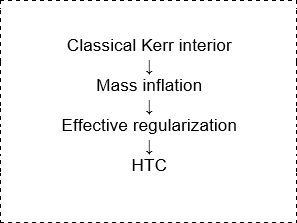
The preceding discussion demonstrates that the principal limitation of the classical interior geometry is not the existence of the Cauchy horizon itself, but the instability associated with its dynamical evolution. Any phenomenological description seeking to connect black-hole interiors with subsequent cosmological evolution therefore requires an effective mechanism capable of preventing the unrestricted growth of the mass-inflation instability.
Within the HRDCC framework, this requirement is introduced at the phenomenological level through the assumption of an effectively regularized interior evolution. The present work intentionally avoids attributing this regularization to a unique microscopic theory. Instead, the regularized interior is regarded as the effective macroscopic outcome of physical processes that remain to be derived from a more complete quantum- gravitational description.
Under this interpretation, the classical Cauchy horizon no longer represents the final physically meaningful boundary of the interior spacetime. Rather, the unstable horizon is replaced by a finite transition region in which the effective gravitational dynamics remain well defined despite the breakdown of the classical description. The precise microscopic structure of this region is intentionally left unspecified. Its existence is introduced solely as the minimum phenomenological assumption required to maintain physical continuity across successive cosmological cycles.
This effective regularization should therefore not be interpreted as a modification of General Relativity itself. Instead, it defines the domain of validity of the present phenomenological description. Classical General Relativity accurately describes the exterior spacetime and motivates the interior geometry, while the regularized transition region represents the effective continuation adopted within the HRDCC framework once the classical approximation ceases to remain physically reliable.
The introduction of a regularized interior transition region provides the missing physical ingredient required by the effective cosmological framework established previously. Once such a finite interior region is admitted, the transition between the collapsing parent black hole and the subsequent cosmological cycle can be interpreted as the evolution of an effective geometrical interface rather than as the continuation of the classical Cauchy horizon itself.
Within the HRDCC framework, this effective geometrical interface is identified with the Holographic Transition Core (HTC).
The physical properties and phenomenological interpretation of the HTC are developed in the following section.
4 Holographic Transition Core
4.1 The HTC as an Effective Geometrical Interface
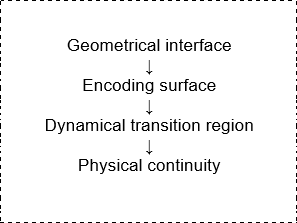
Following the effective regularization discussed in the previous section, the HRDCC framework interprets the Holographic Transition Core (HTC) as the effective geometrical interface separating the dynamically evolving interior of the parent black hole from the subsequent cosmological evolution. Rather than representing a mathematical hypersurface of zero thickness, the HTC is introduced phenomenologically as a finite transition region within which the classical description of spacetime is gradually replaced by an effective interior dynamics compatible with physical continuity.
The HTC therefore should not be regarded as an additional geometrical object superimposed upon the Kerr interior. Instead, it represents the effective physical interpretation of the regularized interior region once the classical Cauchy horizon ceases to provide an adequate dynamical description. In this sense, the HTC is not introduced independently of the interior geometry but emerges naturally from the phenomenological continuation of that geometry beyond the regime where classical General Relativity alone remains sufficient.
Within the present framework, the HTC constitutes the unique geometrical interface through which effective physical degrees of freedom may persist across successive cosmological cycles. Its role is therefore fundamentally different from that of the classical event horizon or the Cauchy horizon. Whereas the event horizon defines causal accessibility and the Cauchy horizon marks the limit of classical predictability, the HTC is interpreted as the effective transition region responsible for maintaining physical continuity during cosmological transition.
At the level considered in the present work, no unique microscopic theory of the HTC is assumed. The present interpretation is intentionally phenomenological and serves only to identify the minimum physical structure required by the effective cosmological framework established previously. The detailed microscopic dynamics responsible for the existence of such a transition region remain the subject of future investigation.
Having identified the HTC as the effective geometrical interface of the regularized interior evolution, we next examine its role as the surface on which the effective holographic representation of physical degrees of freedom is established.
4.2 The HTC as a Holographic Encoding Surface
The introduction of the Holographic Transition Core as an effective geometrical interface naturally raises the question of how physical degrees of freedom are represented within the transition region. In the present phenomenological description, the HTC is interpreted as the effective surface upon which the macroscopic physical state of the collapsing interior is represented before the subsequent cosmological evolution begins.
This interpretation is motivated by the broader holographic viewpoint developed in gravitational physics [15–17], according to which the information required to describe a physical system may admit an effective lower-dimensional representation. Within the HRDCC framework, this concept is employed exclusively at the phenomenological level. The present work does not assume a specific microscopic realization of holographic encoding, nor does it propose a complete holographic quantum-gravitational theory.
Instead, the HTC is regarded as the effective boundary separating two complementary physical descriptions. On one side lies the dynamically evolving interior spacetime governed by the regularized horizon dynamics discussed in the previous section. On the other side begins the effective cosmological evolution associated with the subsequent cosmological cycle. The HTC therefore functions as the interface through which these two effective descriptions remain physically connected.
Within the phenomenological description adopted in the present work, this effective correspondence may be summarized through the following Effective Horizon Transfer Relation: \[\begin{equation} \mathcal{S}_{\mathrm{HTC}}^{\,\mathrm{eff}}=\mathcal{T}_{\mathrm{HTC}}\!\left(\mathcal{S}_{\mathrm{int}}^{\,\mathrm{eff}}\right) \label{eq:effective_horizon_transfer} \end{equation}\]
where \(\mathcal{S}{\mathrm{int}}^{,\mathrm{eff}}\) denotes the effective interior physical state and \(\mathcal{S}_{\mathrm{HTC}}^{\,\mathrm{eff}}\) represents the corresponding effective state associated with the Holographic Transition Core. The operator \(\mathcal{T}_{\mathrm{HTC}}\) is introduced exclusively as an effective phenomenological transfer relation and is not intended to represent a complete microscopic quantum-gravitational mapping.
This equation is intended exclusively as an effective phenomenological relation within the present work. Its microscopic derivation is deferred to future investigations.
In this interpretation, holographic encoding should not be understood as the storage of microscopic particle configurations or complete quantum states. Rather, the HTC is assumed to preserve the effective physical degrees of freedom required to maintain physical continuity across cosmological transition. The detailed microscopic realization of this encoding remains outside the scope of the present work and is intentionally left open.
Accordingly, the role of the HTC is not to provide a microscopic information theory but to establish the effective physical boundary conditions connecting the regularized interior evolution with the subsequent cosmological dynamics. This distinction is essential for maintaining the phenomenological scope adopted throughout the HRDCC publication program.
Once the HTC is interpreted as an effective holographic encoding surface, its physical evolution may be examined through the dynamical processes operating within the transition region itself.
4.3 The HTC as a Dynamical Transition Region
The interpretation of the Holographic Transition Core as an effective encoding surface is incomplete unless the transition region is also regarded as a dynamical physical system. Within the HRDCC framework, the HTC is therefore interpreted not as a static geometrical boundary but as a finite transition region whose effective physical state evolves continuously during cosmological transition.
At the phenomenological level adopted in the present work, the HTC mediates the gradual replacement of the collapsing interior dynamics by the effective cosmological dynamics associated with the subsequent cosmological cycle. Rather than representing an instantaneous transition, the process is interpreted as a continuous evolution of the effective geometrical state within the regularized transition region.
This interpretation naturally allows the rotational properties of the parent black hole to remain dynamically relevant throughout the transition. Instead of being treated as isolated initial conditions, the conserved macroscopic properties of the parent system may continue to influence the effective state of the transition region during cosmological initialization. Within the HRDCC framework, this long-term influence is interpreted phenomenologically as the action of an effective rotational energy reservoir.
The present work intentionally refrains from specifying the microscopic mechanism responsible for this dynamical coupling. Whether the underlying process ultimately originates from horizon thermodynamics, quantum-gravitational degrees of freedom, holographic information dynamics, or a combination of these effects remains an open problem beyond the scope of the current phenomenological treatment.
Accordingly, the HTC is interpreted as the effective dynamical interface through which the macroscopic physical state evolves continuously during cosmological transition while preserving the physical continuity required by the effective HRDCC framework.
The consequences of this interpretation for physical continuity across successive cosmological cycles are discussed in the following section.
4.4 The HTC as the Carrier of Physical Continuity
The principal significance of the Holographic Transition Core does not arise solely from its geometrical or holographic interpretation. Within the HRDCC framework, its primary physical role is to provide the effective interface through which physical continuity is maintained across successive cosmological cycles.
In the absence of such an effective transition region, the end of gravitational collapse and the beginning of the subsequent cosmological evolution would represent two physically disconnected descriptions. The effective cosmological framework developed previously therefore requires a mechanism capable of connecting these phases without assuming either a classical spacetime continuation or a complete microscopic theory of quantum gravity.
The HTC fulfills this role at the phenomenological level. Rather than preserving every microscopic detail of the collapsing interior, it is interpreted as maintaining the effective physical degrees of freedom necessary for the subsequent cosmological evolution. Consequently, physical continuity within the HRDCC framework should not be understood as the exact persistence of microscopic quantum states, but as the persistence of the effective macroscopic physical state through the regularized transition region.
This distinction is central to the philosophy of the HRDCC publication program. Earlier papers introduced effective cosmological components whose microscopic interpretation was intentionally deferred. The present work provides the corresponding phenomenological interior interpretation by identifying the HTC as the effective physical interface through which these effective degrees of freedom remain connected across successive cosmological cycles.
The HTC therefore represents the physical element linking the effective cosmological description developed previously with the interior black-hole dynamics investigated in the present work. Subsequent studies may extend this phenomenological interpretation toward specific microscopic mechanisms, but the existence of the HTC itself should be understood as an effective consequence of the regularized interior evolution established here.
Accordingly, physical continuity is interpreted as the defining physical function of the Holographic Transition Core within the HRDCC framework.
5 Horizon Mechanics
5.1 Rotational Energy Reservoir
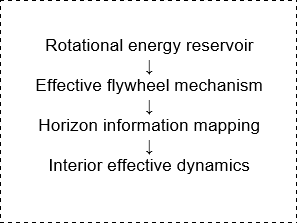
The existence of a regularized transition region alone does not specify the physical mechanism responsible for sustaining the cosmological transition. Within the HRDCC framework, the Holographic Transition Core is therefore interpreted as being dynamically coupled to a long-lived rotational energy reservoir inherited from the parent black hole.
The present interpretation does not assume that rotational energy is transferred directly into cosmological expansion. Instead, the conserved rotational properties of the parent system are regarded as defining an effective macroscopic energy reservoir whose gradual dynamical influence remains relevant throughout the transition process.
Accordingly, the rotational energy reservoir should be interpreted as a physical property of the regularized interior rather than as an additional matter component or independent cosmological field. Its role is to provide the effective dynamical background from which the subsequent transition processes may emerge.
At the phenomenological level considered here, the detailed microscopic coupling responsible for maintaining this reservoir remains intentionally unspecified. The present work requires only that such an effective reservoir exists and evolves continuously throughout the transition region.
5.2 Effective Flywheel Mechanism
The existence of an effective rotational energy reservoir does not by itself explain how its influence may persist throughout cosmological transition. Within the HRDCC framework, this long-term dynamical behavior is interpreted phenomenologically as an effective flywheel mechanism.
The flywheel mechanism does not constitute an independent physical component. Instead, it describes the dynamical response of the rotational energy reservoir during the gradual evolution of the Holographic Transition Core. In this interpretation, the stored rotational energy is not released instantaneously but contributes continuously to the effective interior dynamics throughout the transition process.
Consequently, the effective flywheel mechanism should be understood as a property of the transition dynamics rather than as a separate physical object. It characterizes the persistence of the rotational influence under conditions where the classical description of the interior has already ceased to remain applicable.
This phenomenological interpretation intentionally avoids specifying the microscopic transport processes responsible for the gradual evolution of the reservoir. Whether these ultimately originate from horizon thermodynamics, quantum-gravitational interactions, holographic dynamics, or additional microscopic degrees of freedom remains beyond the scope of the present work.
5.3 Horizon information mapping
The dynamical evolution described in the previous sections establishes the existence of an effective transition interface and a persistent rotational energy reservoir. A remaining question concerns how the effective physical state associated with the collapsing interior is represented throughout this transition.
Within the HRDCC framework, this problem is addressed phenomenologically through effective horizon information mapping. The purpose of this mapping is not to preserve every microscopic degree of freedom individually but to maintain an effective representation of the macroscopic physical state required for the subsequent cosmological evolution.
At the phenomenological level considered here, the effective correspondence between successive macroscopic states may be summarized by the following Effective Horizon Information Mapping: \[\begin{equation} \mathcal{I}_{n+1}^{\,\mathrm{eff}}=\mathcal{M}_{\mathrm{HTC}}\!\left(\mathcal{I}_{n}^{\,\mathrm{eff}}\right) \label{eq:effective_information_mapping} \end{equation}\] where \(\mathcal{I}{n}^{,\mathrm{eff}}\) and \(\mathcal{I}_{n+1}^{\,\mathrm{eff}}\) denote the effective macroscopic physical states associated with two successive cosmological cycles, while \(\mathcal{M}_{\mathrm{HTC}}\) represents the phenomenological mapping provided by the Holographic Transition Core.
The relation should not be interpreted as preserving microscopic quantum states. Rather, it expresses the effective persistence of macroscopic physical degrees of freedom required for physical continuity across successive cosmological cycles.
This equation is intended exclusively as an effective phenomenological relation within the present work. Its microscopic derivation is deferred to subsequent investigations.
Accordingly, horizon information mapping should not be interpreted as a literal transfer of complete quantum states across the transition interface. Rather, it represents an effective correspondence between successive macroscopic physical descriptions connected through the Holographic Transition Core. The detailed microscopic realization of this correspondence remains intentionally unspecified within the present phenomenological treatment.
Several contemporary approaches suggest possible physical mechanisms capable of contributing to such an effective description. Holographic dualities [8, 17, 18] indicate that lower-dimensional boundary representations may encode physically relevant information associated with higher-dimensional gravitational systems. Likewise, developments in black-hole information theory [19–21] have demonstrated that unitary evolution may admit effective descriptions that differ substantially from their microscopic realization. Within the HRDCC framework, these developments provide physical motivation for effective horizon information mapping without uniquely determining its microscopic implementation. The present work therefore does not identify the Holographic Transition Core with any specific holographic correspondence or quantum-information formalism. Instead, horizon information mapping is introduced as the effective phenomenological relation connecting the regularized interior dynamics with the subsequent effective cosmological evolution.
This effective representation naturally leads to the interior dynamical evolution considered in the following section.
5.4 Interior effective dynamics
The preceding sections introduced the principal phenomenological elements required to describe the interior transition within the HRDCC framework. Considered individually, each component addresses a specific aspect of the transition process. Taken together, however, they define a single effective dynamical system governing the evolution of the regularized interior region.
Within this interpretation, the Holographic Transition Core provides the effective geometrical interface, the rotational energy reservoir supplies the long-term dynamical background, the effective flywheel mechanism describes the persistent dynamical response of that reservoir, and horizon information mapping establishes the effective correspondence between successive macroscopic physical states. None of these elements is assumed to operate independently. Rather, they constitute complementary aspects of a single phenomenological interior dynamics.
Accordingly, the HRDCC framework does not regard the interior transition as the consequence of one isolated physical process. Instead, the effective evolution emerges from the coupled interaction of the regularized interior geometry, rotational dynamics, and effective holographic representation. At the phenomenological level adopted here, the transition is therefore interpreted as a collective dynamical process rather than as a sequence of independent mechanisms.
This interpretation also clarifies the relationship between the effective cosmological framework introduced previously and the interior physics developed in the present work. Earlier papers described the macroscopic cosmological evolution phenomenologically without specifying the microscopic interior processes responsible for maintaining physical continuity. The present work complements that description by proposing an effective interior dynamics capable of providing the corresponding physical interpretation while remaining consistent with the phenomenological scope adopted throughout the HRDCC publication program.
The resulting interior dynamics should therefore be understood as an effective description rather than as a complete microscopic theory. Its purpose is not to replace existing approaches to black-hole physics or quantum gravity but to establish a coherent phenomenological framework within which regularized interior evolution, horizon mechanics, and cosmological transition may be interpreted consistently.
The implications of this effective interior framework are discussed in the following section.
6 Discussion
6.1 Relationship to Classical General Relativity
Classical General Relativity provides the indispensable geometrical foundation upon which the present work is constructed. The Kerr and Kerr-Newman solutions [2, 3] establish the spacetime structure of rotating black holes, while the existence of the Cauchy horizon defines the interior region that motivates the present investigation. Without these classical solutions, neither the physical setting nor the geometrical interpretation developed throughout this work would be possible.
At the same time, the present analysis highlights an important limitation of the classical description. Although General Relativity determines the interior geometry, it does not by itself provide a physically satisfactory continuation of the dynamical evolution once the Cauchy horizon becomes unstable. The phenomenon of mass inflation [4, 5, 22] indicates that the classical spacetime description eventually reaches a regime where increasingly large local energy densities challenge the applicability of the purely classical approximation.
The HRDCC framework therefore does not replace or modify Classical General Relativity within its established domain of validity. On the contrary, the classical Kerr geometry remains the physical background throughout the present work. The phenomenological extension proposed here begins only after the classical description ceases to provide a physically meaningful continuation of the interior evolution.
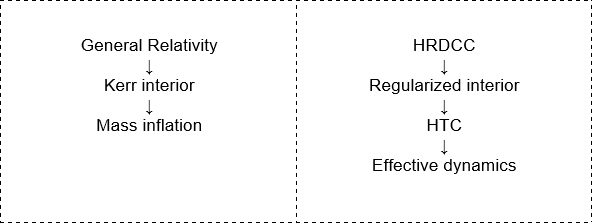
Accordingly, the relationship between Classical General Relativity and the HRDCC framework should be understood as complementary rather than competitive. General Relativity determines the geometrical structure leading to the interior transition, whereas the phenomenological interpretation developed in the present work addresses the subsequent effective evolution of the regularized transition region.
In this sense, the HRDCC framework should be regarded as extending the physical interpretation of black- hole interiors beyond the domain where the classical description alone is expected to remain sufficient, without modifying the established geometrical predictions of General Relativity within their verified range of applicability.
6.2 Relation to Interior Regularization Approaches
One of the central questions addressed by modern approaches to black-hole interiors concerns the possibility of avoiding the classical singular behavior expected during gravitational collapse. Among the most extensively investigated directions are Einstein-Cartan-Sciama-Kibble gravity and Loop Quantum Cosmology, both of which demonstrate that nonsingular gravitational evolution may arise through mechanisms extending beyond Classical General Relativity.
Within Einstein-Cartan gravity, spin-induced spacetime torsion provides an effective repulsive contribution at sufficiently high matter densities, potentially preventing complete gravitational collapse. Loop Quantum Cosmology reaches a qualitatively similar phenomenological outcome through quantum-geometric corrections that replace the classical singularity with an effective bounce. Although their microscopic foundations differ substantially, both approaches illustrate that the classical continuation of gravitational collapse need not necessarily terminate at a singular spacetime boundary.
The HRDCC framework does not attempt to replace either of these approaches, nor does it assume that their respective regularization mechanisms constitute the unique physical description of black-hole interiors. Instead, the present work adopts a more limited objective. The existence of physically motivated regularization mechanisms demonstrates that the assumption of an effectively regularized interior evolution is scientifically plausible and therefore provides an appropriate phenomenological starting point for the interpretation developed here.
An important distinction nevertheless remains. Existing regularization approaches primarily address the avoidance of singular evolution itself. The present work focuses instead on the physical consequences of such regularization once it is assumed to occur. Within the HRDCC framework, the principal question is therefore not how regularization originates microscopically, but how a regularized interior may subsequently function as an effective transition interface connecting successive cosmological cycles.
In this sense, the HRDCC framework should be regarded as complementary to existing regularization approaches. Einstein-Cartan gravity and Loop Quantum Cosmology provide valuable physical motivation for nonsingular interior evolution, whereas the present work investigates the phenomenological horizon mechanics that may become possible once such an effectively regularized interior is admitted.
6.3 Relation to Holographic Approaches
The interpretation of the Holographic Transition Core naturally invites comparison with modern holographic approaches to gravitational physics. During the past decades, the holographic principle, the AdS/CFT correspondence, the Kerr/CFT correspondence, and subsequent developments in black-hole information theory have demonstrated that gravitational systems may admit effective lower-dimensional descriptions under appropriate physical conditions.
These developments provide important conceptual motivation for the present work. In particular, they support the broader idea that the physical state of a gravitational system may be represented effectively through structures associated with boundary or horizon geometries. Within the HRDCC framework, this general perspective motivates the interpretation of the Holographic Transition Core as an effective transition interface rather than as a purely geometrical boundary.
At the same time, the present work intentionally avoids identifying the Holographic Transition Core with any specific holographic correspondence. The HRDCC framework does not assume that the HTC constitutes a realization of the AdS/CFT correspondence, the Kerr/CFT correspondence, or any other established holographic duality. Likewise, concepts originating from black-hole information theory - including Page evolution, quantum-information recovery, ER=EPR, or Stinespring representations - are regarded as possible microscopic sources of physical motivation rather than as defining elements of the phenomenological framework developed here.
The distinction is important. Existing holographic approaches primarily investigate how gravitational information may be represented within specific microscopic or quantum-gravitational settings. By contrast, the HRDCC framework introduces the Holographic Transition Core phenomenologically as the effective physical interface required to maintain continuity between regularized interior evolution and subsequent cosmological dynamics. The present work therefore addresses a different physical level from that considered by existing holographic theories.
Accordingly, the relationship between the HRDCC framework and modern holographic approaches should be understood as complementary rather than competitive. Holographic theories provide valuable physical intuition concerning horizon representations and boundary dynamics, whereas the HRDCC framework investigates how an effective transition interface may operate within a phenomenological description of cyclic cosmological evolution.
6.4 Position of the HRDCC Interpretation
The comparisons presented above indicate that the HRDCC framework should not be interpreted as an alternative formulation of Classical General Relativity, Einstein-Cartan gravity, Loop Quantum Cosmology, or existing holographic approaches. Each of these frameworks addresses a distinct aspect of gravitational physics and contributes valuable physical insight within its own domain of applicability.
The objective of the present work is fundamentally different. Rather than developing a new microscopic theory of gravity, the HRDCC framework establishes a phenomenological architecture capable of connecting several complementary physical ideas into a coherent description of regularized interior evolution and cosmological transition. Within this architecture, the geometrical structure provided by Classical General Relativity, the possibility of nonsingular evolution illustrated by regularization approaches, and the boundary-based perspective suggested by holographic theories are interpreted as mutually compatible elements of a unified phenomenological framework.
An important consequence of this interpretation is that the Holographic Transition Core should not be regarded as an additional physical entity introduced independently of existing gravitational theory. Instead, it emerges as the effective transition interface naturally associated with a phenomenologically regularized interior whose evolution remains physically continuous across successive cosmological cycles.
Consequently, the HRDCC framework does not seek to replace existing theoretical descriptions within their established domains of validity. Rather, it proposes an effective physical interpretation for a regime in which several open problems - including interior regularization, horizon dynamics, and cosmological continuity - must be considered simultaneously. In this sense, the present framework occupies a phenomenological level that is complementary to, rather than competitive with, existing microscopic approaches.
The principal contribution of the present work is therefore not the introduction of new fundamental physical laws but the establishment of a coherent phenomenological interior architecture capable of linking black-hole interior dynamics with the effective cosmological framework developed throughout the HRDCC publication program.
7 Limitations
7.1 Phenomenological Scope
The present work intentionally remains within the scope of an effective phenomenological description. Although the proposed interpretation establishes a coherent physical architecture connecting black-hole interior dynamics with the effective cosmological framework developed previously, it does not constitute a complete microscopic theory of gravitational collapse or quantum gravity.
Throughout this paper, the Holographic Transition Core, the rotational energy reservoir, the effective flywheel mechanism, and horizon information mapping are introduced as phenomenological concepts whose physical roles are defined by their macroscopic dynamical behavior. Their detailed microscopic realization remains intentionally unspecified.
Consequently, the present work should be understood as establishing the effective physical organization of the interior transition rather than the fundamental microscopic origin of every constituent process. This distinction defines the intended scope of the present investigation and remains consistent with the methodological philosophy adopted throughout the HRDCC publication program.
7.2 Microscopic Derivation
The phenomenological interpretation developed in the present work leaves several fundamental mathematical questions intentionally open. In particular, no unique microscopic Hamiltonian governing the Holographic Transition Core is derived, nor is a fundamental action principle proposed for the coupled interior dynamics.
Likewise, the effective horizon information mapping introduced here is not formulated through an explicit operator algebra or a complete quantum-information formalism. The present work therefore does not attempt to derive microscopic evolution equations capable of replacing existing approaches to quantum gravity or black-hole information theory.
These omissions are intentional rather than accidental. At the present stage of the HRDCC publication program, the primary objective is to establish a self-consistent phenomenological architecture before attempting unique microscopic derivations. Any future mathematical formulation should therefore emerge naturally from the physical organization developed here rather than preceding it.
7.3 Future Mathematical Development
Several mathematical developments naturally follow from the phenomenological framework established in the present work. A future microscopic formulation may include the construction of an effective action principle for the regularized interior dynamics, the derivation of a corresponding Hamiltonian description, and the formulation of an operator-based representation of the Holographic Transition Core.
Further developments may also investigate possible connections with candidate theories of quantum gravity, numerical simulations of regularized black-hole interiors, and the evolution of cosmological perturbations generated during the transition process. Such investigations would provide the mathematical foundation required to evaluate the phenomenological interpretation proposed here within a more rigorous theoretical framework.
The present work should therefore be regarded as establishing the physical architecture upon which future mathematical developments may be constructed rather than as providing their final formulation.
The effective phenomenological architecture established here is therefore intended as a foundation for future quantitative developments rather than as the final stage of the theoretical framework.
8 Conclusion
The interior structure of rotating black holes remains one of the most challenging open questions in gravitational physics. While Classical General Relativity provides a remarkably successful description of the geometry of black-hole spacetimes, the physical continuation of the interior evolution beyond the dynamically unstable Cauchy horizon remains uncertain. The present work has addressed this problem at the phenomenological level by investigating how a regularized interior evolution may provide the physical basis for the cosmological transition within the HRDCC framework.
Building upon the effective cosmological framework established in previous papers, we have developed a coherent phenomenological interpretation of black-hole interior dynamics centered on the Holographic Transition Core. Within this interpretation, the HTC emerges naturally as the effective transition interface associated with a phenomenologically regularized interior rather than as an independently postulated physical object. The rotational energy reservoir, effective flywheel mechanism, horizon information mapping, and interior effective dynamics were introduced as complementary components of a unified horizon-mechanics architecture governing the transition between successive cosmological cycles.
The principal contribution of the present work is therefore not the proposal of a new microscopic theory of black-hole interiors, but the establishment of a consistent phenomenological architecture connecting interior horizon dynamics with the effective cosmological description developed throughout the HRDCC publication program. In this interpretation, the Holographic Transition Core provides the effective physical interface through which regularized interior evolution, horizon mechanics, and physical continuity become integrated into a single conceptual framework.
The present work does not propose a complete microscopic theory of black-hole interiors. Rather, it establishes a coherent phenomenological architecture in which regularized interior dynamics, horizon mechanics, and holographic transition are interpreted as complementary aspects of a single effective physical interface. Within the HRDCC framework, this interface is identified with the Holographic Transition Core, providing the physical basis for maintaining continuity across successive cosmological cycles. The phenomenological architecture developed here establishes the conceptual foundation upon which subsequent investigations of primordial perturbations, Chladni resonances, non-Gaussian signatures, and observational consequences may be constructed within the continuing HRDCC publication program. description toward a physically interpretable interior architecture.
9 Summary of Symbols and Abbreviations
| Symbol | Meaning |
|---|---|
| \(M\) | Macroscopic mass of a black hole |
| \(J\) | Angular momentum of a rotating black hole |
| \(Q\) | Electric charge in Kerr–Newman geometry |
| \(r_+\) | Outer event-horizon radius |
| \(r_-\) | Inner (Cauchy) horizon radius |
| \(t\) | Cosmological coordinate time |
| \(\tau\) | Interior or proper time |
| \(\mathcal{T}_{\rm HTC}\) | Effective Horizon Transfer operator |
| \(\mathcal{M}_{\rm HTC}\) | Effective Horizon Information Mapping operator |
| HTC | Holographic Transition Core |
| HRDCC | Holographic Rotation-Driven Cyclic Cosmology |
| ECSK | Einstein–Cartan–Sciama–Kibble gravity |
| LQC | Loop Quantum Cosmology |
| CFT | Conformal field theory |
10 Bibliography