Main links
Main
HRDCC framework details
- HRDCC landing page
- The HRDCC Publication Program
-
Paper pages
- Paper I. - Holographic Rotation-Driven Cyclic Cosmology (HRDCC): A Unified Dynamical Framework for Cyclic Cosmology
- Paper II. - Planck Remnants and the Origin of Cold Dark Matter within the HRDCC Framework
- « Paper III. - Inherited Cosmic Neutrino Background within the HRDCC Framework »
- Paper IV. - Black Hole Interior Dynamics and Horizon Mechanics within the HRDCC Framework
- Paper V. - Primordial Perturbations, Chladni Resonances and Non-Gaussianity within the HRDCC Framework
- Paper VI. - Observational Tests of the HRDCC Framework: Effective Cosmological Signatures from CMB to Next-Generation Surveys
- Paper VII. - Rotational Dynamics and Phase Reversal within the HRDCC Framework
- Paper VIII. - Microscopic Foundations of the HRDCC Framework
- Paper IX. - Effective Particle Physics across Successive Cosmological Cycles within the HRDCC Framework
Research & Profiles
Paper III. - Inherited Cosmic Neutrino Background within the HRDCC Framework


Abstract
The origin, physical nature, and cosmological role of the Cosmic Neutrino Background (CNB) remain central open questions in modern cosmology. Within the standard cosmological model, relic neutrinos are regarded as a natural consequence of thermal decoupling in the early Universe and are expected to contribute to the radiation and matter sectors throughout cosmic evolution. However, the possible role of inherited neutrino populations across successive cosmological cycles has received comparatively little attention.
Within the effective phenomenological framework introduced in Paper I of the HRDCC publication program, and following the interpretation of the effective cold-dark-matter sector developed in Paper II, the present work investigates the inherited cosmic neutrino sector as a natural extension of the framework. The inherited neutrino population is introduced phenomenologically through the regularized Holographic Transition Core (HTC), where effective physical degrees of freedom may persist across successive cosmological cycles without specifying the underlying microscopic transfer mechanism.
The proposed interpretation suggests that the inherited neutrino sector may contribute to the effective warm-dark-matter component while simultaneously participating in entropy regulation during cosmological transitions. Within this effective description, the Pauli exclusion principle, the Bekenstein entropy bound, and the phenomenological Neutrino Valve are interpreted as complementary elements of a common thermodynamic picture. Their combined action provides a qualitatively consistent mechanism for entropy transfer across successive cosmological cycles while preserving the deliberate separation between the effective phenomenological framework and its possible microscopic interpretation.
The present paper intentionally remains at the effective phenomenological level. No detailed microscopic neutrino transport model, quantum-gravitational derivation, or particle-physics realization is assumed. Instead, the work establishes a logically consistent interpretation that connects the inherited cosmic neutrino background with effective warm-dark-matter phenomenology, entropy regulation, and long-term cyclic cosmological evolution. Detailed microscopic mechanisms are deferred to subsequent investigations.
1 Introduction
The Cosmic Neutrino Background (CNB) is one of the fundamental predictions of standard cosmology. Following thermal decoupling at temperatures of order \(1\,\mathrm{MeV}\), relic neutrinos are expected to permeate the Universe as an almost homogeneous background that contributes to the radiation budget of the early Universe and influences later cosmological evolution through its gravitational effects [1, 2].
Although the CNB has not yet been detected directly, its existence is strongly supported by multiple independent cosmological observations, including Big Bang nucleosynthesis, cosmic microwave background anisotropies, and large-scale structure formation [1, 2]. Because of their finite masses, relic neutrinos also provide a characteristic non-cold contribution to the cosmological matter sector. Their free streaming suppresses structure formation below characteristic length scales, producing an observationally relevant intermediate regime between cold and fully relativistic components [1].
Future experiments, including PTOLEMY and next-generation cosmological surveys, may further constrain both the absolute neutrino mass scale and the properties of the relic-neutrino background [3]. Within the HRDCC publication program, the neutrino sector acquires an additional phenomenological role. Paper I introduced the effective cosmological framework together with the Holographic Transition Core (HTC), which provides the effective interface through which inherited physical degrees of freedom may persist across successive cosmological cycles [4]. Paper II subsequently interpreted the effective cold-dark-matter component in terms of an inherited population of stable Planck remnants [5].
The objective of the present work is not to propose a new neutrino theory or to replace the standard cosmological description of relic neutrinos. Instead, this paper develops an effective phenomenological interpretation in which a fraction of the cosmological neutrino sector is treated as an inherited physical component associated with the regularized HTC. Within this interpretation, the inherited neutrino population may contribute simultaneously to the effective warm-dark-matter sector and to the thermodynamic evolution of successive cosmological cycles.
A central element of this interpretation is the phenomenological Neutrino Valve. Rather than representing a microscopic particle-physics process, it is treated as an effective thermodynamic mechanism linking the inherited neutrino sector to entropy regulation during cosmological transitions. Its physical motivation is based on the complementary phenomenological roles of fermionic occupancy constraints and the Bekenstein entropy bound at the HTC [6].
Accordingly, the present paper remains entirely at the effective phenomenological level. Observational comparisons are formulated exclusively in terms of compatibility with current cosmological constraints, while detailed neutrino transport models, quantum-gravitational derivations, and particle-physics realizations remain outside the scope of the present work. Following the phenomenological interpretation of the effective cold-dark-matter sector developed in Paper II, we now examine the inherited neutrino sector as a complementary inherited component of the effective cosmological framework.
2 Physical Motivation
Relic neutrinos occupy a distinctive position in modern cosmology because they connect particle physics, thermal evolution, and large-scale structure formation. Within the standard cosmological model, neutrinos decouple from the primordial plasma at temperatures of approximately one megaelectronvolt and subsequently evolve as an almost collisionless cosmic background [1, 7]. Although direct detection remains an outstanding experimental challenge, their existence is indirectly supported by primordial nucleosynthesis, cosmic microwave background anisotropies, and large-scale structure measurements.
The finite masses of neutrinos imply that they do not remain purely relativistic throughout cosmological evolution. As expansion proceeds, the massive states gradually become nonrelativistic and contribute to the matter sector. Owing to their large free-streaming length, however, their clustering behavior differs substantially from conventional cold dark matter. Sterile-neutrino and related relic scenarios have therefore been investigated as possible non-cold dark-matter candidates [8].
The standard cosmological framework generally assumes that the relic-neutrino population originates within the thermal history of the present cosmological expansion. Consequently, the physical properties of the CNB are determined by the initial conditions and interactions of the current Universe. Within the HRDCC framework, the effective phenomenological description developed in the preceding papers suggests an additional question rather than an alternative neutrino model: if effective physical degrees of freedom may persist across successive cosmological cycles through the regularized HTC, could a fraction of the effective neutrino sector likewise possess an inherited contribution?
Such a contribution would not replace or modify standard thermal neutrino production. It would supplement the conventional CNB by an effective component associated with cosmological inheritance. This conceptual extension motivates the introduction of the inherited neutrino sector and its possible connection with the effective warm-dark-matter component, entropy regulation during cosmological transitions, and the long-term thermodynamic evolution of the HRDCC framework.
3 Inherited Neutrino Sector
Within the effective HRDCC framework, the inherited neutrino sector is introduced as an effective physical component associated with the regularized Holographic Transition Core. Consistent with the phenomenological philosophy established in Paper I, the present work does not assume a microscopic transfer mechanism between successive cosmological cycles. Instead, the inherited neutrino sector represents an effective interpretation of physical degrees of freedom that may persist through the regularized cosmological transition.
The inherited neutrino population is distinguished from the conventionally produced thermal relic neutrinos of standard cosmology. Thermal relic neutrinos arise during the early expansion of the present cosmological cycle, whereas the inherited sector denotes an additional effective contribution associated with physical continuity across successive cosmological cycles through the HTC. These components are not mutually exclusive and are treated as complementary contributions to the total effective neutrino sector.
No assumption is made regarding the microscopic composition of the inherited population. Whether the relevant degrees of freedom correspond to active neutrinos, sterile neutrinos, Majorana states, or a more fundamental microscopic description remains intentionally unspecified. Such questions belong to the microscopic interpretation of the framework and lie beyond the scope of the present phenomenological treatment.
The effective evolutionary state parameter \(\xi\) provides a macroscopic parameterization of the inherited neutrino sector. It is neither a temporal coordinate, nor a cycle counter, nor a measure of physical progress. Rather, \(\xi\) summarizes the coupled effective macroscopic state of mature cosmological cycles. At the phenomenological level, the effective inherited neutrino population may be represented by \[\begin{equation} n_{\nu}^{\mathrm{inh}} = n_{\nu}^{\mathrm{inh}}(\xi). \label{eq:inherited-population} \end{equation}\]
Equation identity: Effective Inherited Neutrino Population Equation.
Here \(n_{\nu}^{\mathrm{inh}}\) is the effective inherited neutrino number density and \(\xi\) is the effective evolutionary state parameter of mature HRDCC cosmological cycles. Equation [eq:inherited-population] does not specify a production law. It states only that the effective inherited neutrino sector may depend on the macroscopic state of the framework; the underlying microscopic evolution is deferred to later investigations.
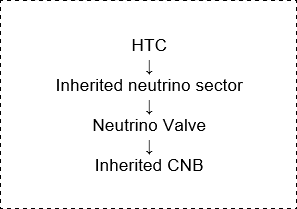
The introduction of this sector naturally leads to the question of how such an effective population may remain physically connected across successive cosmological cycles. Within HRDCC, that connection is interpreted phenomenologically through the HTC, whose thermodynamic role is developed next.
4 Holographic Transition Core and the Neutrino Valve
The inherited neutrino sector requires an effective physical interface through which inherited degrees of freedom may persist across successive cosmological cycles. Within the HRDCC framework, this role is fulfilled by the regularized Holographic Transition Core, introduced in Paper I as the central geometrical interface of the effective cosmological framework [4]. The HTC is not interpreted as a microscopic transport layer but as the effective transition region connecting successive mature cosmological cycles.
Within the present phenomenological description, the inherited neutrino sector interacts with the HTC through effective thermodynamic constraints rather than explicit microscopic particle transport. Two established physical principles motivate this interpretation. The Pauli exclusion principle limits the occupation of identical fermionic quantum states, and the Bekenstein entropy bound relates the maximum entropy of a bounded system to the area of its enclosing surface [6]. Together, these principles motivate an information-limited transition interface rather than an unrestricted transport region.
The Neutrino Valve is not a literal valve or a specified microscopic interaction. It represents an effective thermodynamic relation describing how the inherited neutrino sector may participate in entropy regulation during cosmological transitions while remaining compatible with the finite information capacity associated with the HTC. At the effective phenomenological level, \[\begin{equation} \Gamma_{\mathrm{valve}} = \Gamma_{\mathrm{valve}}(\xi), \label{eq:valve} \end{equation}\]
Equation identity: Effective Neutrino Valve Relation.
where \(\Gamma_{\mathrm{valve}}\) denotes the effective neutrino-valve coupling. Equation [eq:valve] is not a microscopic transport equation; it parametrizes the effective participation of the inherited neutrino sector in entropy regulation within mature HRDCC cosmological cycles.
A minimal phenomenological bookkeeping relation for the associated entropy transfer may be written as \[\begin{equation} \Delta S_{\mathrm{eff}}(\xi) = \Delta S_{\mathrm{inh}}(\xi)-\Delta S_{\mathrm{valve}}(\xi), \label{eq:entropy-transfer} \end{equation}\]
Equation identity: Effective Entropy Transfer Relation.
where \(\Delta S_{\mathrm{inh}}\) denotes the effective inherited entropy contribution and \(\Delta S_{\mathrm{valve}}\) denotes the effective entropy released or redistributed through the phenomenological valve channel. This relation provides bookkeeping only; it does not define a microscopic entropy current, a quantum channel, or a fundamental transport law.
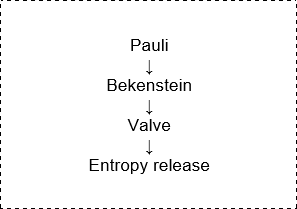
This thermodynamic interpretation leads directly to the phenomenological description of the inherited Cosmic Neutrino Background.
5 Inherited Cosmic Neutrino Background
Within the effective phenomenological framework developed above, the Cosmic Neutrino Background acquires an additional interpretation beyond its standard thermal origin. In addition to the conventionally produced relic-neutrino population, HRDCC allows for an effective inherited neutrino component associated with physical continuity across successive cosmological cycles through the regularized HTC.
The effective CNB is therefore interpreted phenomenologically as the superposition of two conceptually distinct contributions: the standard thermal relic-neutrino population and the inherited neutrino sector introduced in the present work. At the effective level, the total neutrino density may be written as \[\begin{equation} \rho_{\nu}^{\mathrm{eff}} = \rho_{\nu}^{\mathrm{th}}+\rho_{\nu}^{\mathrm{inh}}, \label{eq:neutrino-density} \end{equation}\]
Equation identity: Effective Inherited Neutrino Density Relation.
where \(\rho_{\nu}^{\mathrm{eff}}\) is the total effective neutrino energy density, \(\rho_{\nu}^{\mathrm{th}}\) is the thermal relic-neutrino energy density, and \(\rho_{\nu}^{\mathrm{inh}}\) is the effective inherited neutrino energy density. Equation [eq:neutrino-density] introduces no microscopic production mechanism and does not alter the standard thermal history of relic neutrinos.
If the inherited population becomes partially nonrelativistic during mature cosmological evolution, its phenomenological contribution to the effective warm-dark-matter sector may be expressed as \[\begin{equation} \Omega_{\mathrm{WDM}}^{\mathrm{eff}} = \Omega_{\mathrm{WDM}}^{\mathrm{eff}}(\xi), \label{eq:wdm} \end{equation}\]
Equation identity: Effective Warm-Dark-Matter Contribution.
where \(\Omega_{\mathrm{WDM}}^{\mathrm{eff}}\) is the effective warm-dark-matter density parameter. Equation [eq:wdm] is not a microscopic neutrino-mass model. It states that the effective warm-dark-matter contribution may evolve together with the macroscopic effective state of the inherited cosmological sectors.
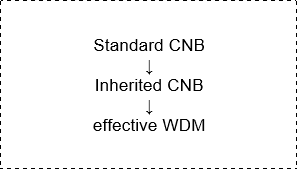
The inherited neutrino sector thereby links two physical roles that are usually discussed independently. It may contribute to the effective matter budget through non-cold clustering behavior while also participating in entropy regulation through the phenomenological Neutrino Valve. Within the present framework, these are complementary manifestations of one inherited cosmological sector rather than independent mechanisms.
6 Observational Consistency
The interpretation developed here should be evaluated in the context of existing observational constraints on relic neutrinos rather than as a replacement for standard neutrino cosmology. The inherited sector is therefore required to remain compatible with the current observational picture.
The CNB has not yet been detected directly, but its existence is strongly supported by Big Bang nucleosynthesis, cosmic microwave background measurements, and large-scale structure evolution [1, 2]. The inherited interpretation supplements rather than replaces the conventional thermal relic-neutrino background.
Future direct measurements may provide additional opportunities to examine the consistency of the inherited interpretation. PTOLEMY aims to detect relic neutrinos directly, while increasingly precise cosmological surveys constrain the total neutrino mass, the effective number of relativistic species, and non-cold contributions to structure formation [2, 3].
At the current phenomenological level, the inherited neutrino sector does not yield a unique quantitative observational signature. It may instead contribute to deviations from the standard interpretation that remain within current uncertainties. Any genuine observational discrimination requires quantitative microscopic modeling, a specified phase-space distribution, and a forward model connecting the inherited component to observables.
The same limitation applies to particle-physics realization. Active, Majorana, sterile, or mixed microscopic interpretations cannot be selected within the present framework. Sterile-neutrino scenarios are therefore treated as comparison classes rather than predictions of HRDCC [8]. Overall, current observations are compatible with the effective interpretation proposed here, but they do not confirm it.
7 Discussion
The principal objective of the present work has been to extend the effective HRDCC framework by introducing an inherited interpretation of the cosmological neutrino sector while preserving the phenomenological structure established in the preceding publications. Rather than proposing a new neutrino theory, the paper develops a logically consistent extension in which inherited neutrino populations may contribute to both the effective warm-dark-matter sector and the thermodynamic evolution of successive cosmological cycles.
A defining feature of this interpretation is the separation between phenomenology and microscopic physics. The inherited neutrino sector has been introduced exclusively through effective macroscopic quantities. No assumptions have been made regarding microscopic neutrino transport across cosmological transitions, quantum-gravitational realization, or particle-physics identity.
The inherited CNB also provides a thermodynamic connection between the previous publications. Paper I established the effective cosmological framework and introduced the HTC as its central geometrical interface [4]. Paper II interpreted the effective cold-dark-matter sector in terms of inherited Planck remnants [5]. The present work complements that picture with an inherited neutrino sector whose phenomenological role extends beyond the matter budget to entropy regulation during cosmological transitions.
Inherited Planck remnants and inherited neutrinos therefore represent distinct effective sectors that coexist within one inherited cosmological architecture while fulfilling different physical roles. This illustrates how multiple effective cosmological components may be associated with the same regularized cosmological transition without requiring identical microscopic origins.
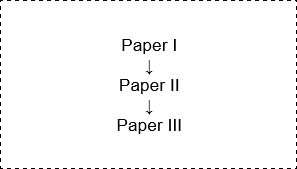
Future investigations may connect the inherited sector with neutrino transport models, quantum-gravitational transition mechanisms, entropy production, and quantitative CNB observables. Such developments extend beyond the scope of the present phenomenological treatment. The contribution of the current work is therefore the establishment of a coherent interpretation that incorporates the inherited CNB into HRDCC while maintaining consistency with previous publications and current observational cosmology.
8 Limitations
The present work intentionally adopts a phenomenological perspective. Its objective is to establish a logically consistent interpretation of the inherited cosmic neutrino sector rather than to construct a microscopic theory of neutrino transport across cosmological transitions.
No quantum-gravitational description of the HTC is assumed, and no explicit mechanism is proposed for the persistence of individual neutrino states between successive cosmological cycles. The inherited sector is introduced only through effective macroscopic quantities. Likewise, the Neutrino Valve is treated as an effective thermodynamic relation and is not derived from a fundamental action, microscopic transport equation, or quantum-information formalism.
The effective warm-dark-matter contribution should be interpreted with the same caution. The present paper does not determine the absolute neutrino mass hierarchy, the Majorana or Dirac nature of neutrinos, the existence of sterile species, or a particular phase-space distribution. These questions remain compatible with several microscopic scenarios and lie outside the adopted scope.
No quantitative cosmological parameter estimation is performed. The work does not fit cosmological datasets, modify Boltzmann solvers, or derive observable spectra. Comparisons with observations are therefore restricted to qualitative compatibility rather than quantitative prediction.
These limitations are deliberate and reflect the modular publication architecture of HRDCC. The effective phenomenological framework developed here provides a foundation upon which future microscopic, numerical, and observational studies may be constructed without redefining the effective cosmological interpretation established in this work.
9 Conclusion
The present work extends the effective HRDCC framework by introducing a phenomenological interpretation of the inherited Cosmic Neutrino Background. Building on the effective cosmological framework established in Paper I and the inherited Planck-remnant interpretation of effective cold dark matter developed in Paper II, the inherited neutrino sector is identified as a complementary cosmological component associated with the regularized Holographic Transition Core.
Within this description, the inherited neutrino population may contribute to two aspects of cosmological evolution. First, a partially nonrelativistic inherited component may contribute to the effective warm-dark-matter sector. Second, the same sector may participate in entropy regulation through the effective Neutrino Valve, motivated phenomenologically by fermionic occupancy constraints and the Bekenstein entropy bound.
The distinction between effective phenomenology and microscopic interpretation has been maintained deliberately. The present work neither replaces the standard cosmological description of relic neutrinos nor proposes a complete microscopic theory of neutrino inheritance. Its principal contribution is to demonstrate that an inherited CNB can be incorporated into the effective HRDCC framework in a logically consistent manner while remaining compatible with current observations and the established publication architecture.
Together with the inherited Planck-remnant population introduced previously, the inherited neutrino sector completes the first effective phenomenological description of the inherited cosmological matter sectors within HRDCC. This provides a coherent foundation for future microscopic investigations of neutrino transport, quantum-gravitational transition mechanisms, entropy evolution, and quantitative observational tests.
10 Summary of Symbols
Table 1 summarizes the principal symbols used in the present work. Only quantities appearing explicitly in the manuscript are included.
| Symbol | Meaning |
|---|---|
| Cosmological quantities | |
| \(\xi\) | Effective evolutionary state parameter of mature HRDCC cosmological cycles;neither time nor a cycle counter. |
| \(\Omega_{\mathrm{WDM}}^{\mathrm{eff}}\) | Effective warm-dark-matter density parameter. |
| \(\Delta S_{\mathrm{eff}}\) | Effective entropy change associated with inherited and valve-mediated contributions. |
| Neutrino sector | |
| \(n_{\nu}^{\mathrm{inh}}\) | Effective inherited neutrino number density. |
| \(\rho_{\nu}^{\mathrm{eff}}\) | Total effective neutrino energy density. |
| \(\rho_{\nu}^{\mathrm{th}}\) | Thermal relic-neutrino energy density. |
| \(\rho_{\nu}^{\mathrm{inh}}\) | Effective inherited neutrino energy density. |
| \(\Gamma_{\mathrm{valve}}\) | Effective neutrino-valve coupling. |
| \(\Delta S_{\mathrm{inh}}\) | Effective inherited entropy contribution. |
| \(\Delta S_{\mathrm{valve}}\) | Effective entropy released or redistributed through the phenomenological valve channel. |
| Framework abbreviations | |
| HTC | Holographic Transition Core. |
| CNB | Cosmic Neutrino Background. |
| HRDCC | Holographic Rotation-Driven Cyclic Cosmology. |
11 Bibliography